
Expanding regional transport capabilities of Central Asia is the most important factor in the integration of countries into the world economy

In the foreign policy of modern Uzbekistan, specific measures are being taken to further strengthen mutually beneficial cooperation, long-term and multilateral partnership with all countries of the world.
In particular, the relations of our state with the countries of Central Asia, which have common historical roots have reached a new level.
In this regard, the heads of state of Central Asia, paying priority attention to deepening cooperation, strengthening constructive and mutually beneficial relations, are particularly focused on developing the transport potential of the region.
In particular, strengthening the atmosphere of good neighborliness and trust in the region, deepening transport interconnection and integration creates the opportunity for the joint implementation of strategic infrastructure projects in the transport sector.
On the initiative of the head of our state, new mechanisms have been created regional cooperation. An example is the Consultative Meetings of the Heads of State of Central Asia.
We can say that this institution has become an important mechanism for joint discussion of regional problems. This important platform has clearly demonstrated its relevance as an effective mechanism for expanding practical cooperation in the field of transport and logistics.
In recent years, Uzbekistan has been implementing a number of measures to develop and bring cooperation in the transport sector with neighboring countries to a new level. Since 2016, Tashkent has restored and developed transport and communication links with neighboring republics.
In 2016 – 2024, the number of flights between Uzbekistan and the countries of Central Asia increased almost 2 times, and the number of passengers - 2.1 times. In addition, new passenger bus routes between our countries were opened, and old routes were restored. This has led to a manifold increase in the number of such flights between Uzbekistan and neighboring countries over the past 8 years.
One of the important events was the opening in 2017 of the Turkmenabad-Farab railway and road bridges across the Amu Darya between Uzbekistan and Turkmenistan. The opening of the Galaba - Amuzang railway line in 2018, connecting the Surkhandarya and Khatlon regions of Uzbekistan and Tajikistan, was marked as a historical event.
42.5 percent of the republic's export and import cargo transportation (9.3 million tons) falls on neighboring countries (Kazakhstan - 6.8 million tons, Kyrgyzstan - 1.5 million tons, Tajikistan - 0.6 million tons, Afghanistan - 1.3 million tons, Turkmenistan - 0.4 million tons), the remaining 57.5% (12.6 million tons) are carried out along international transport corridors with other countries.
The Uzbekistan-2030 strategy approved by the President of Uzbekistan defines specific tasks for raising practical cooperation in Central Asia to a qualitatively new level, especially by strengthening close regional cooperation in the transport and communications sector.
Today, neighboring countries actively support transport and transit projects of Uzbekistan. The implementation of these projects will help increase the attractiveness of Central Asia as a transit center for international corridors East - West and North - South.
These include the development of multimodal transport corridors "China - Central Asia - Caucasus - Europe", "Belarus - Russia - Kazakhstan - Uzbekistan - Afghanistan - Pakistan", "Uzbekistan - Turkmenistan - Iran - Turkey", as well as the construction of railway lines "China - Kyrgyzstan - Uzbekistan" and "Uzbekistan - Afghanistan - Pakistan".
These projects will provide Central Asian countries with the shortest access to Indian Ocean ports and connect South Asia with the markets of Central Asia, Russia, China and Europe. Their implementation will significantly increase the transit potential of Central Asian countries.
It should be noted that it is cooperation in the transport sector that is acquiring strategic importance for all Central Asian states. From this point of view, Uzbekistan, with the support of the countries of Central Asia and its closest partners, continues active transport diplomacy.
This will make it possible to harmonize the national projects of the countries of the region with the international transport corridors North-South and West-East and turn Central Asia into an important link in interregional interconnectedness.
Along with the creation of infrastructure, it is important to combine efforts to harmonize and digitalize procedures for customs clearance of goods and border crossings. This will undoubtedly have a positive impact on the further deepening of transport interconnectedness.
In this direction, it should be especially noted that Uzbekistan and Kazakhstan have completely switched to the electronic exchange of permit forms based on the E-PERMIT digital platform.
In addition, Uzbekistan has successfully tested the “digital TIR” system, allowing freight vehicles to freely cross borders directly with Kazakhstan, Kyrgyzstan and Tajikistan, and plans to introduce this system with Turkmenistan in the near future.
The Central Asian region has long served as a unique bridge connecting Europe, the Middle East, South and East Asia. Today we see great opportunities and untapped reserves for the further development of transport links between our countries and the states of Central Asia with other regions.
Cooperation in the formation of an extensive transport and communication system will make it possible to fully realize the transport and transit potential of Central Asia for the following reasons.
First, according to UN estimates, by 2050 the global demand for cargo transportation will increase 3 times. This trend poses a serious problem for the landlocked countries of Central Asia.
Secondly, according to the United Nations Conference on Trade and Development (UNCTAD), the products of landlocked countries are practically absent from international trade markets, and these countries account for less than 1% of world exports.
In the countries of Central Asia, the share of costs for transporting goods reaches 50% of the final value of goods, which is almost 5 times higher than the world average indicator.
Taking this into account, Uzbekistan, in order to further increase the transport potential of the countries of Central Asia, puts forward the following proposals:
- Develop specific mechanisms for promoting effective transport corridors using uniform tariffs that are convenient for business when entering the markets of China, the countries of South Asia and the Middle East, and the European Union;
- Prepare a unified transport strategy for the countries of our region;
- Create an integrated digital platform for international transportation.
Undoubtedly, the implementation of these initiatives will be an important help in solving pressing problems facing each state in Central Asia. Customs and other procedures along international transport routes passing through the territory of our countries will be improved and harmonized. Common approaches to creating a reliable transport and communication system that will provide access to the most important international markets and seaports will be agreed upon.
According to UN experts, solving all the problems of ensuring the access of goods to world seaports can increase the GDP of the countries of Central Asia by at least 2 times within 10 years.
The President of the Republic of Uzbekistan Shavkat Mirziyoyev, in his speech at the 75th session of the UN General Assembly, emphasized that today the states of Central Asia face an important strategic task to ensure deep integration of the regional market into global economic, transport and transit corridors. In this regard, it was proposed to create a Regional Center for the Development of Transport and Communications under the auspices of the UN.
Within the framework of the activities of the Regional Center, it is possible to fully achieve the intended results in activating existing and forming new transport corridors, ensuring deep integration of the region into the international transport system.
The Regional Center will expand mutually beneficial and effective cooperation in the transport sector, which, in turn, will ensure growth in trade turnover and, undoubtedly, will serve the interests of the countries of Central Asia. Asia.
Transport and logistics cooperation between Uzbekistan and the countries of Central Asia has today become an important factor in sustainable economic growth, expansion of trade volumes and geo-economic integration of the region.
Large-scale projects are being implemented in the region to modernize road, rail, air and multimodal transport networks, diversify international transit flows along such corridors as “Trans-Caspian”, “Trans-Afghan”, “China- Kyrgyzstan - Uzbekistan," "North - South".
In these processes, Uzbekistan, as a central geostrategic territory, is the main connecting link and puts forward important initiatives to harmonize transport infrastructure with neighboring Kazakhstan, Turkmenistan, Tajikistan and Kyrgyzstan, digitalize customs and border processes, as well as reduce freight transportation costs.
This opens up prospects for the formation of a single logistics space in the region, increasing export-import potential and strengthening competitiveness in international trade chains.
Related news
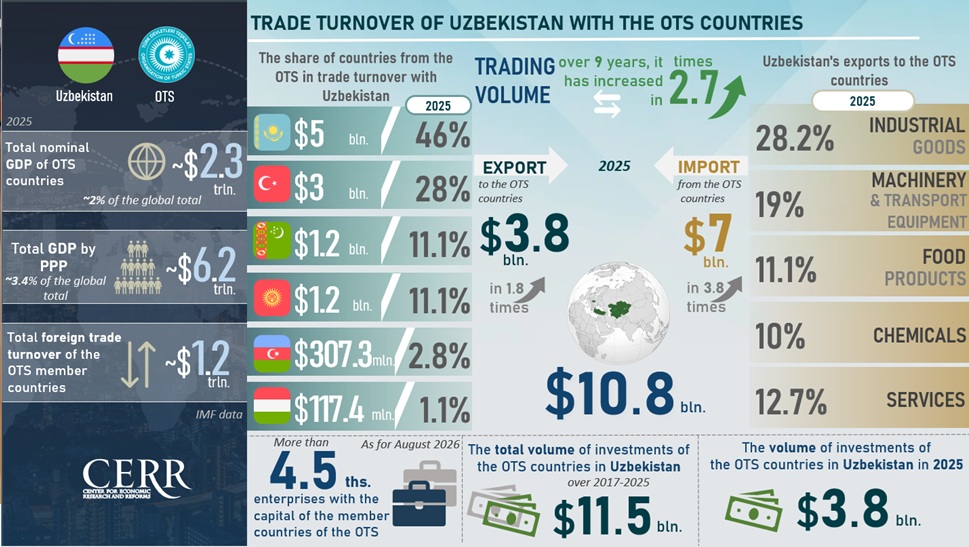
Uzbekistan has moved its economic cooperation with the Turkic states into a practical dimension
Ahead of the 13th Summit of the Organization of Turkic States, scheduled to be held in Ankara, economic cooperation within the OTS is acquiring new substance.
Water security in the turkic world: shared interests and common solutions
Water is a precious blessing that transcends national borders and has long connected peoples and civilizations.

Strengthening Transport Connectivity in Asia through the Development of the Trans-Caspian International Transport Corridor
Shifting international supply chains and expanding trade in Asia are driving demand for sustainable transport routes. For businesses, predictable delivery times, competitive rates, and reliable access to foreign markets are becoming increasingly important.