
Over the past 8 years, New Uzbekistan has absorbed over 113 billion dollars of foreign investment
On the eve of our country's 34th anniversary of independence, the Executive Board of the International Monetary Fund has completed its 2025 consultations under Article IV of the IMF Agreement. The main conclusion about the essence of the ongoing reforms is the positive prospects for the economic development of Uzbekistan against the backdrop of continuing progress in the transition to a market economy. According to the published document, economic indicators remain high, including sustainable growth rates, a reduction in the consolidated budget deficit, the current account deficit and an adequate level of international reserves.
The successful and effective implementation of structural reforms, according to fund experts, allows us to conclude that the prospects are favorable. Amid high global trade policy uncertainty, the IMF's baseline scenario projects real GDP growth to remain robustly strong in the coming years. Such trends are the result of economic openness, industrialization, active investment policy and support for the formation of the export potential of promising industries.
The set of ongoing reforms and effectively implemented solutions is consistent with the available internal resources and reserves for the long-term sustainable development of the country and regions. The course towards irreversible market transformations makes it possible to skillfully combine the tools of targeted government support and the opportunities of entrepreneurial initiative on the path to building a New Uzbekistan.
In recent years, as a result of openness and growing trust in our country, there has been a progressive increase in capital investment. During 2017-2024, the total volume of foreign investment received exceeded $113 billion. More than 80 percent of this comes from foreign direct investment and loans. Activity in the field of attracting finance is observed in leading industries and the fuel and energy complex, which has a corresponding impact on the acceleration of industrialization processes in almost all regions.
Increasing investment cooperation with China, Russia, Germany, Turkey, Saudi Arabia, the Netherlands, the USA, the UK and other countries is becoming a source of attracting advanced technological solutions and expertise, management methods, localizing production and strengthening the export potential of promising industries and regions of Uzbekistan. Attracted resources are primarily invested in the technological re-equipment and modernization of existing and the creation of new previously non-existent production facilities.
Over the past eight years, more than 96 thousand projects worth about $100 billion have been launched as part of investment programs, which has created 1.8 million jobs. In 2024, compared to 2017, the cost of commissioned investment projects increased almost eight times, and the number of jobs increased 2.6 times.
Let us emphasize the factor of the active involvement of the head of our state in this process. As a result of top-level visits and events, 366 investment agreements worth $75 billion have been reached since the beginning of this year. In particular, this year roadmaps for 222 investment projects worth about $45 billion have been approved.
Within the framework of the IV Tashkent International Investment Forum (June this year), agreements were reached on investments worth more than $30 billion (for the implementation of 144 joint projects). In April 2025, on the sidelines of the 5th International Industrial Exhibition “INNOPROM. Central Asia”, held in Tashkent, within the framework of 43 investment agreements reached, it is planned to attract an additional billion dollars to the country’s industrial sector.
In recent years, events have been actively carried out to inform the international community about the possibilities of implementing joint projects. Thus, this year, forums were held in 13 foreign countries as part of the Investor Day of Uzbekistan, in which representatives of 700 well-known foreign companies took part. More than 200 investment projects worth six billion dollars were brought to the attention of potential partners.
Among the important elements of the modern industrial policy of Uzbekistan are the localization of the production of high-quality and competitive products, reducing the import of finished products and components. In accordance with the Localization Program, which included about 10 thousand projects, products worth almost 300 trillion soums were produced during the period 2020-2024. This led to import substitution in the amount of about $25 billion. The localization program made it possible to create new production facilities for previously imported goods, contributed to changing the sectoral structure of the industry and reducing dependence on external supplies by expanding the range of products and services.
THE NUMBER OF EXPORTERS IS GROWING
The formation of an export orientation has become one of the main conditions for success in the implementation of planned plans for the industrialization of Uzbekistan. For 2017-2024, the total volume of exports exceeded $132 billion. It is noteworthy that the average annual growth rate of the country's exports during this period was 12-23 percent. As a result of systematic and targeted support for exporters, in 2024 the geography of exports of domestic products expanded by 55 countries and over the past eight years has reached 186 countries. Last year, the number of exporting enterprises increased by 3,143, and their total number was 7,343.
Only due to an increase in the share of exports of products with higher added value in 2024, supplies to foreign markets increased by a billion dollars. Entering new promising markets, in turn, requires a significant improvement in the quality of manufactured products and their compliance with international standards. As part of the GSP+ program, a set of organizational and technical measures has been implemented to obtain labeling certificates for our products according to the Global G.A.P., Organic, OEKO-Tex, BSCI, CE system and the transition to ISO standards at more than five thousand enterprises. Last year alone, this made it possible to additionally export 617 types of products to the EU countries worth $1.4 billion.
The transition to more demanding product quality standards and technological processes makes it possible to achieve goals for the production and sale of products of a completely different quality in new markets. Export supplies of goods to developed countries confirm the correctness of the chosen strategy, demonstrating its undeniable results. Thus, due to the expansion of the geography of exports and the correct response to the market situation, the selling prices of fruits and vegetables in Uzbekistan last year increased by an average of 14 percent.
The industrial trend of economic development, having ensured a technological leap in a number of industries, had a significant impact on the evolution of the export product range. More recently, Uzbekistan was associated as a country with a monoculture of cotton, and its products were almost the sole leader in exports with the absolute dominance of raw materials. In this regard, according to IMF specialists, there is a decrease in the share of cotton fiber exports from 0.2 percent of GDP to zero from 2021 in the long term. Today, Uzbekistan is exporting more and more high-tech products, and by 2024 its product range has reached four thousand items.
So, compared to 2017, last year the export of raw materials decreased by 22 percent, while the share of exports of finished products increased by 3.3 times, semi-finished products - by 4.4, and the export of services increased by 2.9 times. At the same time, the transition to advanced processing of cotton contributed to doubling the export of clothing and knitwear products and bringing its volume to a billion dollars. This allowed our country to become the second supplier of textile products on the Russian market.
Domestic products become a recognizable national brand, are trusted and popular among foreign consumers. Last year, the products of about 300 Uzbek enterprises were registered on well-known electronic commercial platforms Alibaba, Wildberries and Ozon. As a result, sales of our companies reached $680 million.
In the first half of 2025, export volumes increased by 33 percent compared to the same period last year and approached $17 billion. Since the beginning of the year, 1,557 domestic companies have been added to the list of exporters, accounting for $650 million in supplies.
The steady trend away from raw material exports towards finished high-tech products and services (tourism, transport, construction, IT and others) continues.
INVESTMENT DIALOGUE
It should be noted that in our country an institutional environment is being built and operates effectively to resolve strategically important issues of industrial development with a clear export focus by attracting foreign capital. For this purpose, the corresponding ministry and government departments responsible for this range of issues, as well as organizations promoting interaction between the state and the private sector, have been created.
The Council of Foreign Investors under the President of the Republic of Uzbekistan is an institutional platform for direct dialogue between the government of the republic and investors (including international financial institutions). The activities of the council as a consultative and advisory body effectively contribute to attracting foreign direct investment in priority sectors of the economy, organizing high-quality business dialogue taking into account best international experience.
The activities of the Council are carried out under the patronage of the President of Uzbekistan, who personally takes part in the meetings of this body. In order to organize systematic work to attract investments, a corresponding resolution was adopted by the leader of the country to implement the agreements reached at the last meeting of the council. The document also implies ensuring the systematic implementation of the initiatives and proposals put forward by the meeting participants, as well as measures to improve the activities of the Secretariat of the Foreign Investors Council.
In parallel with the formation of an effective institutional environment, consistent work is being carried out to improve the legislative framework to ensure rapid industrial development, intensify investment processes and expand the export potential of industries and regions of the country. This process is in the field of close attention and direct participation of parliamentarians of Uzbekistan. As a result, in recent years, more than 500 state functions for regulating business have been abolished, about 70 have been transferred to the framework of public-private partnerships and outsourced to the private sector. 72 types of licensed activities and 40 permits were legally abolished to improve the business climate and simplify the business environment.
POSITIVE ASSESSMENT
These transformations receive a positive assessment from foreign rating agencies and organizations. Thus, according to the Index of Regulatory Restrictions on Foreign Direct Investment (Organization for Economic Development and Cooperation), our country has the best rating among the Central Asian region. This year, the republic’s indicators on the Heritage Foundation’s Index of Economic Freedom, the indicators “Freedom of Trade” and “Freedom of Investment” have significantly improved.
Let's return to assessing the prospects for the dynamics and effectiveness of reforms based on the results of the latest IMF consultations with Uzbekistan in accordance with Article IV of the IMF Agreement. According to the final document of the fund, a positive aspect of ensuring the sustainable development of Uzbekistan is the opportunities provided by the acceleration of structural reforms, an increase in the inflow of income and capital, as well as favorable dynamics of commodity prices.
Analysis of indicators of industrialization, investment activity and expansion of export indicators indicates the real effectiveness of the Strategy "Uzbekistan - 2030" and a set of related measures to strengthen economic potential and international the authority of the country. This, in turn, becomes a demonstration of the irreversibility of reforms aimed at building an independent New Uzbekistan.
Durbek Akhmedov,
Deputy of the Legislative Chamber
Oliy Majlis Republic of Uzbekistan
Doctor of Economic Sciences, Professor
Related news
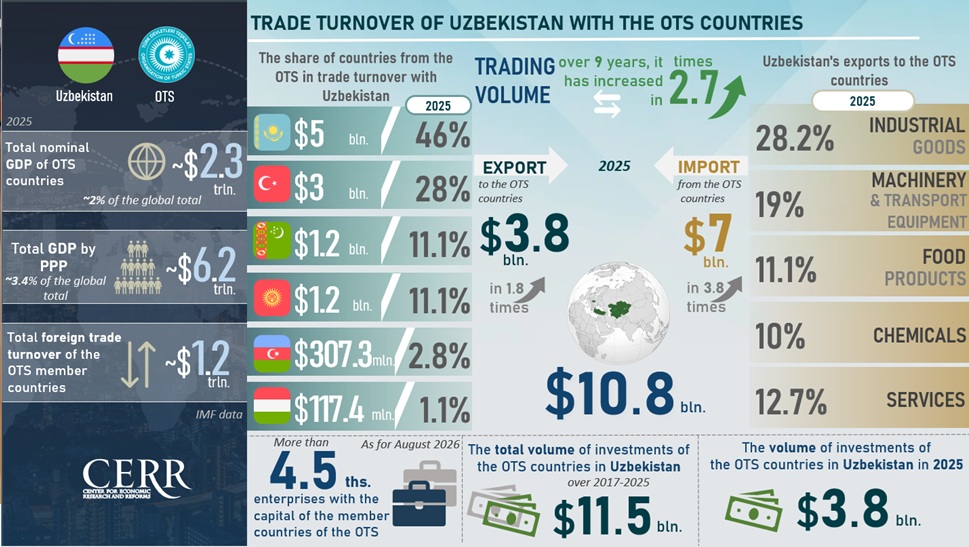
Uzbekistan has moved its economic cooperation with the Turkic states into a practical dimension
Ahead of the 13th Summit of the Organization of Turkic States, scheduled to be held in Ankara, economic cooperation within the OTS is acquiring new substance.
Water security in the turkic world: shared interests and common solutions
Water is a precious blessing that transcends national borders and has long connected peoples and civilizations.

Strengthening Transport Connectivity in Asia through the Development of the Trans-Caspian International Transport Corridor
Shifting international supply chains and expanding trade in Asia are driving demand for sustainable transport routes. For businesses, predictable delivery times, competitive rates, and reliable access to foreign markets are becoming increasingly important.