
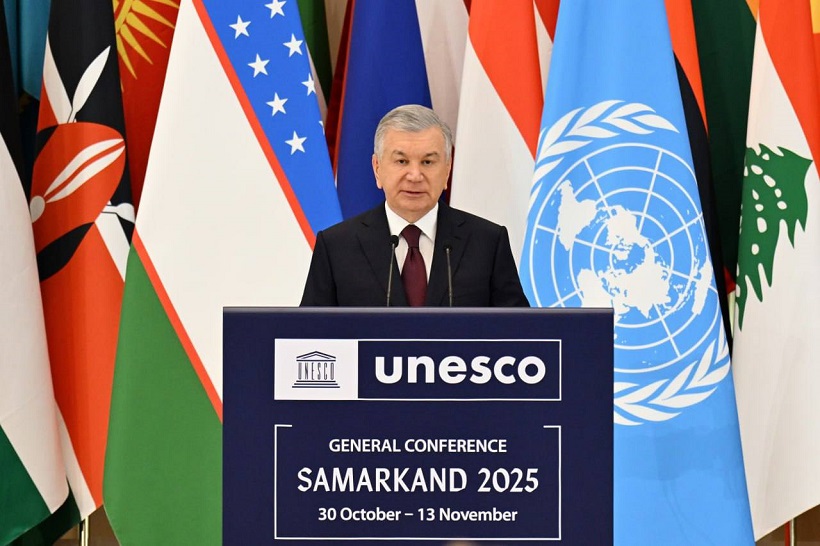
Speech by the President of the Republic of Uzbekistan Shavkat Mirziyoyev at the opening ceremony of the 43rd session of the UNESCO General Conference
Dear Mr. Chairman!
Dear Madam Azoulay!
Heads of delegations!
I am sincerely glad to welcome you to the beautiful land of Uzbekistan, which for many centuries has been at the crossroads of different cultures and civilizations.
For the first time in the last 40 years, our conference is being held outside the UNESCO headquarters - in the ancient and forever young Samarkand. And this, of course, makes us particularly proud.
I take this opportunity to express my deep gratitude to those participating in the forum, His Excellency the President of Serbia, dear Mr. Aleksandar Vučić, His Excellency the President of Slovakia, dear Mr. Peter Pellegrini, Director General of UNESCO Ms. Audrey Azoulay, all delegations member states.
We perceive the holding of such a representative forum in our country as a manifestation of the high trust of the member states of the organization in the dynamic large-scale reforms being carried out in New Uzbekistan.
UNESCO, celebrating its 80th anniversary, over the past years has become an authoritative world institution for global cooperation in the fields of education, science, culture, art and information, and as well as mutual trust and solidarity.
The role and importance of this organization in preserving the national identity of the peoples of the world, their cultural heritage, and strengthening dialogue between different religions are increasing.
It is deeply symbolic that our forum is being held in Samarkand, which has gone down in human history as a center of unique knowledge, intercivilizational dialogue and humanistic ideas.
Since ancient times, this land has been the cradle of great discoveries of mankind, a city where science, literature and culture flourished. I'll give just one example. Under the domes of the observatory, built by the great ruler and scientist Mirzo Ulugbek, a unique star table was created. As history shows, it later served to make scientific discoveries by such outstanding scientists as Copernicus and Kepler.
Welcome to Samarkand - the pearl of the Great Silk Road, a city with a three-thousand-year history, a city of peace and friendship between nations and peoples!
Dear ladies and gentlemen!
We are all, of course, seriously concerned about the weakening mechanisms of global consensus and multilateral cooperation in the humanitarian sphere in today's rapidly changing world.
As a result of geopolitical tensions and military conflicts occurring around the planet, great damage is being done to unique monuments, holy places and priceless cultural heritage.
The gap in access levels is growing between states to knowledge and technologies, digital resources. As a result, inequality of opportunity and poverty are increasing. This difficult situation requires even greater unity to fully realize UNESCO's core objectives.
We reaffirm our strong commitment to the high and noble goals of UNESCO. Our country is always ready to be a bridge between East and West, North and South, a platform for open and constructive all-round cooperation.
In recent years, Uzbekistan, as an equal member of UNESCO, has been taking consistent steps to bring interaction with the organization to a qualitatively new level. In particular, the five-year cooperation program until 2027 is being effectively implemented. The anniversaries of our great ancestors - Abu Raikhan Beruni, Ahmad Fergani, Amir Temur, Ali Kushchi, Kamoliddin Bekhzod, significant dates in the history of such scientific institutions as the Khorezm Mamun Academy, and such literary monuments as the epic "Alpamysh" - were widely celebrated internationally.
The cities of Khiva, Bukhara, Shakhrisabz and Samarkand included in the World Heritage List were also joined by priceless monuments in the Zarafshan-Karakum direction. The natural territories of the Western Tien Shan and the Turan deserts, also included in this list, clearly demonstrate the unique biological diversity of the region.
Along with this, about 20 types of intangible heritage have received worthy recognition of the peoples of the world, such as “Shashmakom”, Katta Ashula, “Lazgi” dance, askiya, pottery and the art of miniature painting, the Nowruz holiday, traditions production of atlas and adras.
Under the auspices of UNESCO, festivals “Sharq Taronalari”, maqom art, bakhshi, folk arts and crafts, and ethnic sports are regularly held.
At the initiative of Uzbekistan, important documents were adopted - the resolution “Khiva process: promoting international cooperation in Central Asia” (2021), the Tashkent Declaration on Early Childhood Care and Education and the Tashkent Declaration on the occasion of the International Day of Universal Access to Information (2023).
There are 8 departments and 24 schools that are UNESCO partners in the republic.
Tashkent and Fergana entered the Global Network of Learning Cities UNESCO. In addition, hundreds of cultural heritage sites have been restored based on advanced technologies and international standards.
Dear friends!
A number of additional events will be held in the country within the framework of the Samarkand General Conference. Thus, in ancient Bukhara, for the first time, a Biennale of Contemporary Art is being held, in the capital, under the auspices of UNESCO, a Regional Center for the Development of Preschool Education will be opened, the winners of the UNESCO – Uzbekistan International Prize named after Abu Raihan Beruni will be awarded, an international conference will be held on the role and significance of artificial intelligence in the activities of museums, we will also join the Global Convention on the Recognition of Qualifications related to Higher Education.
I express special gratitude to all Member States for their full support of the initiatives of Uzbekistan and active participation in our international events.
Dear guests!
Time itself demands achieving UNESCO’s global goals and taking our multifaceted cooperation to a new level.
I would like to put forward a number of proposals on the main issues on the agenda.
Firstly,the development of inclusive education and the widespread use of artificial intelligence technologies are becoming an urgent task today.
It is very important to provide every child, regardless of his physical and social characteristics, with equal opportunities to receive an education. In this regard, we consider it appropriate to create a UNESCO Platform for the development of inclusive education for children with special needs.
We hope that you will support our plan to hold the World Vocational Education Summit with the aim of organizing an international dialogue on the exchange of knowledge and experience in the field of education.
Our priority is to educate a new generation fluent information technology and creative thinking. In order to widely introduce artificial intelligence into the education system, we are ready to implement the “Artificial Intelligence – School” project in our country with the participation of UNESCO.
We also propose to hold, under the auspices of UNESCO, an International Forum of Experts on the Ethics of Artificial Intelligence with the participation of representatives of leading universities, pedagogical and research institutes of all continents.
Secondly,it is necessary to strengthen joint action to preserve the world's intangible cultural heritage, which is an invaluable asset of humanity.
We are interested in the development of the UNESCO Memory of the World Programme, established to protect and make accessible unique heritage objects such as oral folk art, manuscripts, archives and valuable historical documents, cultural data.
We propose to declare the date of creation of this program - November 19 of each year - as International Documentary Heritage Day, and also to establish the International Institute of Digital Heritage within UNESCO.
As is known, ancient Bukhara was included in the UNESCO Creative Cities Network in the area of crafts and folk art. We are ready to hold an International Congress on this topic here in 2027.
Thirdly,it is important to more actively implement global programs for developing the leadership abilities and competencies of women.
According to the UNESCO Institute for Statistics, in the world women make up 25 percent of heads of scientific and cultural institutions, 30 percent of heads in the field of education, 33 percent among researchers. This shows that, unfortunately, inequalities still exist in ensuring women's rights.
At the same time, ensuring gender equality is one of UNESCO's fundamental priorities, and, as stated, all the organization's initiatives must be integrated with this goal. We believe that the time has come to create a UNESCO Academy on Women's Leadership to study the best practices and experiences of Member States and exchange knowledge in this area.
We also propose to hold a Global Forum of Women in Education, Culture and Science in Samarkand with the participation of famous researchers, artists, teachers and innovators from all continents.
Fourth,an effective joint fight against the climate crisis is also a pressing issue.
Significant increases in average temperatures, melting glaciers, desertification, soil erosion, and urbanization processes have a serious impact on the condition of cultural heritage sites.
We are putting forward the global initiative “UNESCO Capital of Environment,” which provides special recognition and encouragement to cities that are responsible for the environment and successfully implementing “green” programs. In addition, we advocate the development of a resolution of the UNESCO Executive Board “On strengthening measures for the preservation of cultural heritage in the context of globalization and climate change.” We are ready to hold an international symposium on this issue in the city of Khiva.
Fifthly,it is necessary to take joint effective measures against the dissemination of biased information, manipulation of public opinion, and discrimination in the virtual space.
We are taking the initiative to hold an International Festival of Children's Cultural Content to exchange the best creative works and multimedia ideas of the younger generation, whose worldview is being formed in the environment of digital transformation.
In order to develop analytical perception of information, protect young people from manipulation, and ensure transparency of information, we propose to develop a UNESCO Comprehensive Strategy for the Development of Media Literacy.
And one more question.In modern conditions, when inter-religious contradictions are intensifying in the world, it is more important than ever to actively promote such universal principles as tolerance, mutual understanding and harmony.
We can effectively combat radicalism and Islamophobia by widely explaining the essence of Islamic culture and education throughout the world. In this regard, we call for the joint use of the potential of unique projects implemented in Uzbekistan - the Center for Islamic Civilization, the research centers of Imam Bukhari, Imam Maturidi, Imam Termezi, Bahauddin Naqshband.
Dear friends!
I am confident that today’s forum will be an important practical step in establishing new areas of cooperation, strengthening the atmosphere of mutual trust, strengthening the mechanisms of global partnership in the field of sustainable development.
Undoubtedly, the “Samarkand spirit”, drawing strength from the eternal traditions and values promoted by UNESCO, will lead us to further unity in the name of common progress.
I wish you all good luck on this noble path, success in the work of the session UNESCO.
Official website of the President of the Republic of Uzbekistan
Related news
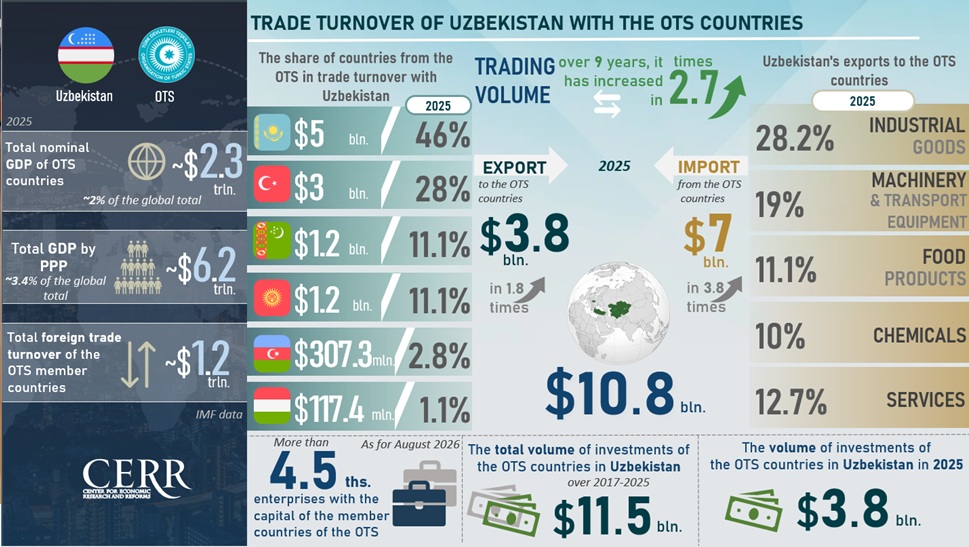
Uzbekistan has moved its economic cooperation with the Turkic states into a practical dimension
Ahead of the 13th Summit of the Organization of Turkic States, scheduled to be held in Ankara, economic cooperation within the OTS is acquiring new substance.
Water security in the turkic world: shared interests and common solutions
Water is a precious blessing that transcends national borders and has long connected peoples and civilizations.

Strengthening Transport Connectivity in Asia through the Development of the Trans-Caspian International Transport Corridor
Shifting international supply chains and expanding trade in Asia are driving demand for sustainable transport routes. For businesses, predictable delivery times, competitive rates, and reliable access to foreign markets are becoming increasingly important.