
Leading initiatives of Uzbekistan in SCO railway projects
On the eve of the next summit of the Shanghai Cooperation Organization (SCO), the issue of developing sustainable transport infrastructure in the region is of particular relevance. Today, transport corridors are not just logistics routes, but strategic arteries along which not only cargo moves, but also mutual trust, economic partnership and regional stability.
At each SCO summit, issues of transport and communication interaction are traditionally given priority attention. The President of the Republic of Uzbekistan Shavkat Mirziyoyev, speaking at the previous 24th SCO summit in Astana, especially emphasized the need to form a holistic and interconnected transport and transit system to strengthen interregional ties.
In the context of increasing geopolitical instability in the Red Sea and Eastern Europe, the need to create alternative, reliable land routes in the following directions "Europe - China" and "Europe - South Asia" through Central Asia comes to the fore.
In this context, an important task becomes not only the development of infrastructure, but also the coordination of transport and logistics initiatives with other international and regional structures, such as the Economic Cooperation Organization (ECO), the Cooperation Council of the Arab States of the Gulf, the Eurasian Economic Union (EAEU), the Association of Southeast Asian Nations (ASEAN) and others. Such coordination makes it possible to build effective, connected routes that open up new opportunities for the SCO countries and partner states.
As the head of our state has repeatedly emphasized, the implementation of joint transport projects will contribute to economic integration, expansion of trade relations and strengthening of the region’s position in the global transport system.
The development of railway infrastructure occupies a special place in these efforts. Since its creation, the SCO has consistently given priority to the development of the transport sector, especially the railway sector. This emphasis has made rail transport a key factor in strengthening economic relations between member states, stimulating trade growth and tourism development. An interconnected transport network plays a vital role in strengthening economic integration in the region and increasing the competitiveness of member countries.
Currently, the total length of the railway network of the SCO countries is 348.3 thousand km, of which more than 60% (210.2 thousand km) are electrified. The annual volume of cargo transported through this network is about 8.2 billion tons, cargo turnover is 7.5 trillion ton-kilometers, passenger turnover is almost 1,424 billion passenger-kilometers.
For landlocked countries of Central Asia, railways are the main and most sustainable mode of transport. Today it accounts for more than 80% of all freight and passenger traffic in the region. Given its geographical location, climate resilience and high energy efficiency, railway transport remains a key tool for the region’s integration into global trade and transport chains.
Among neighboring countries, the majority of Uzbekistan’s trade turnover falls on China, Russia and Kazakhstan. The total share of trade turnover with these countries was about 40% in the first half of 2025: China - 18.2%, Russia - 16.1%, Kazakhstan - 5.9%. This is followed by Türkiye with a share of 3.6% and the Republic of Korea – 2.2%.
Russia and Kazakhstan retain their status as Uzbekistan’s leading trading partners. The high share of these countries in trade with Uzbekistan is due to historical ties, geographic proximity, as well as stable transport and communication links.
This, in turn, determines the leading role of the SCO countries in the foreign trade cooperation of Uzbekistan among international and regional structures.
In connection with the above, Uzbekistan is actively diversifying routes in the direction of South Asia and the Asia-Pacific region.
Uzbekistan cooperates with foreign partners to implement strategic railway projects. These projects not only strengthen the transit potential of the country, but also emphasize its role as a logistics hub of Central Asia.
In the context of Uzbekistan’s leading initiatives in the SCO railway projects, strategic projects for the construction of new highways are of particular importance: “China - Kyrgyzstan - Uzbekistan” and "Uzbekistan - Afghanistan - Pakistan".
It is gratifying to note that in April 2025 full-scale construction of the railway "China" began in Kyrgyzstan Kyrgyzstan - Uzbekistan, about 40% of which will pass through tunnels and bridges - this is one of the most technically complex projects in the region.
Regarding the project "Uzbekistan - Afghanistan - Pakistan" - together with colleagues from Afghanistan and Pakistan, a tripartite framework agreement was signed on the development of a full-fledged feasibility study of the project, which is of strategic importance for the whole of Eurasia.
The railway "China - Kyrgyzstan - Uzbekistan" plays a key role in the SCO transport system, because:
- for China it creates the shortest land route to Central Asia and Europe, reducing the load to overloaded destinations;
- Kyrgyzstan gets direct access to international highways and turns into a transit hub;
- Uzbekistan has an alternative route to the Chinese market and access to Europe and South Asia through Afghanistan and Pakistan;
- for other SCO countries the route is shortened by almost 1000 km, reducing costs by 30–40% and speeding up logistics.
Looking at problems of integration within the SCO, it is necessary to note a number of key limitations that impede the full development of railway communication between the countries of the region.
Firstly, today the railways of the SCO countries remain fragmented and are not connected into a single network. There are overland routes from China to Europe passing through the infrastructure of Kazakhstan and Russia, as well as alternative routes using multimodal transport through Azerbaijan, Georgia, Turkey and the Caspian Sea (using rail and road transport).
However, within the SCO region there are no full-fledged railway connections between the countries of the European Union and South Asia, in particular with Pakistan and India. This significantly limits the development of mutual trade and slows down economic integration between some of the largest economies in Eurasia.
Secondly, when forming international transport corridors within the SCO, problems remain related to the inconsistency of the regulatory frameworks of the participating countries. Among the key barriers are the lack of unified standards for transportation documents in railway transport, as well as significant technical differences, including different railway gauge widths and discrepancies in the dimensions of rolling stock.
It should be noted that in order to solve the above problems, as well as for the purpose of practical implementation of the initiatives of the President of the Republic of Uzbekistan, voiced at the SCO summits, in particular, to ensure deep integration of participating countries into global production chains and the accelerated implementation of digital technologies and artificial intelligence, Uzbekistan is implementing a set of measures aimed at strengthening the role and status of railway organizations within the SCO.
Thus, the national railway company of Uzbekistan is actively working together with partners - the railway administrations of the SCO countries to transform the existing platform "Meeting of Leaders railways of the SCO member states" to the "Council for the Integration of Railway Spaces of the SCO Countries."
Within the framework of this initiative, practical steps are being taken to form new and develop existing land transport corridors covering the entire Eurasian region.
We are talking, in particular, about such strategically important routes as: "China - Kyrgyzstan – Uzbekistan – Turkmenistan – Iran – Türkiye – Europe”, “CIS countries – Uzbekistan – Afghanistan – Pakistan” with access to the ports of the Indian Ocean.
It is planned that the headquarters of the Council Directorate will be located in Tashkent. It also envisages the creation of an International Center for Digital Transport Services, which will become an important element of the digital transformation of transport and logistics infrastructure in the SCO space.
All of the above initiatives will certainly strengthen the transport and logistics potential of the region, developing trade between the countries of Europe, the CIS, the Asia-Pacific region and South Asia.
For these purposes, Uzbekistan is actively developing its internal transport infrastructure: The electrification of railways continues, the rolling stock fleet is being updated, the network of high-speed lines is expanding, in particular, work is underway to develop a feasibility study for a separate high-speed line Tashkent - Samarkand. By the end of this year, the arrival of six modern high-speed trains Hyundai Rotemfor the Tashkent-Khiva high-speed route is expected, the development of roadside and logistics infrastructure continues.
On the eve of the next SCO summit, Uzbekistan is once again demonstrating its readiness to form a sustainable, interconnected and open transport system focused on the long-term and mutually beneficial development of everything region.
Dildora Ibragimova,
Head of the Department
Center for the Study of Problems of Development of Transport and Logistics
Ministry of Transport of the Republic of Uzbekistan
Related news
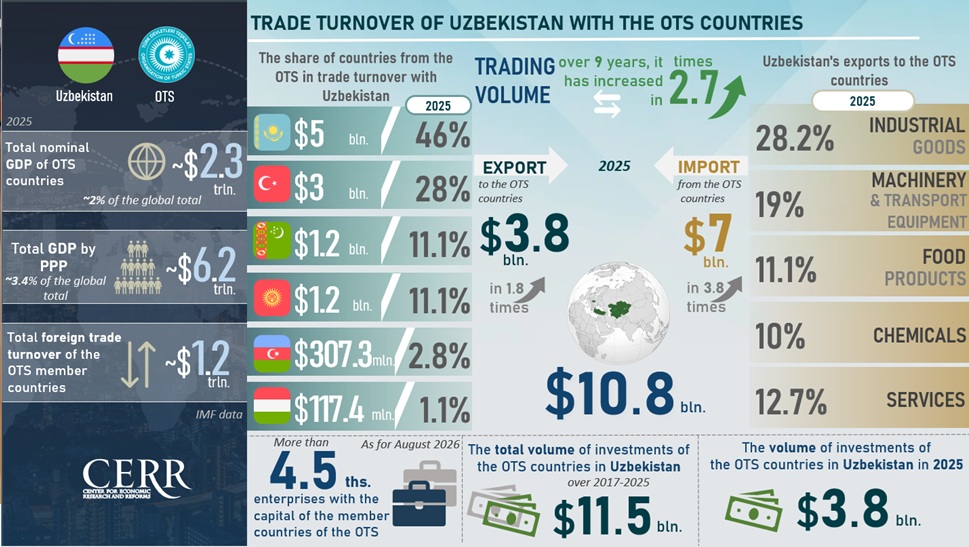
Uzbekistan has moved its economic cooperation with the Turkic states into a practical dimension
Ahead of the 13th Summit of the Organization of Turkic States, scheduled to be held in Ankara, economic cooperation within the OTS is acquiring new substance.
Water security in the turkic world: shared interests and common solutions
Water is a precious blessing that transcends national borders and has long connected peoples and civilizations.

Strengthening Transport Connectivity in Asia through the Development of the Trans-Caspian International Transport Corridor
Shifting international supply chains and expanding trade in Asia are driving demand for sustainable transport routes. For businesses, predictable delivery times, competitive rates, and reliable access to foreign markets are becoming increasingly important.