
The law “On the protection of children from all forms of violence” came into force in Uzbekistan

On May 15, 2025, the law “On the Protection of Children from All Forms of Violence” came into force. This regulatory act became a turning point in the legal and institutional design of the state child protection system.
Uzbekistan acceded to the UN Convention on the Rights of the Child in 1992, and ratified it in 1994. And since then it has been consistently implementing measures to create a favorable and safe environment for every child. The adopted document became a key stage in building a state system for protecting the rights and interests of minors.
The new law, based on interdisciplinary and preventive approaches, legally clearly defines all forms of violence (physical, psychological, economic, etc.), as well as neglect. It covers a wide range of risks and threats: from domestic violence and bullying in educational institutions, exploitation, abuse and neglect. Thus, the legislation of Uzbekistan is integrated into the global discourse on the protection of the rights of the child, in which each state party is obliged to take all effective and appropriate legislative, administrative, social and educational measures to protect the child from all forms of physical or mental violence (Article 19 of the Convention on the Rights of the Child).
Expanding the circle of actors responsible for the protection of the child is of particular importance. If previously the main responsibility was placed on parents and guardianship institutions, now the legal field includes educational, medical and law enforcement institutions, as well as self-government bodies of citizens - mahallas. This approach is consistent with international practice of interagency cooperation, mentioned, in particular, in the INSPIRE complex, developed by the World Health Organization in collaboration with other organizations, which includes seven strategies that together constitute a framework for eliminating violence against children, as well as in WHO guidelines for creating national systems for the protection of the younger generation.
The establishment of the Order “For the Protection of Children”, mentioned in the Law of the Republic of Uzbekistan “On the Protection of Children from All Forms of Violence”, is an innovative instrument of state gratitude aimed at creating public respect for professionals working in the field of protecting children's rights. This measure is consistent with UNICEF international recommendations to encourage professionals who prevent violence against children and helps strengthen the values of social responsibility.
In addition, the law provides for the creation of specialized assistance and rehabilitation centers for children affected by violence, the development of educational programs aimed at educating in the spirit of respect for the rights of the child, as well as the systematic training of all specialists working with minors. This is consistent with the comprehensive approach outlined in the World Bank and UNICEF documents on building a sustainable child care system. The key elements in these documents are:
- availability of servicesincluding social protection, health, education and legal assistance, providing comprehensive support to children and their families;
- interdepartmental coordinationaimed at effective collaboration between different sectors and institutions to ensure an integrated approach to protecting the rights and well-being of children;
- accountability implying transparency and responsibility of all system participants to society and stakeholders for the results of their activities.
This approach is consistent with international standards, including Sustainable Development Goal 16, which emphasizes building effective, accountable and inclusive institutions at all levels.
Particular attention in the law is paid to the adaptation of international mechanisms to the traditional and cultural characteristics of Uzbekistan. The institution of mahalla is considered not only as a form of local self-government, but also as an important channel for social monitoring, prevention and response. This approach increases the efficiency of implementation of the law and creates a model of “global localism” (adaptation of universal standards taking into account the national context). This is consistent with the position of the UN Committee on the Rights of the Child, which emphasizes the need for cultural and social relevance of law enforcement mechanisms.
Thus, the adoption of the law “On the Protection of Children from All Forms of Violence” is not just a formal measure to strengthen the regulatory framework, but an expression of the political will of the state aimed at creating a humane, fair and safe society. The document serves as a practical tool for the implementation of Article 3 of the Convention on the Rights of the Child, which enshrines the principle of the best interests of the child as the primary consideration in all actions concerning children.
The adoption of this law indicates that Uzbekistan takes an active position in the global agenda for children's rights, confirming its commitment to international obligations. The law not only strengthens protection mechanisms, but also integrates them into the broader sociocultural and moral context of society. This is an important step towards building a future in which every child is not only protected, but also heard, recognized and respected as a full subject of the law.
Azizbek Toirov,
TSUU teacher
Related news
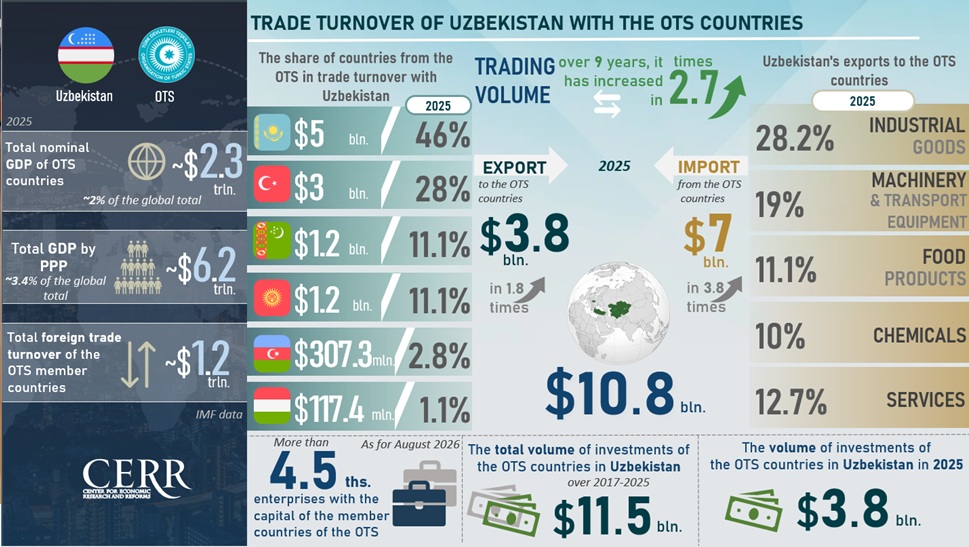
Uzbekistan has moved its economic cooperation with the Turkic states into a practical dimension
Ahead of the 13th Summit of the Organization of Turkic States, scheduled to be held in Ankara, economic cooperation within the OTS is acquiring new substance.
Water security in the turkic world: shared interests and common solutions
Water is a precious blessing that transcends national borders and has long connected peoples and civilizations.

Strengthening Transport Connectivity in Asia through the Development of the Trans-Caspian International Transport Corridor
Shifting international supply chains and expanding trade in Asia are driving demand for sustainable transport routes. For businesses, predictable delivery times, competitive rates, and reliable access to foreign markets are becoming increasingly important.