
Uzbekistan is expanding international transport routes

The unique geographical position of Uzbekistan, bordering all the countries of the Central Asian region, provides an opportunity to connect not only neighboring states, but also East Asia with South Asia, the Middle East with Caucasus and Europe through a sustainable transport network. Today, the countries of Central Asia and the Caucasus are developing dynamically, and consistent economic growth necessitates the further development of the transport and communications complex of our countries.
Moreover, the rapid change in the geopolitical situation in the world requires comprehensive and coordinated work to improve transport infrastructure and diversify foreign trade cargo transportation routes, and develop new and sustainable transport corridors.
Increasing geopolitical tensions in the Red Sea and Eastern Europe in recent years necessitate the development of safe, sustainable and mutually beneficial transport corridors between Europe and China, as well as Europe and Central Asia. Against the backdrop of these geopolitical changes, the Trans-Caspian International Transport Corridor, or Middle Corridor, is in the spotlight of the entire world community and is emerging as an alternative route connecting China, the countries of the Middle East and Central Asia with Europe.
Uzbekistan is working closely with the European Union on the formation of new and development of existing international transport corridors. It is a participant in the international multimodal transport corridor CASCA+ (countries of the Asia-Pacific region - China - Kyrgyzstan Uzbekistan - Turkmenistan - Azerbaijan - Georgia - Turkey - Europe), within the framework of which the Trans-Caspian route is being developed.
It should be noted that on December 20, 2019 in Tashkent with the participation of the Ministry of Transport of the Republic of Uzbekistan, the Protocol of a five-party meeting of the heads of railway administrations (Azerbaijan, Georgia, Kyrgyzstan, Turkmenistan and Uzbekistan) on the development of the international multimodal transport corridor “Countries of the Asia-Pacific Region - China” was signed Kyrgyzstan - Uzbekistan - Turkmenistan - Azerbaijan - Georgia - Europe.” On December 17, 2021, Türkiye acceded to this Protocol, and the Protocol of the Six-Party Meeting was signed between the parties. This document provides for the development by the railway administrations of Kyrgyzstan, Uzbekistan, Turkmenistan, Azerbaijan, Turkey and Georgia of regulations for preferential tariff rates and uniform conditions for the transportation of goods through these territories and in the opposite direction, the appointment of a logistics company responsible for organizing transit container trains from each country, improving interaction at border connecting points (introducing a pre-notification system), as well as the development of logistics centers at points transshipment in the territories of states.
The middle corridor has several routes, and among the existing alternative directions, the route China - Kyrgyzstan - Uzbekistan Turkmenistan - Azerbaijan - Georgia Turkey - European countries is geographically the shortest on the route China - Europe (4917 km).
President of the Republic of Uzbekistan Shavkat Mirziyoyev, speaking at a meeting of the leaders of Central Asia and the European Union, held in Kyrgyzstan in June 2023, particularly emphasized the importance of uniting the efforts of countries by developing transport and communication links between Central Asia and Europe, primarily through the formation of the Middle Corridor. As a result of reforms, the volume of cargo transportation across the Caspian Sea between Uzbekistan and Europe at the end of 2024 amounted to 1.1 million tons, which is 55 percent more than in 2020 (492 thousand tons).
In 2024, the volume of international cargo transportation of Uzbekistan with the EU, Turkey, the Caucasus countries, the USA, and Brazil amounted to 2.8 million tons, which indicates the prospects for further development of cargo transportation along the Middle Corridor. In this regard, in order to significantly develop cargo transportation along the Trans-Caspian route during 2025 and ensure the interests of Uzbekistan, the issue of acquiring two vessels for transportation in the Caspian Sea is being considered. Also, together with Kazakhstan, Kyrgyzstan, Tajikistan, Turkmenistan and Uzbekistan, the countries of the South Caucasus and Turkey, the European Union’s investment strategy “Global Gateway” is being implemented.
Despite the practical measures taken, proper stability has not yet been observed in transportation along the Middle Corridor. This is caused by a number of pressing problems: long delivery times; high transport costs; low level of efficiency of ports on the Caspian and Black Seas and a decrease in the Caspian water level.
In addition, as a result of research, it was revealed that due to unfavorable weather conditions, vehicles intended for international cargo transportation accumulate in the terminal area of the port of Alyat (Azerbaijan). In this case, the average waiting time is 25-30 days.
For comparison: according to data provided by ERAI (Eurasian Railway Alliance) for the first half of 2024, the average travel time for container block trains on the China-Europe route along the Northern Corridor is seven days, the cost of transportation is $3,289. According to data provided by Transgroup systems LP, the delivery time for cargo from Tashkent along the Middle Corridor is 35-40 days, the cost of transportation is $5,500.
Due to the above factors, the Middle Corridor is still losing competitiveness compared to alternative routes (Northern Corridor, Southern Corridor).
However, one should take into account the fact that the Middle Corridor, or Trans-Caspian International Transport Route, opens up new opportunities for trade cooperation between Asia and Europe.
To establish closer ties between countries along this corridor and the European Union, it is necessary to eliminate the above-mentioned problems and ensure further development of the corridor so that EU countries and a number of leading banks invest in ports located in the Caspian and Black Seas (Turkmenbashi, Kuryk, Aktau, Alyat, Poti, Batumi), as well as in the transport infrastructure of countries located along the corridor (Kyrgyzstan, Uzbekistan, Turkmenistan, Kazakhstan, Azerbaijan, Georgia), which directly affect transportation along the corridor.
In today's rapidly changing world, you cannot rely on just one factor. In order to increase the attractiveness of the transport corridors of the republic and create alternative ones, the Ministry of Transport of the Republic of Uzbekistan is implementing a number of practical measures to develop the international transport corridor China - Kyrgyzstan - Uzbekistan - Turkmenistan Iran - Turkey (5430 km).
This route, connecting China with Turkey, is the most profitable, along it stretches railway infrastructure and cargo can be delivered from China (Kashgar) to Turkey (port of Istanbul) by rail, and from the port to the countries of Europe and the Black Sea by road, rail or sea.
In order to develop the corridor, on November 1, 2023, within the framework of a meeting of the Economic Cooperation Organization (ECO), the ministers of transport of Uzbekistan, Turkmenistan, Iran and Turkey signed a Protocol on the development of the transport corridor Uzbekistan - Turkmenistan - Iran - Turkey. According to the document, operators responsible for container transportation by rail will be appointed from each participating country, and agreements will be reached on conducting test transportation along the corridor and providing tariff discounts on them. Currently, work is underway to attract China, Kyrgyzstan and Tajikistan to the signed Protocol on the development of the corridor.
It is also expected that the construction of the strategic railway line China - Kyrgyzstan - Uzbekistan will make cargo transportation along the China - Europe land route even more attractive. It is recognized as the project of the century, reviving the Great Silk Road. The laying will reduce the distance to Europe by 900 km, and the delivery time by seven to eight days.
The creation of several transport corridors between Uzbekistan and the European Union will not only strengthen transport links, but will also serve to increase trade turnover between the countries and improve economic indicators, as well as improve the quality of life.
Related news
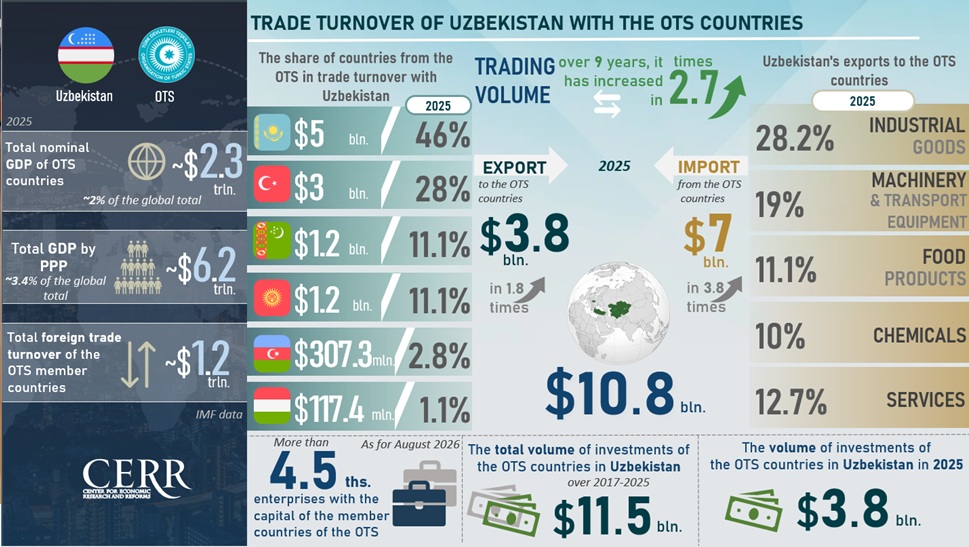
Uzbekistan has moved its economic cooperation with the Turkic states into a practical dimension
Ahead of the 13th Summit of the Organization of Turkic States, scheduled to be held in Ankara, economic cooperation within the OTS is acquiring new substance.
Water security in the turkic world: shared interests and common solutions
Water is a precious blessing that transcends national borders and has long connected peoples and civilizations.

Strengthening Transport Connectivity in Asia through the Development of the Trans-Caspian International Transport Corridor
Shifting international supply chains and expanding trade in Asia are driving demand for sustainable transport routes. For businesses, predictable delivery times, competitive rates, and reliable access to foreign markets are becoming increasingly important.