
Uzbekistan-Bulgaria: dialogue of traditions and strategic interests

On June 9-11, at the invitation of President Shavkat Mirziyoyev, President of Bulgaria Rumen Radev will pay an official visit to Uzbekistan.
Relations between Uzbekistan and Bulgaria have deep historical roots. Scientists note that contacts between peoples of Turkic origin, which include the ancestors of the Bulgarians, and the regions that make up modern Uzbekistan, go back to the era of the Great Silk Road. These ties, based on migration and trade and cultural flows, became the foundation for mutual interest and respect.
Modern diplomatic relations between the two countries were established on September 12, 1992. Since then, Tashkent and Sofia have been consistently developing political dialogue, and in recent years a new dynamic of activity has emerged, giving relations a qualitatively different character.
Political interaction between Uzbekistan and Bulgaria is based on the spirit of constructive partnership and mutual support. Bilateral contacts at the highest and highest levels have intensified in recent years, which reflects Uzbekistan’s general policy of strengthening ties with the states of the European Union. Bulgaria, as an EU member state, is considered by Tashkent to be among the promising partners in Europe.
The meeting of the President of Uzbekistan Shavkat Mirziyoyev with the President of Bulgaria Rumen Radev, held on September 20, 2017 on the sidelines of the 72nd session of the UN General Assembly, confirmed their mutual commitment to developing bilateral dialogue and strengthening cooperation, establishing the basis for further deepening interstate relations, including the current visit.
Within the UN and OSCE, Bulgaria consistently supports Uzbekistan’s initiatives aimed at sustainable development of Central Asia and ensuring regional stability. The Bulgarian side highly appreciates the reforms being implemented within the framework of the “New Uzbekistan” Strategy, including the strengthening of civil society institutions and the development of the media sector.
Inter-parliamentary relations are also consistently developing. There is a friendship group “Bulgaria-Uzbekistan” in the Bulgarian parliament; by a joint decision of the chambers of the Oliy Majlis, an inter-parliamentary group for cooperation with the People’s Assembly of Bulgaria was created.
As part of this cooperation, a mutual exchange of visits is carried out, the dynamics of which have become more active in recent years. In July 2018, a delegation led by the chairman of the Bulgaria-Uzbekistan Friendship Group in the People's Assembly of Bulgaria, Adlen Shevked, visited Uzbekistan.
In November 2018, a delegation of the inter-parliamentary group "Uzbekistan-Bulgaria" of the Legislative Chamber of the Oliy Majlis visited Bulgaria, where they met with the leadership of the People's Assembly, representatives of the Ministries of Foreign Affairs, Economy and Tourism, the mayors of the cities of Plovdiv and Kardzhali.
In December 2021, Chairman of the Senate of the Oliy Majlis Tanzila Narbaeva took part and delivered a video message at the high-level ministerial conference “Ways of development of society in the context of demographic changes” in Sofia.
The foreign policy departments of the two countries maintain regular contacts, including holding inter-ministerial consultations, during which not only bilateral issues are discussed, but also the current international agenda, including climate, digital transformation, combating disinformation and human rights.
On October 23, 2023, within the framework of participation in the 19th Ministerial Meeting “European Union-Central Asia” in Luxembourg, a meeting was held between Minister of Foreign Affairs Bakhtiyor Saidov and Deputy Prime Minister, Foreign Minister of Bulgaria Maria Gabriel.
Economic interaction between Uzbekistan and Bulgaria has not yet reached a level corresponding to the potential of both countries. However, there are prerequisites for intensifying cooperation in such areas as pharmaceuticals and biomedicine, information technology and telecommunications, agriculture and food processing, renewable energy (including solar and hydrogen technologies), textile and chemical industries.
The parties intend to intensify the activities of the Uzbek-Bulgarian Intergovernmental Commission on Trade, Economic, Scientific and Technical Cooperation, The 5th meeting of which was held in Sofia in September 2019.
The investment potential of both countries is becoming increasingly attractive from the point of view of partnership, which is facilitated by the liberalization of the economy of Uzbekistan, the development of free economic zones and active support for small and medium-sized businesses.
Today, 30 enterprises operate in Uzbekistan with the participation of investors from Bulgaria, including 4 - with 100% Bulgarian capital. The main areas of their activity are oil refining, production of finished textile products, the food industry, trade operations and the service sector.
Both countries are showing interest in developing transport and logistics cooperation, especially in the context of the Trans-Caspian international transport route, which can connect Uzbekistan with the ports of the Black Sea through the Caucasus. Bulgaria, with its developed infrastructure and logistics hubs, is capable of playing the role of a transit corridor between Central Asia and the European Union.
Uzbek-Bulgarian cooperation is actively developing in the humanitarian and educational spheres.
The Uzbekistan-Bulgaria Friendship Society and the Bulgarian Cultural Center make a great contribution to strengthening intercultural dialogue.
Partnerships between the cities of Bukhara and Varna, Samarkand and Plovdiv become a symbol of friendship, cultural understanding and trust. Through the exchange of delegations, cultural projects and joint initiatives, they contribute to strengthening the dialogue between the peoples of Uzbekistan and Bulgaria.
In recent years, screenings of Bulgarian films and exhibitions of artists have taken place in Tashkent and Samarkand. Embassies and diaspora organizations contribute to the promotion of the culture of both countries through language courses, musical evenings and round tables on the topic of cultural heritage.
In the field of education, cooperation agreements were signed between the Tashkent Institute of Chemical Technology and the Sofia University of Chemical Technology, the Tashkent State Institute of Law and Sofia University, the Samarkand State Medical Institute and the Sofia Medical University. Memorandums of cooperation were also signed between Namangan State University and the Technical University of Varna, the University of World Economy and Diplomacy and the Diplomatic Institute at the Bulgarian Foreign Ministry. This interaction contributes to deepening humanitarian ties, improving the quality of personnel training and strengthening mutual understanding between the youth of the two countries.
In addition, Uzbekistan and Bulgaria participate in the Erasmus+ programs, under which Uzbek students undergo training and internships at Bulgarian universities, as well as at the Bulgarian Academy of Sciences.
Significant potential for further development of bilateral cooperation can also be seen in the field of tourism. Both countries have a rich historical and cultural heritage, unique architectural monuments and diverse natural landscapes, which creates favorable conditions for the development of mutual tourist exchange.
Thus, it is obvious that Uzbekistan and Bulgaria intend to fully reveal and realize the potential of bilateral interaction based on trust and mutual respect for each other’s interests.
In this regard, undoubtedly, The upcoming visit of the President of Bulgaria Rumen Radev to Uzbekistan, as well as his participation in the IV Tashkent International Investment Forum, will give a powerful impetus to the further development of mutually beneficial partnerships and will lay the foundation for building up relations in all directions.
IA Dunyo
Related news
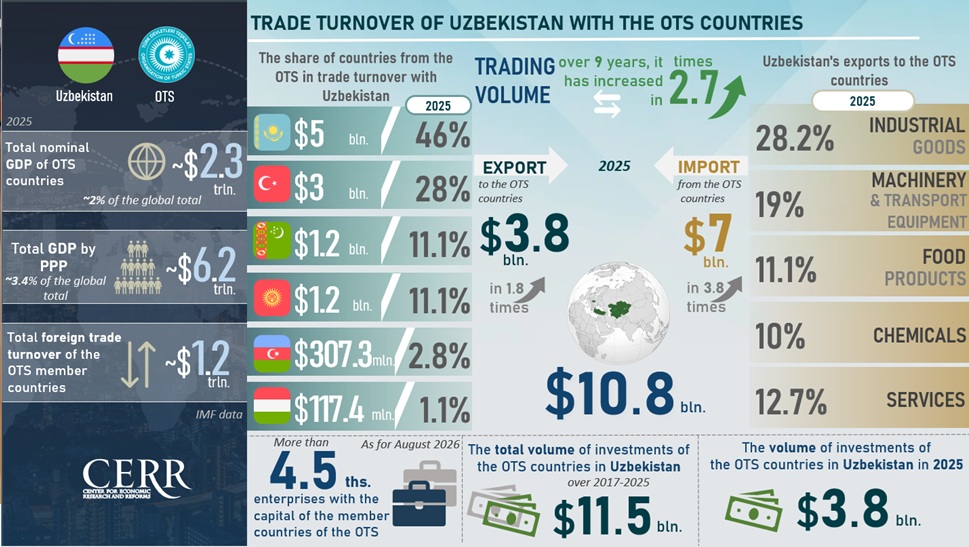
Uzbekistan has moved its economic cooperation with the Turkic states into a practical dimension
Ahead of the 13th Summit of the Organization of Turkic States, scheduled to be held in Ankara, economic cooperation within the OTS is acquiring new substance.
Water security in the turkic world: shared interests and common solutions
Water is a precious blessing that transcends national borders and has long connected peoples and civilizations.

Strengthening Transport Connectivity in Asia through the Development of the Trans-Caspian International Transport Corridor
Shifting international supply chains and expanding trade in Asia are driving demand for sustainable transport routes. For businesses, predictable delivery times, competitive rates, and reliable access to foreign markets are becoming increasingly important.