
The development of transport interconnectivity is the foundation for the revival of connectivity between Central and South Asia

Project for the construction of the Trans-Afghan Corridor (Uzbekistan-Afghanistan-Pakistan railway)
I. Historical foundations of the interconnectedness of Central and South Asia
Central and South Asia have been closely intertwined with a network of trade, cultural and intellectual ties since ancient times. Their geographical location at the crossroads of the Great Silk Road contributed to the active exchange of goods, knowledge and ideas. Thanks to this interaction, there was a spread of knowledge, scientific achievements in medicine, astronomy, mathematics and architecture, as well as the formation of high spiritual and cultural values that influenced the development of world civilization.
For centuries, these regions not only actively traded, but were also often part of common state entities. In different eras, such powerful powers as the Greco-Bactrian and Kushan kingdoms, the Turkic Khaganate, the states of the Ghaznavids, Timurids and Baburids arose here. Personalities who left a deep mark on the history of science and literature - from Al-Khwarizmi and Ibn Sino to Alisher Navoi and Rabindranath Tagore, became symbols of the large-scale intellectual and spiritual progress that occurred thanks to the close ties between Central and South Asia.
However, by the 19th century, the natural interaction of the two regions was disrupted due to political changes. The closure of borders, the growth of conflicts and the loss of former trust have led to a weakening of trade, economic and cultural ties. Today, the restoration of historical interconnectedness is again of particular relevance, because the potential for cooperation between Central and South Asia remains enormous and in demand in the modern world.
II. Trade between Central and South Asia: current state, structural features and export potential
Over the past eight years, trade relations between the countries of Central and South Asia have demonstrated steady growth dynamics. Despite this, overall trade volumes remain relatively low compared to the regions' potential. The main role in the development of mutual trade is played by Uzbekistan and Kazakhstan, which account for the overwhelming majority of both exports and imports. The rest of Central Asian countries still have a limited presence in South Asian markets.
Cumulative average annual imports of Central Asian countries from South Asia during the period 2017–2024 are characterized by high concentration in a number of key product groups. The leading position is occupied by pharmaceutical products (HS code 30), the volume of imports of which reaches 485 million US dollars per year. This indicates the region's strategic dependence on the supply of medicines and medicines, mainly from India.
The second and third places are occupied by categories of mechanical engineering products: reactors, boilers and mechanical equipment (code 84) with a volume of $140 million, as well as electrical machines, sound recording and television equipment (code 85) - $90 million. Significant volumes of imports are also observed in consumer goods, such as sugar and confectionery ($74 million) and meat products ($44 million).
The total average annual imports of India and Pakistan from Uzbekistan and Kazakhstan in the period 2017–2024 demonstrate a pronounced commodity concentration, with mineral fuels, oil and products of its distillation (HS code 27). The volume of supplies in this category amounts to 1.047 billion US dollars per year, which confirms the strategic importance of Central Asian energy resources in meeting the energy needs of South Asia.
Next in importance are edible vegetables, roots and tubers (code 07) with a volume of $99 million, as well as inorganic chemicals, including rare earth and radioactive compounds (code 28), exports of which amount to $85 million. These categories reflect the agro-industrial and raw materials nature of Central Asian exports.
In 2017–2024, Kazakhstan remained the leading exporter from Central Asia to India. Peak volumes occurred in 2020 - $1992.0 million, after which there was a sharp decline to $449.2 million in 2023 with a partial recovery in 2024 to $464.2 million. Turkmenistan increased exports to India from $14.9 million in 2017 to $212.4 million in 2023, but in 2024 the volume decreased to $108.5 million. Uzbekistan demonstrated moderate but stable export volumes, ranging from $10.1 million in 2019 to $52.8 million in 2023. Kyrgyzstan and Tajikistan have negligible exports, less than $10 million annually.
Central Asian exports to India remain highly concentrated in Kazakhstan, while Uzbekistan and Turkmenistan show potential for increased supply.
Imports from India to Central Asian countries grew steadily during the period under review. The leader in terms of import volume is Uzbekistan: in 2024, imports amounted to a record $1,292.8 million compared to $282.0 million in 2017, which indicates a multiple increase. Kazakhstan also showed an increase in imports, reaching $510.7 million in 2024. Turkmenistan maintained modest volumes ($46.8 million in 2024). Imports of Kyrgyzstan and Tajikistan from India have practically ceased in recent years.
Uzbekistan has become the main driver of an increase in imports from India, ensuring a dynamic expansion of trade flows. Thus, trade with India is largely characterized by a predominance of imports over exports.
Exports from Central Asian countries to Pakistan during the analyzed period showed significant growth, primarily from Uzbekistan. In 2017, the volume of Uzbek exports was only $7.5 million, while by 2024 it had grown to $408 million. Tajikistan also showed activity in 2020–2022, but its performance declined in subsequent years. Kazakhstan, Turkmenistan and Kyrgyzstan maintained a relatively low level of exports to Pakistan.
Imports from Pakistan also grew dynamically. Uzbekistan showed the greatest growth: from $24 million in 2017 to $188 million in 2024. Kazakhstan and Tajikistan also increased their import volumes, while the figures for Turkmenistan and Kyrgyzstan remained at a minimum level. Thus, Uzbekistan is becoming a key participant in strengthening trade ties with Pakistan, actively increasing both exports and imports of goods.
Analysis of trade with Bangladesh shows that Uzbekistan occupies a leading position among Central Asian countries in terms of export volumes, although overall figures remain modest. Over the years, the volume of exports ranged from 6.4 to 50.5 million dollars. Kazakhstan and Tajikistan also supplied supplies, but in much smaller volumes. Kyrgyzstan and Turkmenistan practically did not carry out export operations in the direction of Bangladesh. This shows that trade with Bangladesh requires further development as exports are limited predominantly to Uzbekistan, which is showing a fluctuating downward trend.
Imports from Bangladesh showed higher activity from Kazakhstan and Uzbekistan. In 2024, Kazakhstan increased imports to $119 million and Uzbekistan to $70.8 million, while imports to Tajikistan, Kyrgyzstan and Turkmenistan remained low.
Thus, trade with Bangladesh is at the formation stage, with Kazakhstan and Uzbekistan playing a leading role in this process.
Mutual trade between the countries of Central Asia and South Asia is showing positive dynamics, although its scale is still far from reaching its full potential. In recent years, Uzbekistan has become the main driver of trade growth with South Asia, especially actively developing ties with Pakistan. Kazakhstan continues to maintain a leading role in trade with India, despite a slight decline in export volumes after 2021.
Overall, Central Asian exports to India grew significantly between 2017 and 2020, peaking at $2013.4 million in 2020. However, starting from 2021, there has been a gradual decline in export supplies, falling to $602.6 million in 2024. Imports from India also showed growth, especially after 2020, increasing from $928.7 million in 2020 to $1,850.1 million in 2024. In 2017–2022, Central Asian countries maintained a positive trade balance with India. However, starting in 2023, the trade balance turned negative and reached a deficit of -$1,247.4 million in 2024, reflecting rising imports with a sharp decline in exports.
Since 2023, Central Asia has faced a widening trade deficit with India, which requires active measures to stimulate exports.
B During the observed period, exports from Central Asian countries to Pakistan grew steadily: from $46.7 million in 2017 to a record $423.8 million in 2024. Imports from Pakistan fluctuated: after declining in 2020 ($72.8 million), they rose again to $240.0 million in 2023 and stood at $231.5 million in 2024. The trade balance was negative in 2017–2018. The situation has improved since 2019, with a significant surplus of $112.2 million recorded in 2021. In 2024, the trade surplus amounted to $192.3 million. Central Asia has significantly strengthened its position in the Pakistani market, turning a negative balance into a strong surplus thanks to rising exports.
Central Asian countries' exports to Bangladesh remained low, falling from $51.8 million in 2017 to $17.9 million in 2024. Imports from Bangladesh, on the contrary, increased significantly: from $62.3 million in 2017 to $189.9 million in 2024. Throughout 2017–2024, a stable trade balance deficit remained. The deficit increased from -$10.6 million in 2017 to -$172.0 million in 2024. Central Asian countries' trade with Bangladesh is developing in favor of the latter, and Central Asian countries need to focus on diversifying and increasing exports to this market.
In general, imports of goods from South Asian countries to Central Asia are growing faster than exports, creating a negative trade balance in favor of South Asia. At the same time, there is a desire of the countries of Central Asia to diversify foreign economic relations and intensify trade with South Asian partners.
Trade between the countries of South and Central Asia demonstrates noticeable uneven development both by country and by product range. According to the data presented, India is the largest exporter to the Central Asian region, with the largest number of commodity items worth over $1 million being imported by Kazakhstan (34 items) and Uzbekistan (33 items). Pakistan and Bangladesh have a much more limited trade presence in the region, especially in Turkmenistan, where there are no imports of a single product category worth over $1 million from Pakistan, and only one from Bangladesh to Uzbekistan and five to Kazakhstan.
At the same time, the export position of Central Asian countries to South Asia is much more modest. The leaders are Uzbekistan and Kazakhstan, exporting 8 commodity items each to India, as well as 5 and 3 commodity items, respectively, to Pakistan. The remaining countries in the region - Kyrgyzstan, Tajikistan and Turkmenistan - have a limited number of exports to South Asia, indicating a lack of diversification of their trade relations with the region. Tajikistan especially stands out, as it has virtually no commodity items over $1 million exported to India and Bangladesh.
Thus, there is an asymmetry in mutual trade: South Asian countries export much more actively to Central Asia than vice versa.
This indicates the potential for the development of export capabilities of the Central Asian countries, especially in the direction of India and Pakistan, taking into account the growing economies of these countries and the possible demand for primary and processed goods.
Prospects for further trade growth directly depend on the development of transport connectivity, in particular, on the implementation of new routes through Afghanistan and the creation of multimodal logistics corridors. Simplification of trade procedures and the elimination of regulatory barriers will also play a significant role, which will allow countries in the region to more actively integrate into the economic space of South Asia.
III. Development of transport and logistics infrastructure as a key factor in reviving dialogue and cooperation
In July 2021, the conference “Central and South Asia: Regional Connectivity” was held in Tashkent. Challenges and Opportunities”, which became a turning point in realizing the need to restore historical ties between the two regions. In his speech at the conference, the President of the Republic of Uzbekistan Shavkat Mirziyoyev emphasized that the creation of new transport and communication corridors is vital for the development of trade, strengthening security and expanding humanitarian ties.
The Trans-Afghan Railway Termez-Mazar-i-Sharif-Kabul-Peshawar is considered as a strategic project aimed at strengthening the integration of Central and South Asia.
The initiative should become a powerful incentive for economic growth, expansion of trade, development of transport and logistics connections and increasing the export potential of the region. The project, the idea of which arose in the early 2000s, received official support in 2017 with the signing of an intergovernmental agreement between Uzbekistan and Afghanistan.
In subsequent years, Kazakhstan, Russia and Pakistan joined the implementation, and from 2022 - Qatar and the UAE as financial and technical partners.
The length of the new The railway will be about 600 km, and the design capacity is estimated at 20 million tons of cargo per year. Completion of construction is planned by the end of 2027, with full operation by 2030.
The Termez-Mazar-i-Sharif-Kabul-Peshawar trans-Afghan railway project is estimated at approximately $5 billion. As the route becomes operational, it is expected that the delivery time for goods between Pakistan and Uzbekistan will be significantly reduced - from the current 35 days to just 3-5 days. It is also expected that the cost of transporting one standard container will decrease almost threefold, which will make the route especially attractive for business. According to forecasts, cargo traffic on the new railway in the future could reach 10 million tons per year.
The project is of great strategic importance, as it will significantly reduce the time and costs of delivering goods between Central Asia and the ports of the Arabian Sea, as well as support the economic recovery of Afghanistan. It will strengthen Uzbekistan’s position as a key transport hub within the framework of the One Belt, One Road initiative.
This new transport corridor is designed to connect the European Union, Russia, Uzbekistan, Afghanistan, Pakistan, India, and subsequently the countries of Southeast Asia.
However, the successful implementation of the project requires solving a number of serious problems: ensuring security along the route, attracting a sufficient amount of investment and unifying technical standards between countries. The prospects for the Trans-Afghan Corridor directly depend on international coordination of efforts and effective project management.
IV. Conclusions and strategic guidelines for deepening interconnectedness
Analysis of trade flows, infrastructure initiatives and historical ties between Central and South Asia confirms the presence of a solid base and high potential for the development of strategic partnerships.
Mutual trade, despite the positive dynamics, remains limited both in volume and in the range of goods, with pronounced asymmetry in favor of South Asian countries. The development of transport connectivity, especially through the implementation of cross-border corridors, such as the Termez – Mazar-i-Sharif – Kabul – Peshawar railway, opens up opportunities to overcome these imbalances and enhance economic flows.
At this stage, the key strategic guidelines should be:
1) accelerated construction and commissioning of multimodal transport routes across Afghanistan;
2) harmonization of technical, customs and regulatory procedures;
3) diversification of export supplies from Central Asia to South Asia, including high value-added goods
4) strengthening coordination between governments, international institutions and the private sector.
These measures will transform historical ownership into a sustainable economic partnership that contributes to regional stability and prosperity.
In the context of global geo-economic shifts, strengthening interconnectedness between Central and South Asia is gaining not only economic but also strategic importance. Regional cooperation can become a powerful factor in sustainable development, reducing dependence on foreign markets and forming our own logistics and production chains. Central Asia, using its transit potential and growing economic ambitions, has a chance to take its rightful place in the new architecture of Eurasian interconnectedness.
Related news
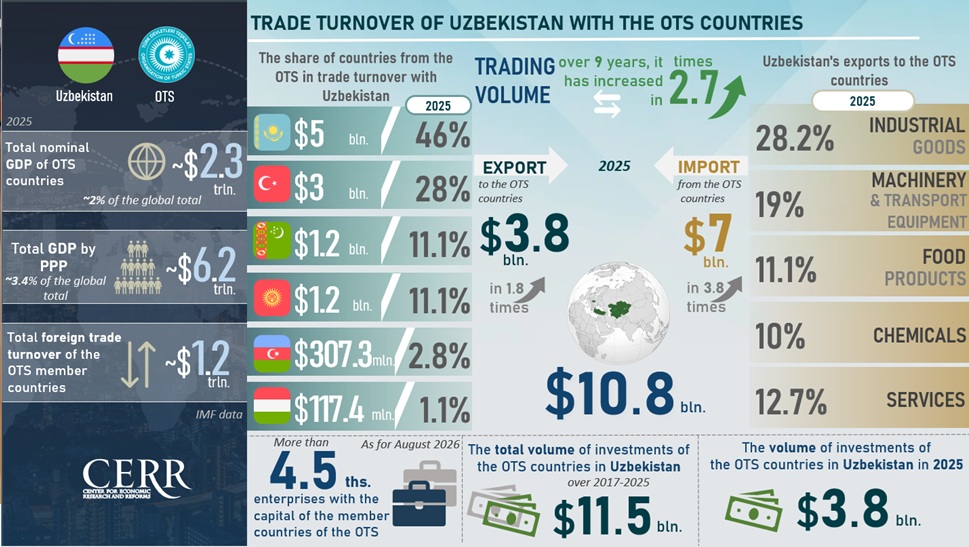
Uzbekistan has moved its economic cooperation with the Turkic states into a practical dimension
Ahead of the 13th Summit of the Organization of Turkic States, scheduled to be held in Ankara, economic cooperation within the OTS is acquiring new substance.
Water security in the turkic world: shared interests and common solutions
Water is a precious blessing that transcends national borders and has long connected peoples and civilizations.

Strengthening Transport Connectivity in Asia through the Development of the Trans-Caspian International Transport Corridor
Shifting international supply chains and expanding trade in Asia are driving demand for sustainable transport routes. For businesses, predictable delivery times, competitive rates, and reliable access to foreign markets are becoming increasingly important.