
Development of regional connectivity is the key to security and stability in Central and South Asia

Central and South Asia, with significant economic, demographic and resource potential, still remain one of the least integrated regions of the world. Strengthening the interconnectedness between them is not only an economic necessity, but also a strategic imperative dictated by the tasks of ensuring regional security, sustainable development and stability.
Historically, both regions were closely connected by trade and cultural routes, primarily within the framework of the Great Silk Road. However, the geopolitical upheavals of the 19th and 20th centuries, including the protracted conflict in Afghanistan and the competition of external powers, led to the breakdown of these ties and increased mutual isolation.
Today, in the context of globalization, the restoration of these lost ties has become an objective requirement of international trade and economic integration. For Central Asian countries, access to seaports is critically important in order to expand foreign economic activity. South Asia, in turn, is interested in energy and water resources, as well as access to new markets. The economic complementarity of the regions opens up wide opportunities for mutually beneficial cooperation.
Uzbekistan plays a leading role in promoting the agenda of regional connectivity. In December 2020, President Shavkat Mirziyoyev, in his message to the Oliy Majlis, identified the development of the southern vector of foreign policy as a strategic priority. For the first time in recent history, Uzbekistan has officially announced its intention to intensify interaction with South Asia, promote a peaceful settlement in Afghanistan and restore the country's role as a natural bridge between the two regions.
A major event in the implementation of this initiative was the international conference “Central and South Asia: Regional Connectivity. Challenges and Opportunities”, held in Tashkent in 2021 on the initiative of the President of Uzbekistan. It marked a transition from declarative statements to practical steps to bring the two regions closer together.
During the conference, which was attended by more than 250 representatives of 44 states and about 30 international organizations, a number of initiatives were announced aimed at creating a systematic approach to bringing Central and South Asia together, including the development of trade and investment, the removal of barriers to goods, services and capital, the implementation of transport and infrastructure projects, digital integration in trade and logistics with the participation of international organizations. Measures were also proposed to strengthen food security, combat drug trafficking and terrorism, environmental cooperation, develop tourism and humanitarian ties through educational programs and forums.
In continuation of these efforts, the conference proposed to develop and submit for consideration to the UN General Assembly a draft resolution establishing common approaches, basic principles and directions of dialogue between Central and South Asia. This initiative received widespread support, and at the 76th session of the UN General Assembly the resolution was unanimously approved. The document was co-sponsored by 40 countries from different regions of the world.
The implementation of this vision is facilitated by the practical intensification of interregional cooperation, which is fully consistent with the efforts of the countries of the two regions to deepen the partnership. These efforts are already bringing tangible results, especially in the area of economic interaction, where there is steady positive dynamics.
If previously South Asia was perceived primarily through the prism of threats associated with the situation in Afghanistan, in recent years the emphasis has shifted towards constructive cooperation. Thus, trade turnover between Uzbekistan and Pakistan increased from $36.5 million in 2017 to more than $400 million in 2024. During the visit of Pakistani Prime Minister Shahbaz Sharif to Uzbekistan in February 2024, the parties agreed to increase this figure to $2 billion and create a joint transport and logistics company.
Positive dynamics are also observed in relations with India: the volume of mutual trade increased from $323 million in 2017 to $1 billion in 2024 year. These indicators reflect not only growing economic interest, but also strengthening political will to deepen cooperation.
Afghanistan, Uzbekistan’s fifth largest export market, occupies a special place in the regional architecture. Over the past five years, trade turnover between the two countries has increased 1.5 times and amounted to $1 billion in 2024. There are 550 enterprises in Uzbekistan with the participation of Afghan capital, of which 443 are entirely Afghan. Joint projects cover such areas as the food industry, production of building materials, agriculture, tourism and textiles.
A significant step towards strengthening transport connectivity was the creation of the international transport and logistics hub Termez Cargo Center in Termez. The center operates on the “single window” principle, providing a wide range of services: customs clearance, banking and tax transactions, sanitary control, certification, currency exchange, transport and hotel services. Particular attention is paid to humanitarian logistics: cargo sent to Afghanistan and neighboring countries undergo a simplified and priority customs procedure.
The initiatives promoted by Uzbekistan have made it possible in recent years to formulate a new strategic agenda with South Asia. Taking into account the region's population (more than 2 billion people) and total GDP ($3.4 trillion), South Asia is becoming one of the most promising areas for expanding the foreign economic presence of Uzbekistan.
Increasing regional connectivity contributes not only to the growth of trade, but also to the creation of conditions for sustainable development - through a more equal distribution of resources, lower transport costs and diversification of economies. The most important direction in this context remains the development of transport infrastructure.
The key project here could be the construction of the Mazar-i-Sharif - Kabul - Peshawar railway, which was also initiated by the head of Uzbekistan in 2018. Today, delivering one container from Central Asia to international ports costs five times more than from countries with direct access to the sea. The implementation of the project will reduce delivery costs by almost three times - from 900 to 286 dollars, and travel time - from 35 to 3-5 days. This will radically change the economic dynamics of the region, open up new export opportunities and attract investment.
For Central Asian countries, including Uzbekistan, which are landlocked and forced to cross the territories of two states, reducing logistics costs is critical. On average, such countries spend about 18% of export earnings on transport costs, while for coastal countries this figure is about 9%. Moreover, according to UNCTAD, in some cases, import transport costs for Central Asian countries reach 60% of the cost of imported goods.
At the same time, the technical implementation of infrastructure projects is only one side of the process. Their effective functioning depends on ensuring sustainable security along transit routes. In the absence of lasting peace in Afghanistan, trans-Afghan corridors remain largely at the conceptual development stage. This highlights the inextricable link between economic interconnectedness and political stability: without the formation of a reliable security architecture, the implementation of regional initiatives is difficult.
Energy projects such as CASA-1000 and TAPI, aimed at meeting the energy needs of South Asia and diversifying the export routes of Central Asia, are also becoming significant. The TAPI project, in particular, provides for the transportation of 33 billion cubic meters of gas per year from Turkmenistan through Afghanistan and Pakistan to India. Its implementation is supported by international investors, including the Asian Development Bank, as well as large energy corporations such as Gazprom, Chevron and ExxonMobil.
However, the success of these projects is determined not only by economic logic, but also by political will, security, and the willingness of investors to accept risks associated with the unstable situation in the region.
In addition to traditional energy, cooperation in the field of nuclear energy is becoming a promising area. Kazakhstan, which has the world's largest uranium reserves, is actively expanding exports, including supplies to India. In accordance with the signed agreements, Kazakhstan plans to supply up to 2,100 tons of uranium by 2030, which will partially satisfy India's growing demand for nuclear fuel. This also helps to strengthen mutual economic dependence and expand strategic interaction.
Thus, the formation of sustainable interconnectedness between Central and South Asia is a complex task that requires an integrated approach: from joint implementation of infrastructure projects and expansion of energy cooperation, to strengthening trust and coordination in the security sector.
Initiatives promoted by Uzbekistan create unique opportunities for launching a new stage of regional integration. However, their implementation largely depends on the stabilization of the situation in Afghanistan, international recognition of the current government, easing tensions between India and Pakistan, as well as on the political readiness of all countries in the region for deep and sustainable cooperation.
The future of Central and South Asia as a single, stable and sustainable region is being formed today - through decisions, efforts and initiatives aimed at strengthening interconnectedness, trust and sustainable development. The progressive course that Uzbekistan is taking and the active involvement of other countries in the region open up broad horizons for multifaceted cooperation.
Tanbaev O.
V.N.S. MICA
Related news
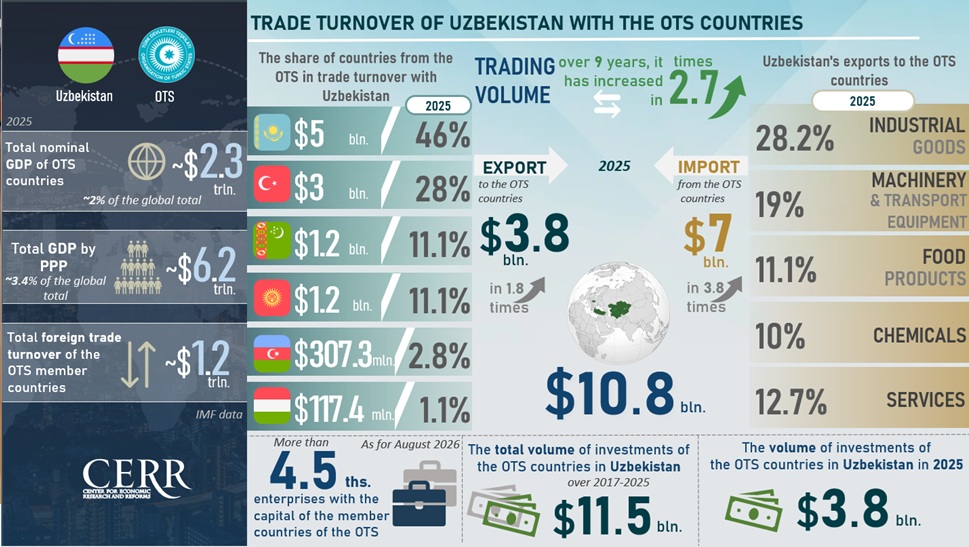
Uzbekistan has moved its economic cooperation with the Turkic states into a practical dimension
Ahead of the 13th Summit of the Organization of Turkic States, scheduled to be held in Ankara, economic cooperation within the OTS is acquiring new substance.
Water security in the turkic world: shared interests and common solutions
Water is a precious blessing that transcends national borders and has long connected peoples and civilizations.

Strengthening Transport Connectivity in Asia through the Development of the Trans-Caspian International Transport Corridor
Shifting international supply chains and expanding trade in Asia are driving demand for sustainable transport routes. For businesses, predictable delivery times, competitive rates, and reliable access to foreign markets are becoming increasingly important.