
The educational policy of New Uzbekistan opens up new horizons in the region
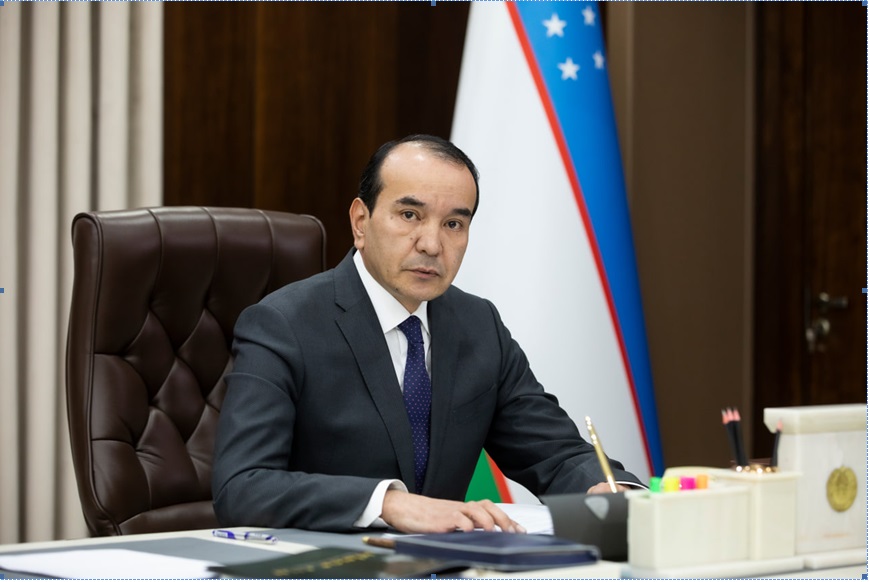
We are the happiest children of our people. We have been privileged to see the days our Jadid ancestors dreamed of, to create the future they desired. I was once again convinced of this during the events within the framework of the seventh Consultative Meeting of the Heads of State of Central Asia.
In recent years, Central Asia has acquired a new look on the world political map. Today it is recognized that the states of the region are not competitors, but partners, reliable allies, walking together along the path of development. Therefore, other regions and powerful states reckon with us and see their future in harmony with the spirit of Central Asia. This is no coincidence. Because various contradictions have intensified in the international arena, with only material interests coming to the fore. It was in this situation that, thanks to the political will of our President and his wise decisions, a completely new policy of generosity, inherent to our people, prevailed in our region. All Central Asians are happy about this. Because our peoples lived as neighbors, matchmakers and relatives, as a single people with common joy and sadness.
Our President, in awakening the spirit of Central Asia, first of all, followed the path of further rapprochement of our peoples. We wisely used the power of literature and art to take our relationship to the next level. In particular, various events and festivals were organized between cultural representatives of our countries. Performances by representatives of art and culture, holding large concerts as part of visits of heads of state have become commonplace.
Our President has made it a tradition to donate books to his colleagues. To be honest, at that time we understood this only within the framework of cultural ties. Time itself shows that the path chosen by our President is the path to the hearts of the people!
After all, the people of Central Asia consider Hazrat Navoi their ancestor. In the same way, we love Jami, Fizuli, Magtymguly, Abay, like Bobur or Alisher Navoi. We value the epic “Manas” as our own epics; we read Aitmatov’s works more than anyone else. This in itself means that our peoples have lived for centuries inseparably, like flesh and nails. The head of our state brought such important aspects to the level of state policy. This opened the way to the hearts of our peoples. As a result, the seventh Consultative Meeting of the Heads of State of Central Asia was rich in historical events. The main thing is that, as a result, very important decisions were made for the future of the region.
In particular, the Concept of Regional Security and Stability in Central Asia was adopted. In today's global world, security is very important. In such a situation, it is impossible to develop alone. Where there is peace, there will be stability. Therefore, the new Central Asia is viewed in the international arena as a peaceful and stable region. In our region, not only natural wealth, economic resources, but also human capital are at a sufficient level. At a time when mutual conflicts and economic crises are escalating in different parts of the world, Central Asia, while maintaining stability, really looks like a rescue ship for others.
Maintaining this stability while using its potential to achieve economic growth is not easy. This is correctly understood by every person who carefully observes the working regime of our President. Because the head of our state strengthens international ties day and night. Speaking from the global podium, he promotes not only national, but also universal interests. Calls for resolving any contradictions and disputes through peaceful, diplomatic means.
It is these calls, aspirations and initiatives that have awakened the spirit of Central Asia today. The entire region unanimously decided to maintain security and stability. In the words of our President, we deeply realized that our strength is in unity, our path to success is in friendship and cooperation.
Relations in the “Central Asia Plus” format have strengthened in recent years. Our region demonstrates a united position in the international arena. At the same time, it is actively integrating into the world economy. Investment attractiveness is growing, export opportunities to third markets are expanding, and transit potential is increasing. For example, last year the volume of mutual trade between our countries reached 10.7 billion US dollars. The total volume of investments in our region increased by 17 percent.
Further increase in economic relations, a correct assessment of geopolitical processes changing every second, unpredictable in advance - is an urgent task. In this sense, it is gratifying that at the Consultative Meeting a catalog of threats to the security of Central Asia and measures to prevent them, designed for 2026-2028, were identified.
The consultative meeting of the heads of state of Central Asia was organized on the initiative of our President. The Seventh Consultative Meeting was chaired by the head of our state. During this period, our cooperation was extremely effective. In order to further increase the potential for cooperation, more than 20 major events were held. A regional cooperation forum was established at the level of deputy prime ministers. Ministerial meetings were also held for the first time. In particular, meetings were held between the ministers of geology, industry, agriculture, ecology and culture.
It is because of such aspects that we have the right to say that a new period of the Consultative Meeting has begun. Just one example: now the member states of the Consultative Meeting cooperate separately, individually in each area. We were once again convinced of this at meetings at the ministerial level.
Within the framework of the International Congress on the theme “Central Asia: common spiritual and educational heritage - common future” at the Center for Islamic Civilization, we held a meeting for the first time with the ministers of culture of Central Asia and Azerbaijan. Various issues of multilateral cooperation were discussed at it. We discussed issues of cooperation in various areas of culture and art. We exchanged views on the current state of regional cultural cooperation and long-term plans.
Our peoples have one thing in common. Namely: others listen more to elders, people who have earned the respect of the people. They follow them. It is this aspect that is our unique strength that sets us apart from other regions. Therefore, vital questions were raised about expanding cultural exchange between cultural figures in the future. As a result, we reached agreements to expand regional cultural cooperation.
Mutual respect and generosity between peoples do not arise on their own. We must admit that human psychology has a strong tendency towards negative information. In today's global world we see enough examples of this. It is this aspect that our President deeply understood, carefully analyzed and created the opportunity for cultural workers to strengthen such ties. I believe that cultural workers and the intelligentsia in general are responsible for the further development of peace and mutual understanding in the region. It is we who must prepare positive content leading to this and present it to our people. In this sense, we have united around a common opinion on holding joint events and festivals in the fields of art, literature, cinema, theater and music. Events like these remind us of our identity. They glorify the universal ideas, friendship and generosity that were promoted by Navoi, Jami, Fuzuli and Magtymguly, Abay and Aitmatov and which became the reason for the awakening of the spirit of Central Asia today.
It is gratifying that we will expand joint projects on the study, restoration and digitization of cultural heritage. In addition, we will develop exchange programs among young creators. At the same time, we reached an agreement on the organization of seminars, conferences and summer schools. We also exchanged views on the issue of strengthening cooperation in the field of training and advanced training in the field of culture and art. The main thing is that positive opinions were expressed about the development of the “Cultural Brand of Central Asia.”
Watching this process, meetings and agreements within the framework of the heads of state, I felt that today Central Asia has in the full sense become a single region, a single force. Our peoples have gone through many trials before reaching this day. We can see this in the example of our Jadid ancestors. Fortunately, the current river continues to flow. Our ancestors always called the people of the world to enlightenment, friendship and goodness. Today we, as a single region, continue this ancient tradition. It is gratifying that the head of our state wisely uses these values of ours not only on the path of our country, but also of world solidarity. This was clearly manifested in the initiatives put forward by our President at the Consultative Meeting of the Heads of State of Central Asia.
In particular, an initiative was put forward to create a Council of Elders, consisting of public figures with rich life experience and authority, based on our values and traditions in the field of public diplomacy. At the same time, the fundamental importance of further improving cooperation mechanisms and legal frameworks was emphasized. Especially the initiative to transform the Consultative Meeting into the strategic format “Community of Central Asia” has become the cherished dream of each of us.
Because now Central Asia is not just a region, but a single voice, a united force, strengthening its place on the world political map. Therefore, our President, in his speech at the seventh Consultative Meeting of the Heads of State of Central Asia, emphasized: “I am firmly convinced that today we stand on the threshold of a historic awakening of our region as a New Central Asia.”
It is for this reason that developed countries seek to cooperate with us. This is a great opportunity for the countries of the region. Its wise use depends on our unity, friendship and ability to defend our interests in solidarity. In New Uzbekistan, it is precisely because such important aspects are always in the spotlight that it is recognized as people's politics. How sincere these confessions are is confirmed by the scale of countries willing to cooperate with us. There are two important reasons for the strong desire of developed countries for a New Uzbekistan. First of all, the new Uzbekistan is recognized as a state that promotes the ideas of peace and humanism.
At this point one vital truth needs to be said. No matter how formidable a person may seem, he still lives striving for peace and friendship. Countries are the same too. They can go to various contradictions for the sake of their interests. But deep down they want peace and prosperity. The position of New Uzbekistan in foreign policy provides precisely these guarantees of peace and friendship.
The second and important aspect is that thanks to the people's foreign policy, Central Asia has achieved unity. Now it is seen not as a platform supplying labor and natural resources, but as a new force with broad economic potential in the international arena. As part of the Consultative Meeting, the leaders of the countries visited the Center of Islamic Civilization. Our President emphasized that this center is a unique platform for creating scientific knowledge and ideas, conducting research, and popularizing our common cultural and historical heritage. This means that it is natural that the center will become a place serving the scientific and spiritual elevation of young people.
We have reason to talk about this with such complete confidence, of course. At the Consultative Meeting, our President put forward a proposal to regularly organize the first International Congress dedicated to the spiritual heritage and ideas of enlightenment. According to this, the congress will be held annually in the country presiding over the Consultative Meeting.
All this shows that the countries of Central Asia are united not only because of economic or security issues, but also because they are involved in education. We know well that relationships built on any material interest are temporary. In our region there live peoples with a common history and a common past. This is the cause of unity that transcends any material interests. Therefore, at meetings at the level of heads of state, issues of culture and education always occupy a place on the agenda. This evokes boundless pride and admiration in our hearts. At the same time, this also comes with the responsibility of being a generation worthy of such glorious days. Indeed, at a time when the educational policy of the new Uzbekistan opens up new horizons in Central Asia, to be worthy of this is both the duty and responsibility of every son of this land!
Ozodbek Nazarbekov,
Minister of Culture of the Republic of Uzbekistan
Related news
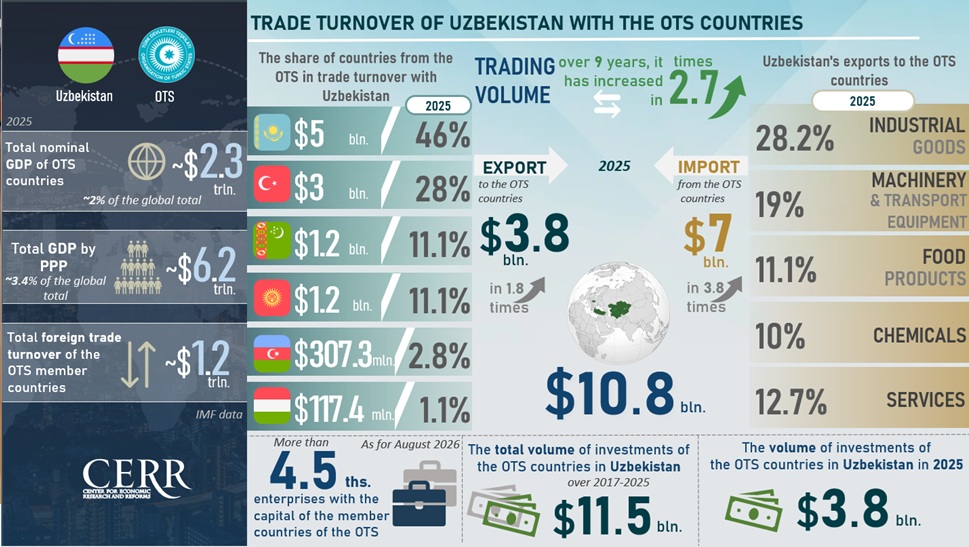
Uzbekistan has moved its economic cooperation with the Turkic states into a practical dimension
Ahead of the 13th Summit of the Organization of Turkic States, scheduled to be held in Ankara, economic cooperation within the OTS is acquiring new substance.
Water security in the turkic world: shared interests and common solutions
Water is a precious blessing that transcends national borders and has long connected peoples and civilizations.

Strengthening Transport Connectivity in Asia through the Development of the Trans-Caspian International Transport Corridor
Shifting international supply chains and expanding trade in Asia are driving demand for sustainable transport routes. For businesses, predictable delivery times, competitive rates, and reliable access to foreign markets are becoming increasingly important.