
Priority areas for ensuring food security in Uzbekistan
The globalization of the world economy, a series of crises, including pandemics, natural disasters and geopolitical challenges, have significantly increased the need for countries to ensure food security. In such conditions, for each state, this problem acquires strategic importance.
For Uzbekistan, food security is of paramount importance, since it directly affects the socio-economic stability of the country, the standard of living and well-being of the population.
In 2023, 24 percent of the 14 million citizens employed in the economy (that is, 3.4 million people) worked in the fields of agriculture, forestry and fisheries. The share of agriculture in the country's gross domestic product is 19.2 percent. This indicates that the industry plays an important role not only in ensuring food security, but also in increasing employment and increasing foreign exchange earnings through exports.
Thanks to the diversification of production in agriculture, the introduction of cluster and cooperation systems, the widespread use of modern agricultural technologies, as well as support for household plots, it was possible to increase the volume and quality of products. These measures are aimed both at providing the population with quality food products, and at reducing imports and strengthening the national food system.
At the end of 2024, the total volume of products and services in the fields of agriculture, forestry and fisheries in Uzbekistan amounted to $36.9 billion. This is 3.1 percent more than in 2023. The growth is primarily due to the digitalization of the industry, the widespread introduction of the cluster system and the implementation of reforms aimed at growing export products.
Uzbekistan currently exports over 180 types of agricultural and food products to more than 80 countries. This indicates growing international demand for domestic agro-industrial products and the strengthening of our republic’s position in the global food market.
In 2024, exports of food products and livestock amounted to $2.2 billion, equivalent to 8.1 percent of the country’s total exports. At the same time, imports of this category of products reached $3.7 billion, accounting for 9.5 percent in the total import structure. This indicates that today a significant part of food needs is still covered by external markets. In this regard, it is necessary to expand domestic production and effectively use resources in this area.
As a result of a systemic policy aimed at reforming agriculture and developing horticulture, along with stabilizing the food supply of the domestic market, export potential is consistently growing. In the areas of fruit and vegetable growing, melon growing and viticulture, the production of competitive, high-quality products is achieved. The volume of exports of organic and processed products is expanding especially rapidly, for which there remains high demand in foreign markets.
Last year, Uzbekistan exported 2036.2 thousand tons of fruits and vegetables, which is 15.8 percent more than in 2023. The total value of exports of fruits and vegetables amounted to $1,549.5 million - 31.2 percent more than in the previous year. This growth rate indicates an expansion in the scale of production in the country’s agricultural sector and an increase in export potential. At the same time, the share of these products in total exports of Uzbekistan amounted to 5.8 percent.
A significant increase in the export of fruits and vegetables indicates the strengthening of Uzbekistan’s position in international markets and an increase in the export orientation of the national economy.
The Law “On Food Security” adopted in 2025 was an important step towards strengthening the country’s food security and the legal framework regulating relations in this area. The document is aimed at strengthening control over the quality and safety of food products, ensuring sustainable development and strengthening the role of the agri-food sector in the national economy.
At the same time, the law serves as a tool for implementing measures to ensure food security, integrating the country's food sector into global markets, strengthening production and control compliance with international standards.
Cooperation of Uzbekistan with the Food and Agriculture Organization of the United Nations (FAO) is an important component of the country's strategic efforts to ensure food security and sustainable development. It is carried out by studying the best practices of developed countries and adapting them to the national policies and practices of Uzbekistan.
In particular, during international conferences held in Samarkand, the effective practices of developed countries in the field of food security were analyzed, and ways of adapting them to the realities of Uzbekistan were discussed. This, in turn, reflects the effectiveness of the efforts being made and the strengthening of the country’s position in this direction.
Reforms carried out in Uzbekistan are in line with the UN Sustainable Development Goals, including ensuring food security, improving nutrition and promoting sustainable agriculture. The measures implemented within the framework of these goals contribute to strengthening the country's socio-economic stability and long-term economic growth.
In order to ensure food security, large-scale reforms in agriculture are being implemented in Uzbekistan.
Firstly, part of the land traditionally specialized in growing cotton and grain has been reoriented to the production of vegetables, legumes and melon crops. This helps to increase the volume of food production, eliminate shortages in the domestic market and improve the food supply of the population.
Secondly, the introduction of cluster and cooperative systems in agriculture has significantly increased the potential for processing, storage and export of products. For 2025, it is planned to expand the production of products with high added value, which is one of the priority areas for the development of the food industry.
Thirdly, the state provides preferential loans and subsidies for household plots, which enable the population to grow products on their own plots, thereby enriching local markets.
In addition, innovative solutions and modern technologies play an important role in strengthening food security. In particular, the introduction of blockchain technology allows for effective control of product quality and increases the transparency of supply chains.
At the same time, improving the agrological system and modernizing storage facilities can significantly reduce product losses. As a result of the reforms carried out, Uzbekistan has significantly increased the level of self-sufficiency in food products and reduced dependence on imports.
Food security depends not only on the quantity, but also on the quality and safety of food products. In Uzbekistan, the legal and regulatory framework has been strengthened in this direction, and standards relating to the quality and safety of food products are mandatory for legal entities and individuals. Strict control is exercised over compliance with sanitary, veterinary and phytosanitary rules. The food industry has implemented HACCP and GHP systems - fundamental food safety tools that are used in the food industry to reduce risks. In addition, citizens, civil society institutions, non-governmental non-profit organizations and the media are actively involved in the implementation of public control over the quality of food products.
Attention has been increased to issues of proper nutrition, and government propaganda campaigns are being implemented in the country. It should be especially noted that the State Program for the current year sets the task of strengthening educational work among the population on issues of a healthy lifestyle and proper nutrition. This in turn helps to increase citizen awareness, promote health and prevent disease.
There are a number of important challenges facing food security.
First, climate change, drought and water scarcity are negatively impacting agricultural productivity.
Second, global crises such as the pandemic, economic instability and fluctuations in the global economy pose risks to food supplies. To reduce these risks, Uzbekistan is implementing measures to stockpile and reduce dependence on imports.
Sharp increases in food prices could affect household incomes and disrupt economic stability. The state strives to ensure price stability through preferential lending and a price monitoring system.
The level of poverty also remains a serious problem. For 2025, the current goals are to determine the extent of poverty and increase the economic accessibility of food.
In addition, the lack of scientific research and qualified personnel in the field of food security negatively affects the development of this area. It is necessary to introduce effective educational programs and trainings.
Our country is implementing the Strategy to ensure food security of the Republic of Uzbekistan and healthy nutrition until 2030, which provides for the efficient use of resources to improve the living conditions of the population. In particular, the water management system is being improved, land fertility is increasing, and food production is increasing.
Modernization of agriculture and doubling of exports by attracting foreign and domestic investment are also planned. Strengthening cooperation with international organizations, in particular FAO, is important to ensure food security.
Educating the population on healthy eating and food security and improving the system for training qualified personnel remain among the key tasks. In addition, the widespread use of digital technologies and innovations helps improve the efficiency of the entire food supply chain.
Uzbekistan has already made significant progress in ensuring food security. At the same time, in order to eliminate existing problems and prepare for global economic changes, it is necessary to continue and intensify efforts in this direction. It is important not only to modernize agriculture, diversify production and develop the agricultural sector, but also to strengthen international cooperation.
Iskandar Urokboev,
Expert at the Center for Sustainable Development
Related news
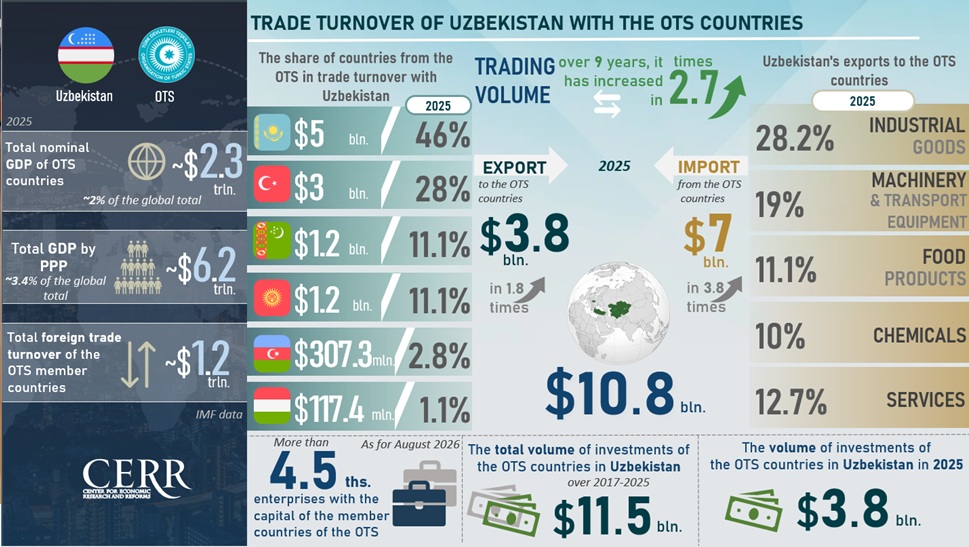
Uzbekistan has moved its economic cooperation with the Turkic states into a practical dimension
Ahead of the 13th Summit of the Organization of Turkic States, scheduled to be held in Ankara, economic cooperation within the OTS is acquiring new substance.
Water security in the turkic world: shared interests and common solutions
Water is a precious blessing that transcends national borders and has long connected peoples and civilizations.

Strengthening Transport Connectivity in Asia through the Development of the Trans-Caspian International Transport Corridor
Shifting international supply chains and expanding trade in Asia are driving demand for sustainable transport routes. For businesses, predictable delivery times, competitive rates, and reliable access to foreign markets are becoming increasingly important.