
The new Uzbekistan strengthens the legislative framework for the protection of human rights
Promotion, protection and observance of human rights and freedoms in New Uzbekistan are among the priorities of state policy. Over the past years, the country has built a solid foundation of national statehood, ensuring the principles of the rule of law and respect for human rights.
INTERNATIONAL INITIATIVES OF THE NEW UZBEKISTAN
Today, more than ever, the exchange of best international experience in implementing the UN Sustainable Development Goals, promoting digital transformation, and applying innovative solutions in the delivery of public services, radically improving the efficiency of public administration institutions.
In March 2025, the Secretary-General launched the UN 80 Initiative, aimed at transforming the work of the UN - identifying opportunities for increasing efficiency, reviewing the implementation of mandates, exploring potential structural changes and restructuring of programs within the United Nations system.
General UN Secretary Antonio Guterres appealed to states: “We cannot wait for ideal conditions. We must now take the first decisive steps to renew and reform international cooperation to make it more comprehensive, fair and inclusive.”
The New Uzbekistan supports the initiatives of the Secretary-General to ensure international peace and stability, reform the UN and its main institutions to adapt them to modern realities. In recent years, cooperation with the UN has been at an unprecedented level, with 160 joint programs and projects being successfully implemented. Just this year, the heads of key structures and institutions of the organization, including UN-Habitat and UNICEF, visited Uzbekistan, and a representative office of UN Women opened in Tashkent.
We actively participate in the activities of all UN structures. From 2021 to 2023 they became members of the Human Rights Council, and in 2024 they became members of ECOSOC, the ILO Governing Body and the Human Rights Committee. This year, Uzbekistan was elected for the first time to the Council of the Food and Agriculture Organization of the United Nations (FAO) for 2028-2029. Membership in the FAO Council opens up broad opportunities for Uzbekistan in shaping global agricultural and food policies, developing regulations and standards, presenting national and regional initiatives, as well as promoting projects and attracting additional financial resources.
Our country is among the top five most progressive countries in the Global Sustainable Development Index. A new five-year cooperation program with the UN is expected to be signed in the context of achieving the SDGs. A Forum on Civil Service Issues was jointly held. Active preparations are underway for the 43rd session of the UNESCO General Conference in Samarkand.
Over the past few years, at the initiative of Uzbekistan, more than 15 resolutions of the UN General Assembly have been adopted. In 2025 alone, our country initiated and co-sponsored three resolutions adopted during the 79th session of the General Assembly:
International Day of Remembrance for Earthquake Victims (April 29, 2025);
International Day for Awareness of the Special Needs of Developing Countries with No Access to sea, and the unique development challenges they face (July 25, 2025);
The role of artificial intelligence in creating new opportunities for sustainable development in Central Asia (July 25, 2025).
It should be emphasized that this year, the International Day for Awareness of the Special Needs of Landlocked Developing Countries and the Special Development Challenges They Face was celebrated for the first time during the Third United Nations Conference on Landlocked Developing Countries, which took place on 5-8 August 2025 in the Avaza National Tourist Zone (Turkmenistan).
The countries of Central Asia, which are landlocked, are known to show how coordinated efforts can turn geographic vulnerability into a basis for sustainable development. Through the creation of new transport corridors, joint economic projects and deepening cooperation in energy and water resources, the region is becoming a model for successful integration. This helps overcome the fact that the GDP of landlocked countries is typically 40-60 percent lower than that of coastal states, and their share of world trade is less than one percent.
According to the World Bank, due to high transport costs and unstable transit systems, the Central Asian region loses up to two percent of GDP annually. Logistics costs account for up to 60 percent of the total cost of goods, which is several times higher than the global average. That is why, as the only twice inland country in the world, Uzbekistan advocates for new reliable transit corridors and logistics infrastructure, and also proposes to develop, under the auspices of the United Nations, a Global Agreement on Transit Guarantees for Landlocked Countries.
PROTECTION OF HUMAN RIGHTS IN NEW UZBEKISTAN
In 2025, the world community celebrates the 60th anniversary of the adoption of the first binding legal treaty on human rights - the International Convention on the Elimination of All Forms of Racial Discrimination, as well as the 30th anniversary of the Beijing Declaration and Platform for Action on women, which laid the foundation for the gender dimension of the social and political life of our time. The country is implementing comprehensive action plans to celebrate these anniversaries with the wide participation of civil society institutions and educational institutions.
This year, the anniversaries of many regional instruments in the field of human rights protection are also celebrated, namely: the 75th anniversary of the adoption of the European Convention on Human Rights, the 50th anniversary of the CSCE Helsinki Act, the 30th anniversary of the CIS Convention on Human Rights and Fundamental Rights human freedoms, as well as the 25th anniversary of the EU Charter of Fundamental Rights. These documents are also the pillars for the modern international system for the protection of human rights.
New Uzbekistan actively participates in regional structures for the protection of human rights. This year, the chairman of the newly formed [1] CIS Human Rights Commission visited Uzbekistan. A representative of Uzbekistan was elected to the OIC Independent Standing Commission on Human Rights for the period 2025-2028 during the 51st session of the Council of Foreign Ministers of the Organization of Islamic Cooperation.
In June, the 21st meeting of the Subcommittee on Justice, Home Affairs, Human Rights and Related Issues “Uzbekistan - European Union” was held in Brussels (Belgium), at which An exchange of views took place on ensuring human rights and freedoms, reforming the judicial and legal system, developing civil society institutions, fighting corruption, and gender equality.
Human rights are an indicator of the progress of modern civilization. Unfortunately, the socio-economic crises, geopolitical changes and armed conflicts occurring in the world leave their mark on human rights. As is known, the Vienna Declaration and Program of Action on Human Rights recommended that each state adopt national plans of action in the field of human rights. Today, more than 150 national plans (strategies) in this direction have been adopted in 80 countries around the world. They are approved at different levels: by Presidents, parliaments, governments. The period of action is also different: for the short, medium or long term.
The experience of Central Asia is noteworthy. The constitutions of the Central Asian countries clearly enshrine the principle “The state respects and ensures human rights.” Kazakhstan is implementing the Action Plan in the field of human rights and the rule of law, approved by the President of the country in 2023. In Kyrgyzstan, the government has adopted a Human Rights Action Plan for 2022-2024. In 2023, the government of Tajikistan adopted the National Strategy for the Protection of Human Rights for the period until 2038. The President of Turkmenistan approved the National Action Plan in the field of human rights for 2021-2025.
The National Strategy of the Republic of Uzbekistan on Human Rights, adopted in our country in 2020, is the first document of this kind. As part of ensuring the implementation of the tasks defined by the National Strategy, the system of reliable protection of the rights, freedoms and interests of children, youth, women, persons with disabilities and other vulnerable categories of the population has been improved, the legislative framework for the national preventive mechanism for the prevention of torture has been formed, forced and child labor has been eradicated. This was a critical step aimed at codifying reforms and implementing international commitments, including the Sustainable Development Goals, especially Goal 16 on Peace, Justice and Strong Institutions.
As part of the implementation of the National Strategy, two codes, 33 laws, 15 decrees and 11 resolutions of the Cabinet of Ministers directly related to the protection of human rights have been adopted over the past four years. Only in 2025, a number of laws were adopted related to strengthening punishment for the crime of human trafficking, improving the system of support for families and women, and preventing torture against detainees; The Concept of ensuring freedom of conscience of citizens and state policy in the religious sphere in the Republic of Uzbekistan was approved. The number of conventions of the International Labor Organization ratified by Uzbekistan has reached 25. In 2021, the UN Convention on the Rights of Persons with Disabilities was ratified.
In accordance with UN recommendations, historic progress has been made in the area of eradicating statelessness. From 1991 to 2016, only 482 people received citizenship of Uzbekistan, while from 2017 to 2024 - more than 80 thousand. This demonstrates a commitment to inclusion and respect for the individual, enhancing his honor and dignity.
Active cooperation with the Human Rights Council and its special procedures continues. Uzbekistan has developed and is implementing seven national action plans based on recommendations from various UN agencies. These are plans to implement UN Security Council Resolution 1325 on Women, Peace and Security; to combat discrimination against women; on economic, social and cultural rights; on the rights of persons with disabilities; on the implementation of the recommendations of the High Commissioner for Human Rights; on combating terrorism; on children's rights. A draft road map has been prepared for the implementation of the recommendations of the UN Special Rapporteur on the right to adequate housing Balakrishnan Rajagopal following his visit to Uzbekistan.
As part of the implementation of the World Program for Human Rights Education and the National Program for Human Rights Education in the Republic of Uzbekistan, comprehensive measures are being taken to create a culture of human rights and introduce human rights training courses at all stages of the educational process. In particular, in recent years, the National Center of the Republic of Uzbekistan for Human Rights has conducted training seminars on human rights throughout the country, including all regions, Tashkent and the Republic of Karakalpakstan. About three thousand law enforcement officers, investigators, prosecutors, judges and penitentiary employees took part in them.
In order to organize scientific research and increase educational potential on human rights issues, the National Center entered into memorandums of cooperation with the Academy of the Ministry of Emergency Situations, the Law Enforcement Academy, the Academy of the Ministry of Internal Affairs, the Institute for Advanced Studies of the Ministry of Internal Affairs, and the Notary Chamber of Uzbekistan.
PERSPECTIVES IN THE FIELD OF HUMAN RIGHTS
As part of the State program for the implementation of the Strategy “Uzbekistan - 2030” in the “Year of Environmental Protection and Green Economy”, a draft of a new National Strategy for Human Rights until 2030 was developed. Its development took into account advanced international experience, the international obligations of the Republic of Uzbekistan in the field of human rights, as well as national practice that has developed over the past period. In addition, the document reflects the recommendations of UN human rights bodies presented as part of the consideration of national reports of Uzbekistan.
The draft strategy process was open and inclusive. Although the State Program identified the National Center of the Republic of Uzbekistan for Human Rights, the Prosecutor General's Office, the Ministries of Justice and Internal Affairs as the responsible executors for the development of the draft strategy, representatives of the Supreme Court, the Commissioner of the Oliy Majlis of the Republic of Uzbekistan for Human Rights, the Children's Ombudsman, the Business Ombudsman, and the National Social Protection Agency under the President of the Republic of Uzbekistan were additionally involved in the working group for the preparation of the project.
At the first stage, over 150 proposals were received from more than 50 government and non-government organizations. At the second stage, the project was finalized taking into account expert comments from 30 state and public institutions. At the third stage, a discussion took place at meetings of the Coordination Council for the Development of Legal Sciences in the Republic of Uzbekistan and the Scientific Coordination Council at the National Center of the Republic of Uzbekistan for Human Rights, scientific forums. To conduct public discussion, the draft was also posted on the Portal for discussing draft regulatory legal acts from April 18 to May 3 of this year. During this time, the document was viewed more than three thousand times. Also, 180 proposals were received regarding the content of the document, including 11 comments.
In addition, national consultations on the draft strategy were held, in which representatives of ministries and departments, national human rights institutions, civil society institutions, and scientific and educational institutions took part. The draft National Strategy was discussed during international consultations with the participation of representatives of the diplomatic corps and international organizations; recommendations were also received from OHCHR, OSCE, and the UN country team in Uzbekistan.
The draft National Strategy was informed within the framework of the following international events:
round table “Prospects for model lawmaking of the Interparliamentary Assembly of member states of the Commonwealth of Independent States. Dialogue and Solutions", organized within the framework of the XIII St. Petersburg International Legal Forum;
international conference "Artificial Intelligence and Human Rights: Opportunities, Risks and Vision of a Better Future", held in Doha (Qatar);
international scientific and practical conference "Constitutional changes. Law and Order", held in Astana (Kazakhstan);
International symposium "Strengthening the rule of law: the role of ombudsmen and national human rights institutions", organized in Baku (Azerbaijan);
Forum on Human Rights Development "China - Central Asia - 2025" on the topic "Deepening intercivilizational exchange and mutual enrichment for the joint development of human rights”, held in Xi’an (China);
144th session of the UN Human Rights Committee in Geneva (Switzerland).
In general, the draft National Strategy for Human Rights until 2030 covers six priority areas. Firstly, it is the protection of personal and political rights. Secondly, ensuring economic, social, cultural and environmental rights. Thirdly, the strategy is aimed at supporting socially vulnerable groups of the population (the most active direction). Fourthly, the development of national institutions in the field of human rights and civil society is envisaged. Fifthly, great attention is paid to education and training in the field of human rights. Sixth, special importance is attached to international cooperation in the field of human rights.
Implementation of the tasks proposed by the new National Strategy for Human Rights provides for improving the mechanisms for applying the norms of the Constitution of the Republic of Uzbekistan, increasing the effectiveness of the implementation of recommendations of international organizations, as well as further strengthening the legal framework for the protection of personal, political, economic, social, cultural and environmental human rights.
Akmal Saidov,
Director of the National Center of the Republic of Uzbekistan
Human Rights Academician
Related news
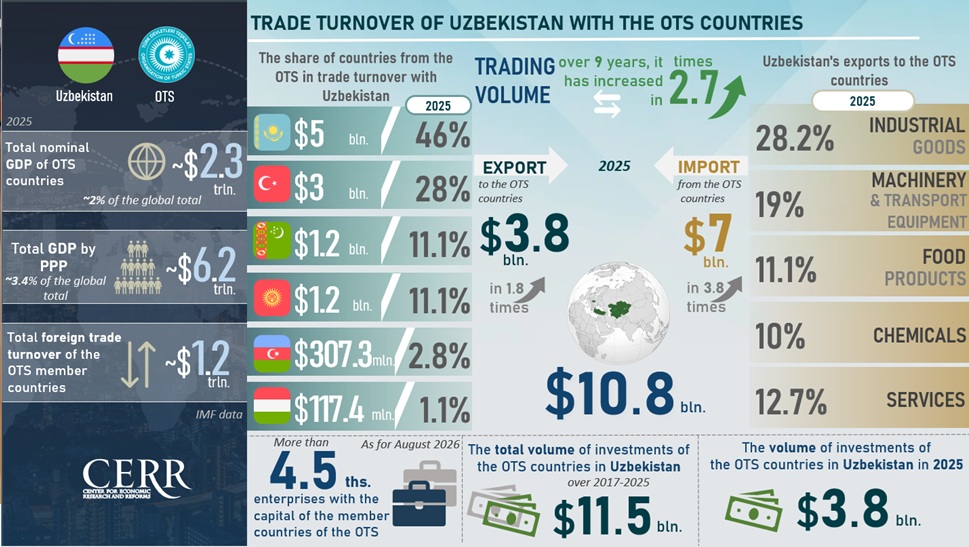
Uzbekistan has moved its economic cooperation with the Turkic states into a practical dimension
Ahead of the 13th Summit of the Organization of Turkic States, scheduled to be held in Ankara, economic cooperation within the OTS is acquiring new substance.
Water security in the turkic world: shared interests and common solutions
Water is a precious blessing that transcends national borders and has long connected peoples and civilizations.

Strengthening Transport Connectivity in Asia through the Development of the Trans-Caspian International Transport Corridor
Shifting international supply chains and expanding trade in Asia are driving demand for sustainable transport routes. For businesses, predictable delivery times, competitive rates, and reliable access to foreign markets are becoming increasingly important.