
New Uzbekistan: from constitutional reforms to constitutional stability
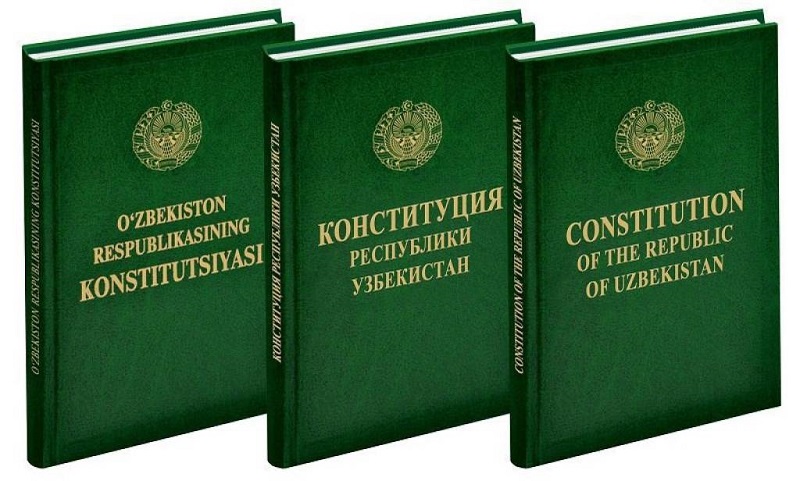
2025 is the year of anniversaries
2025the year turned out to be busy memorableand anniversary dates.It is very noteworthy that this year marks the 80th anniversary of the United Nations and the 50th anniversary of the CSCE Helsinki Act. At the 80th anniversary session of the General Assembly, the international community reaffirmed the need to transform the work of the UN - identifying opportunities for increased effectiveness, reviewing the implementation of mandates and exploring potential structural changes and realignment of programs.
In 2025, the global community celebrates the 60th anniversary of the adoption of the first binding legal treaty on human rights, the Convention on the Elimination of All Forms of Racial discrimination, as well as the 30th anniversary of the Beijing Platform and the Program of Action for Women, which laid the foundation for the gender dimension of the social and political life of our time.
Human rights are an indicator of the progress of modern civilization. Unfortunately, the socio-economic crises occurring in the world, tariff wars, climate change, food security leave their mark on issues of human rights, implementation of the Agenda in the field of sustainable development for the period until 2030.
Today, New Uzbekistan is confidently following the path of irreversible democratic reforms, implementing a pragmatic foreign policy, conducting an open and active dialogue with the world community, and carrying out large-scale reforms in the field of strengthening guarantees for the protection of human rights and freedoms.
XXIcentury: constitutional map of the world
We live in a world of constitutions that are formed in conditions of rapidly changing dynamics and are characterized by significant diversity. Today, constitutions help formnational identity, mitigate social divisions, adapt human life to interaction with machines and artificial intelligence, and cope with natural and man-made crises.
The first quarter of theXXI centuryabecamea a period of rapid constitutional reforms and renewals of constitutions around the world. Here are some statistics: in the 21st century, about60new constitutions were adopted in countries around the world; more than750times parliaments considered amendments to the Constitutions. There are practically no constitutions left in the world that have not undergone changes. In short, modern constitutions strive to meet the demands of globalization and national developments.
Indeed, the possibility of amendment is a fundamental feature of all written constitutions. One of the features of constitutional reforms is the strengthening of national constitutional identity by consolidating fundamental values, first of all, state sovereignty and the territorial integrity of the country, family and childhood.
The stormy constitutional dynamics in the world inevitably require turning to the foundations of constitutional reforms, which, in turn, determines the theoretical understanding of constitutionalism, or, in other words, modern constitutional legal understanding.
Understanding the Constitution presupposes both real action and the application of constitutional norms, that is, “The Constitution in action”. The main goal is to build a constitutional state.
The development of the constitution, in general, always corresponds to the main stages of development of the society and the state itself.
Covering almost all aspects of the development of the state and society, the Constitution defines the most general normative regulation. The Constitution, more often than other laws, including codes, is addressed to society as a whole, social strata, individuals and citizens.
The study of constitutional changes in the world allows us to note a characteristic feature - the need to adapt the Basic Law of the state to the requirements of modernity and its ability to respond to emerging challenges.
XXIcentury: trends in constitutional development world
Responding to the challenges of the global world in one or another area of constitutional regulation, we inevitably come across the general issue of understanding law, especially constitutional legal understanding. The essence of the changes taking place in socio-economic structures, in the socio-political life of each country, one way or another, is reflected in the evolution of constitutional legislation.
The priority trends of modern constitutional development in the world come down to the following:
• the complexity of constitutional reforms. They cover political, economic, social, cultural and humanitarian spheres, as well as the relationships and interdependence of constitutional reforms and modernization processes;
• expanding the scope of constitutional regulation, reforming the mechanism of public administration and changing the form of government;
• developing the constitutional space, strengthening legal sovereignty and determining the constitutional identity of the state;
• expanding the catalog constitutionals human rights and freedoms and strengthening judicial protection of human rights and freedoms
• expanding the powers of constitutional justice, providing citizens with the right of direct access to the Constitutional Court;
• globalization of constitutional law-making, consolidating generally accepted principles and norms of international law in national constitutions states of the world;
• greening of constitutional development of the state and society, implementation of the principle of accessibility of quality medical care;
• consolidation and development of digital rights, institutionalization of the information society, legal regulation of cybersecurity;
• internationalization of constitutional development, strengthening the influence of international law.
In the modern world, the Constitution is one of the key factors in ensuring the political and social stability of the state, sustainable development of civil society.
Modern constitutions go beyond the simple creation and regulation of relations between government institutions, and the definition of procedural processes. They have gone through a process of humanization, giving a central role to individuals and groups, by including a bill of rights and fundamental freedoms as one of the fundamental elements of the constitution. The success of constitutional reforms largely depends on the support they receive from various sectors of society.
Features of the Constitution of New Uzbekistan
The United Nationsnotes that “Constitution development is a sovereign national processand that to ensure success, this process must be led and implemented by countries themselves. There is no “one size fits all” constitutional modelor process, and that national ownership must include the participation of government agencies, political parties, civil society and the general public.
It is thebroad participation of the peoplein the process of recent constitutional changes in Uzbekistan that isthe first distinguishing feature of these reforms The changes were developed after an open and free public discussion, which ensured broad public participation and meaningful debate.
The second featureis the constitutional and legal status of human rights bodies. In accordance with the Paris Principles, recommendations of the Vienna Declaration and Program of Action, national human rights institutions have been created in Uzbekistan.
Uzbekistan has become the fourth country(after Mexico, Morocco, Egypt) in the world to have secured the constitutional status of national human rights institutions.
The third featureis strengthening guarantees for the effective protection of human rights and freedoms. As is known, the Vienna Declaration and Program of Action in the field of human rights recommended that each state adopt national plans of action in the field of human rights. Today, more than 150 national plans (strategies) in the field of human rights have been adopted in 80 countries of the world.
Since 2020, Uzbekistan has been implementing the National Strategy for Human Rights,which also included issues of introducing the institution of constitutional complaint, expanding the subjects of initiating issues in the Constitutional Court.
Currently, a new Strategy until 2030 is under development year, where the priority will be the protection of fundamental rights taking into account the norms of the new Constitution.
The fourth feature is the important importance of forming a culture of constitutional consciousness citizens. Within the framework of the UN World Program for Human Rights Education measures have been taken in the field of human rights education in educational institutions.
It is no coincidence that at theSixth Congress of the World Conference of Constitutional Courtsin Madridin October 2025, participants called forthe formation of a culture of constitutionalismin which judicial decisions are faithfully implemented and judicial criticism remains constructive. It is transparency, accountability and dialogue with institutions and civil society that strengthen, rather than weaken, the independence of the judiciary.
The Constitutional Court of the Republic of Uzbekistan is 30 years old
This year the Constitutional Court of the Republic of Uzbekistan celebrates its thirtieth anniversary. I would like to note that back in 1990, 35 years ago, the first law on constitutional supervision was adopted in the Republic of Uzbekistan, and the Constitutional Supervision Committee was created.
Over the years of its existence, the Constitutional Court has shaped the practice of constitutional justice. At the same time, this practice is in constant development, which suggests that the legal system does not stand still and develops along with other socio-political processes and institutions.
In light of the thirtieth anniversary of the Constitutional Court, it is worth noting those changes to the Constitutional Law “On the Constitutional Court”, the foundation of which was laidby the constitutional reform of 2023. The main thing is that the amendments affecting the status of the Constitutional Court and issues of process are based on taking into account many years of national practice and positive international experience.
Thus, as a result of the changes made, the approach to the admissibility of accepting a complaint for proceedings is based on the principle of exhaustion, according to which, in order to accept a complaint for proceedings, the applicant will need to exhaust all domestic remedies. Although seemingly ambiguous at first glance and capable of limiting access to constitutional justice, such a decision is actually aimed at improving the quality of the activities of the constitutional control body, ensuring the coherent functioning of the entire judicial system and limiting the occurrence of cases of duplication of functions of the courts.
It should be especially noted that in 2024 the National Center for Human Rights submitted a question to the Constitutional Courtabout giving an interpretation of Article86of the Constitutional Law “On the Constitutional Court of the Republic of Uzbekistan”. The Constitutional Court explained that the day of completion of the consideration of the case in court should be understood as the day of adoption of the last judicial document based on the results of the consideration of the case.
An equally important aspect of the legal status of the Constitutional Court was also the expansion of the scope of its powers, first of all, the court cangive an opinion on the conformity of the Constitution of issues submitted to a referendumof the Republic of Uzbekistan. This right was successfully tested during the constitutional reform of 2023.
Based on thirty years of experience in the activities of the Constitutional Court, it is absolutely fair to conclude that the legal formulas laid down in the Constitution not only have the deepest legal meaning, but are also in constant dynamics.
The Constitutional Court, applying and interpreting the Constitution, reveals not onlythe "letter",but andthe “spirit”of one or another of its provisions at each new stage of development and thereby adapts it to changing relations in society.”
The thirty-year mark is an important stage to sum up the interim result of the development of constitutional justice of New Uzbekistan. The Constitutional Court demonstrates its commitment to the fundamental legal principles laid down in the Constitution, creating and strengthening the legal foundation for the development of the country.
Akmal Saidov,
Director of the National Center
of the Republic of Uzbekistan
on human rights, academician
Related news
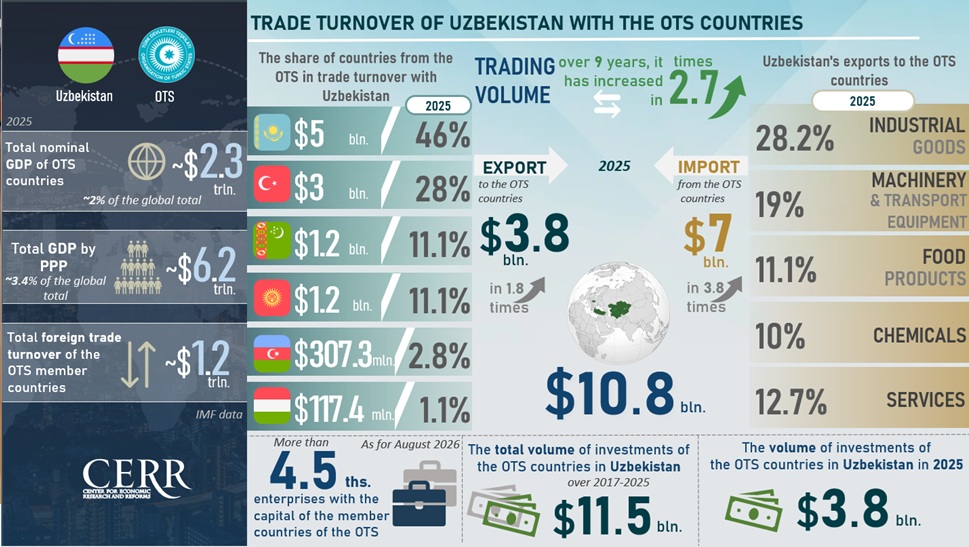
Uzbekistan has moved its economic cooperation with the Turkic states into a practical dimension
Ahead of the 13th Summit of the Organization of Turkic States, scheduled to be held in Ankara, economic cooperation within the OTS is acquiring new substance.
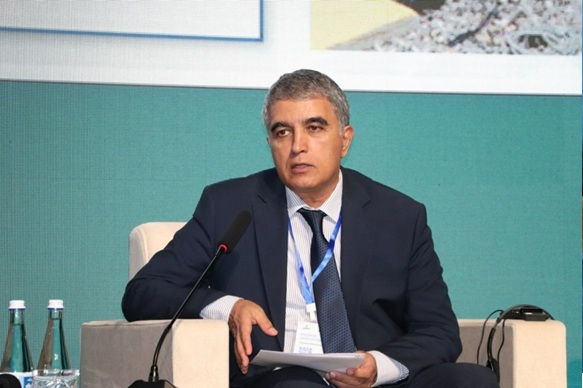
Water security in the turkic world: shared interests and common solutions
Water is a precious blessing that transcends national borders and has long connected peoples and civilizations.

Strengthening Transport Connectivity in Asia through the Development of the Trans-Caspian International Transport Corridor
Shifting international supply chains and expanding trade in Asia are driving demand for sustainable transport routes. For businesses, predictable delivery times, competitive rates, and reliable access to foreign markets are becoming increasingly important.