
How Central Asia is turning geography into power
Central Asia is not geographically adjacent to maritime borders, and everyone knows that Uzbekistan, located in its very center, is one of only two countries in the world passing through the territory of two countries to access the sea.
Located at the center of the crossroads of trade routes during the era of the Great Silk Road, Uzbekistan has a unique opportunity to become an important supplier of logistics for cargo flows between China and Southern Europe, on the one hand, and the Indian subcontinent, the CIS and Northern Europe, on the other hand.
To sell domestic products at competitive global prices, it is necessary to develop additional export trade routes to countries such as China, the countries of the Asia-Pacific region, the Middle East, India and Pakistan. This requires competitive, efficient transport and transit corridors that will allow increasing the volume of transit cargo passing through the Republic of Uzbekistan.
In turn, cooperation in the formation of an extensive transport and communication system will make it possible to fully unleash the transport and transit potential of landlocked countries. According to UN estimates, by 2050 the demand for freight transport in the world will increase 3 times. This trend represents a direct challenge for landlocked countries.
Landlocked countries account for less than 1% of world exports and, accordingly, the share of Central Asian countries in global exports of transport services is very small and is represented in the following proportions: Uzbekistan - 0.1%, Kazakhstan - 0.3%, Tajikistan - 0.007%, Kyrgyzstan - 0.03%.
A limited number of international transport corridors pass through the territory of Uzbekistan. The main countries forming the transit of Uzbekistan are neighboring Afghanistan, Kazakhstan, Tajikistan and Kyrgyzstan and Russia, which is considered an important trading partner for the Central Asian countries.
The transport isolation of the region, undiversified transport routes and limited export supplies mainly in the northern direction, lead to a lack of profit due to the sale of domestic goods mainly to neighboring countries at a fairly low cost.
Transport isolation seriously constrains the economic growth of the countries of our region. The share of costs for transporting goods in the Central Asian states reaches 60% of the final cost of goods, which is almost 5 times higher than the world average - 11%.
However, thanks to the comprehensive and strategically verified policy of the country's leadership in the field of logistics of cargo transportation, Uzbekistan is successfully taking measures to optimize transport routes, develop infrastructure and improve logistics processes. The introduction of modern technologies in both railway and road transport, active cooperation with international transport partners and the creation of favorable conditions for cargo owners contribute to a significant reduction in transport costs.
According to calculations by specialists from the Center for the Study of Transport and Logistics Problems under the Ministry of Transport of the Republic of Uzbekistan, in 2024 the share of transport costs in the cost of national products when imported averaged 11% (in 2022 year - 17%, 2023 - 14%) and 3% for exports (in 2022 - 6%, 2023 - 4%).
In addition, rapid changes in the international situation and growing geopolitical tension require us to join efforts to diversify international transport routes and prevent breaks in the supply chain.
Taking into account the above trends, Uzbekistan has in recent years taken practical measures to form promising and develop existing multimodal transport corridors in the region, such as “China – Central Asia – Caucasus – Europe”, “China – Kyrgyzstan – Uzbekistan – Turkmenistan – Iran – Turkey” and “CIS countries – Uzbekistan – Afghanistan – Pakistan” with access to the Indian Ocean, which will certainly strengthen the transport and logistics potential of the region, developing trade between the countries of Europe, the Caucasus and South Asia.
Today, neighboring countries actively support transport and transit projects of Uzbekistan, the implementation of which will help increase the attractiveness of Central Asia as a transit hub of the international East-West and North-South corridors.
For example, the construction of the railway lines "China - Kyrgyzstan - Uzbekistan", "Uzbekistan - Afghanistan - Pakistan" will provide the shortest routes to the ports of India ocean, connecting South Asia with the markets of Central Asia, China and Europe.
According to experts, the China-Kyrgyzstan-Uzbekistan railway will become the shortest route from China to European countries
and the Middle East. The distance will be reduced to 1000 kilometers, and the delivery time of goods to 10 days.
The construction of the Uzbekistan-Afghanistan-Pakistan railway is another key project of transregional cooperation. This project will connect the South Asian railway system with the Central Asian and Eurasian ones. This railway will create a new paradigm for trade and economic cooperation at the continental level.
As a result of the project, the cost of transporting goods from Pakistan to Uzbekistan, according to preliminary calculations, will decrease by 3 times, and the delivery time will be up to 5 days.
It is important to note that this project should be considered not only from an economic point of view, but also as part of the efforts to achieve peace and economic progress in Afghanistan. By supporting the establishment of Afghanistan as a bridge connecting Central and South Asia, we solve not only socio-economic and transport and communication problems, but also make a significant contribution to ensuring regional security and stability of these regions.
Of course, the corridor through Afghanistan, ensuring interconnectedness between the countries of Central Asia, the CIS and South and Southeast Asia, opens up new opportunities and markets with a population of more than one and a half billion people.
However, the effective functioning of various corridor options is hampered by the lack of uniform Rules for the transportation of goods, a single standard of transportation document that would be used for all types of transport, as well as the lack of digital platforms for providing clients with cargo transportation services remotely from anywhere in the world. All this slows down the transport integration of Asian countries in the context of the development of routes between Central and South Asia and China, on the one hand, and the integration of Asian countries with European communications on the other.
Along with the creation of infrastructure, it is important to combine efforts to harmonize and digitalize procedures for customs clearance of goods and border crossings, which will have a positive impact on deepening our transport interconnectedness.
The transition to electronic data exchange in order to simplify cargo transportation is especially important for landlocked countries, as it allows for the development of land routes and improved access to seaports and world markets.
In this direction, I would like to note that since 2012, Uzbekistan has been consistently working to digitalize the TIR system in the field of international road transport. This led to Uzbekistan becoming the first country in Central Asia to implement TIR-EPD, Real-Time SafeTIR, AskTIRweb technologies and one of the first countries in the world to start testing electronic guarantee technology.
In December 2022, the first e-TIR transportation took place in full compliance with the 11th Annex to the TIR Convention between Uzbekistan and Azerbaijan. Pilot projects of “digital TIR” with Kazakhstan, Kyrgyzstan and Tajikistan have also been successfully implemented, which allows vehicles with cargo to freely cross country borders. In the near future, it is planned to introduce this system with Turkmenistan.
In 2021, a project for the electronic exchange of permit forms based on the E-PERMIT digital platform was implemented for the first time between Uzbekistan and Turkey. Uzbekistan, together with Turkey, Kazakhstan and Azerbaijan, have completely switched to the electronic exchange of permit forms and have begun to implement this system with other countries.
In recent years, Uzbekistan has managed to make significant progress in strengthening regional cooperation. This allows us to set new ambitious goals - establishing closer ties within the framework of regional cooperation.
A striking example is the Protocol of a multilateral meeting of relevant ministries in the field of transport between four countries (Uzbekistan, Turkmenistan, Iran and Turkey), signed in November 2023 in the city of Tashkent of the Republic of Uzbekistan within the framework of the ECO ministerial meeting and aimed at forming an international multimodal corridor between Asia and Europe through “Uzbekistan - Turkmenistan – Iran – Turkey.”
In addition, Turkmenistan and Uzbekistan are trying to fully utilize the potential of the Turkmenbashi International Seaport and the international multimodal route “countries of the Asia-Pacific region (APR) – China – Kyrgyzstan – Ubekistan – Turkmenistan – Azerbaijan – Georgia – Europe” within the framework of the Protocol between the heads of the railway administrations of Uzbekistan, Kyrgyzstan, Turkmenistan, Azerbaijan, Georgia and Turkey.
During the first half of this year, the volume of export-import cargo transportation of the Republic of Uzbekistan through the Caspian Sea (in the direction of Turkey, Europe, South America, Africa and other regions) amounted to about 500 thousand tons, which is 7% more compared to the same period last year. At the same time, the bulk of traffic was transported through the territory of Turkmenistan - 84%, the share of the route through Kazakhstan was 16%.
This indicates the importance of the transit corridor through Turkmenistan, providing sustainable and effective logistics connections with western and southern markets.
We all understand that the relevance of interaction increases significantly in the context of global geopolitical turbulence, disruptions in trade and transport and logistics chains, as well as worsening food security problems, where transport plays a major connecting role.
In such conditions, it is important to strengthen joint work to find new ways and mechanisms of cooperation, as well as promote common and mutually beneficial goals.
Taking this into account, in order to further increase the transport potential of landlocked countries, we believe it is necessary to coordinate efforts in the following areas:
Firstly,accelerating the implementation of the Uzbekistan-Afghanistan-Pakistan railway construction project. By creating a unified railway infrastructure of the CIS countries with the countries of South Asia (Afghanistan, Pakistan, India, Bangladesh), this project allows, without additional costs, to ensure the rapid transportation of goods along the North-South corridor, connecting the largest markets of South Asia with the markets of the CIS countries and Europe.
Secondly,the formation of a new UN agenda with an emphasis on digital transformation of international transport, aimed at developing global uniform standards for digital documentation for cargo transportation, supporting cross-border digital corridors and the sustainability of global supply chains using digital tools.
Thirdlyinvolving landlocked countries in the draft UN Convention on Trade Documents for the Modernization and Development of Goods, completed on July 14, 2025 digitalization of global trade.
The new draft UN Convention addresses the legal gap in international trade by establishing a harmonized legal framework for negotiable documents of title in all modes of transport - air, road, rail and sea - regardless of the different modes of transport used to transport goods.
This will allow landlocked countries to more fully participate in global trade and build a more efficient, sustainable and digital trade ecosystem.
Fourth,the creation of an effective containerization system for international transport in landlocked countries will significantly reduce transport costs and delivery times of goods, increasing the competitiveness of these countries in global markets and accelerate their integration into global supply chains.
Thus, according to the 2023 Logistics Performance Index (LPI) published by the World Bank, the average delivery time from the arrival of cargo at the port of an exporting country to leaving the port of an importing country takes 44 days, which is about 60% of all international trade time.
Use of containerization when combined with digital technologies, it can reduce delays at ports by up to 70%, significantly increasing the timeliness and reliability of deliveries.
Fifthly,increasing the level of education and developing knowledge sharing are key resources for the growth of any country.
To this end, it is necessary to make joint efforts to create a platform for the exchange of experience and knowledge in the field of digitalization of logistics and international trade, which will help landlocked countries introduce best practices and innovations, accelerating their economic growth.
Dildora Ibragimova
Head of Department, Center for Study
Problems of Transport and Logistics Development
under the Ministry of Transport of the Republic of Uzbekistan
Related news
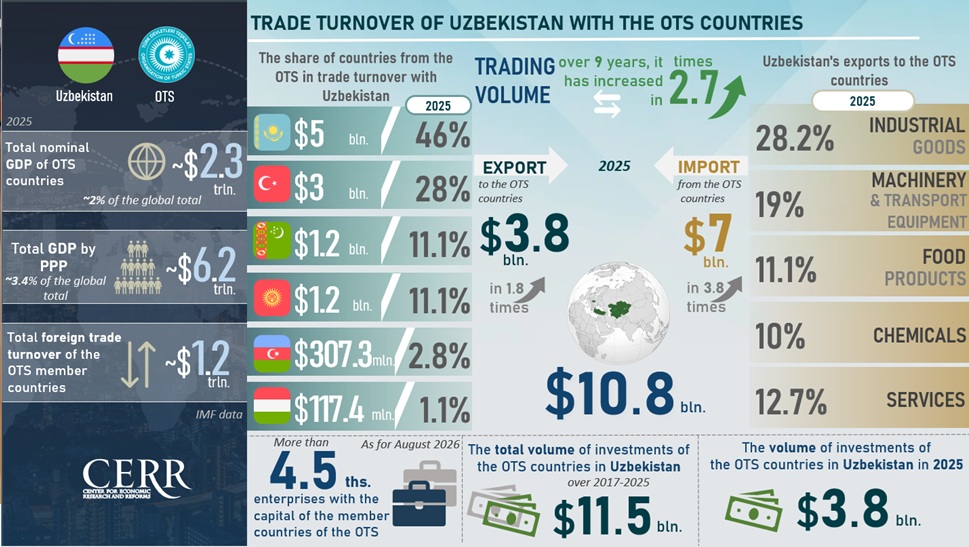
Uzbekistan has moved its economic cooperation with the Turkic states into a practical dimension
Ahead of the 13th Summit of the Organization of Turkic States, scheduled to be held in Ankara, economic cooperation within the OTS is acquiring new substance.
Water security in the turkic world: shared interests and common solutions
Water is a precious blessing that transcends national borders and has long connected peoples and civilizations.

Strengthening Transport Connectivity in Asia through the Development of the Trans-Caspian International Transport Corridor
Shifting international supply chains and expanding trade in Asia are driving demand for sustainable transport routes. For businesses, predictable delivery times, competitive rates, and reliable access to foreign markets are becoming increasingly important.