
Central and South Asia: common trade, economic, historical, cultural and civilizational space

The Termez Dialogue on the interconnectedness of the regions of Central and South Asia is planned to be held from May 19 to May 21, 2025 on the topic: “Building a common space peace, friendship and prosperity." The main goal of the Termez Dialogue is to strengthen interconnectedness between the regions of Central and South Asia. This format is aimed at discussing current issues, such as strengthening cooperation between Central and South Asia in ensuring security, stability and sustainable development, expanding the role of the private sector and financial structures in deepening interregional interconnectedness and ensuring economic growth.
In the context of the observed crises in the modern international system, characterized by the growth of traditional and non-traditional threats to peace and security, deepening interregional ties, strengthening interstate political trust and developing joint cooperation in countering common challenges are tasks that are equally relevant for all countries of the two regions. Therefore, the Termez Dialogue acquires special significance and relevance for Central and South Asia.
The great philosopher and historian Ibn Khaldun once said: “Geography is destiny.” Centuries have passed, but these words still have not lost their significance and relevance. By the will of history and due to its geographical location, Uzbekistan found itself deprived of direct access to world sea routes. It is obvious that the nearest sea routes pass through the territory of our southern neighbor, Afghanistan, which has been engulfed in wars and conflicts for many years.
During the time of our great ancestor Zakhiriddin Babur and his descendants, 13 trade caravans passed along the southern routes. The restoration of historical ties with the Indian subcontinent, the development of trade and economic cooperation, as well as the creation of new transport corridors are among the priorities of the foreign policy strategy of modern Uzbekistan.
As the President of the Republic of Uzbekistan Shavkat Mirziyoyev noted: “Today the world has entered an era of global geopolitical transformations, bringing both challenges and new opportunities. In these conditions, the revival of mutual ties between Central and South Asia, where about two billion people live today, is becoming an even more relevant and objective process. I think that the time has come, based on the enormous historical, scientific, spiritual and cultural heritage of our peoples, the complementarity of our economies, and the presence of intellectual potential, to consolidate our joint efforts, which will undoubtedly give a powerful synergy effect. We recognize that interconnectedness, cooperation, dialogue and, most importantly, trust are the driving force for ensuring stability and sustainable development, improving the living standards and well-being of the people of our regions. This approach is the call of the time.”
Afghanistan is an interregional transport bridge connecting Central Asia with South Asia, the Middle and Far East. The closest seaports to the Central Asian region pass through the territory of Afghanistan. In this context, the launch of the Trans-Afghan transport corridor is of strategic importance for Uzbekistan. Uzbekistan’s access to sea ports through Afghanistan is 2–3 times shorter than through the ports of the Black and Baltic Seas, and 5 times shorter than routes to the ports of the Pacific Ocean.
According to analytical data, 60% of all international transport in Uzbekistan passes through transit routes through the countries of Central Asia and Afghanistan. In terms of shares of transit routes: 69% falls on Kazakhstan and Turkmenistan, 21% on Tajikistan, 6% on Kyrgyzstan and 4% on Afghanistan. In the future, Uzbekistan is able to create favorable conditions and opportunities for bringing Central Asian countries to international markets through the territory of Afghanistan. In this regard, the opening of the international Trans-Afghan corridor will serve as the basis for expanding interregional trade dialogue. In particular, Uzbekistan will gain access to world markets through the ports of Iran, Pakistan and India, which will open up new opportunities for realizing the enormous transit potential of the entire region.
Today, Uzbekistan provides significant support for the economic recovery of Afghanistan.
It was Uzbekistan that went down in history as the country that built the first railway on the territory of Afghanistan - the line "Hairatan - Mazar-i-Sharif", commissioned in 2010. This railway was put into operation ahead of schedule - 11 months. Since its launch, over 20 million tons of cargo have been transported along this route, of which about 5.5 million tons were export goods from Uzbekistan.
According to the Asian Development Bank, thanks to the construction of this railway, 1,200 permanent jobs were created in Afghanistan, employment in the regions where the project was implemented increased by more than 10%, and more than 7 million people gained access to railway services. services. In addition, cargo delivery times have been halved, and the volume of trade between Uzbekistan and Afghanistan has increased from $520 million in 2008 to more than $1 billion in 2012. During the same period, Afghanistan's total foreign trade grew from $3.5 billion in 2008 to $6.8 billion.
According to experts, Hairatan is Afghanistan's main land and river port, through which about 50% of the country's imports pass. And today this railway remains the main route connecting Uzbekistan with Afghanistan and ensuring the delivery of humanitarian goods. In this context, the city of Termez is of particular importance.
One of the issues that will be discussed during the Termez dialogue will be the deepening of cooperation on the implementation of the initiative to build the Termez - Mazar-i-Sharif - Kabul - Peshawar railway (Kabul Corridor), which is a continuation of the Hairaton - Mazar-i-Sharif line and is considered as one of the key projects of the Trans-Afghan transport corridor.
To date, the route of the Kabul Corridor railway in the direction “Termez – Naibabad – Logar – Kharlachi” has been formed, and a “road map” has been developed for coordinating the project between Uzbekistan, Afghanistan and Pakistan. Experts evaluate this railway as the “project of the century” and the “gateway” to the sea routes of South Asia. Indeed, the successful implementation of this project will open up opportunities comparable to historical proportions.
Nevertheless, it is no secret that the project faces a number of obstacles. Thus, according to data for 2024, trade turnover between the two regions barely exceeds $5 billion. Obviously, this figure does not reflect the full potential and real capabilities of the two regions. In this regard, it is important to emphasize the following aspects of the significance of the Kabul Corridor:
Firstly, the corridor will contribute to solving a number of socio-economic problems and will also help eliminate the social basis of destructive phenomena such as terrorism and drug trafficking. If you carefully examine the project, it becomes obvious that it will not only connect the central cities and provinces of Afghanistan, but will also give a powerful impetus to the development of the country's production and industrial infrastructure, which is currently in decline. The project will help reduce unemployment (create up to 500 thousand jobs), fight poverty, and eliminate electricity shortages. In addition, the construction of the Mazar-i-Sharif - Torkham highway will speed up the completion of the Kabul Ring Road project.
Secondly, this railway will occupy an important place not only in the development of regional, but also international economic and political relations. According to experts, the Kabul Corridor will contribute to the expansion of trade, growth of exports and imports between Europe, Central Asia, Pakistan, India and the countries of Southeast Asia. In the context of a slowdown in global economic growth, the implementation of this project will not only be a catalyst for regional development, but also a new source of incentives for global economic growth.
Thirdly, the project will connect all member states of the Shanghai Cooperation Organization (SCO) through the territory of Afghanistan. Geographically, this will provide access for Russia and Central Asia to the markets of India and Pakistan, and for India and Pakistan to access the markets of Central Asia, Russia and Europe.
Fourth, the corridor will open up opportunities for Uzbekistan to gain access to the nearest seaports. The commissioning of this railway will contribute to the diversification of trade and economic ties, transport and logistics ties, and will allow us to break out of transport isolation.
It is obvious that the Termez dialogue will become the necessary platform for discussing and resolving a number of problems standing in the way of the implementation of Trans-Afghan Transport Corridor projects aimed at South Asia. Conducting the Termez Dialogue with the participation of political, economic and business circles creates conditions for a comprehensive discussion of trade, economic, investment, transport, logistics and energy projects, as well as to facilitate their financing.
If we look at history, Termez has long been a crossroads of cultures, uniting different peoples, ethnic groups, languages and religions. This city was recognized as the center of Zoroastrianism, Christianity, Islam, Buddhism and other faiths. Archaeological finds in the vicinity of Termez, in particular the ancient city of Dalverzintepa, indicate that this territory was the cradle of various peoples and cultures. According to scientists, the first capital of the Kushan kingdom was located precisely on the site of Dalverzintepa. The archaeological monuments of the city, especially the jewelry discovered in the Dalverzintepa treasury, clearly demonstrate the high level of cultural and economic ties between the peoples who inhabited the territories of Central Asia, Afghanistan, Pakistan and India in ancient times.
In addition, the city of Termez is the birthplace of outstanding Islamic scientists and thinkers who made a significant contribution to the development of world science and culture, such as Hakim Termizi, Iso Termizi, Sobir Termizi and other universal thinkers. It can be said without exaggeration that today there is a real opportunity to turn Termez into a space that unites various historical civilizations.
Today’s cooperation between the states of Central Asia, their policy of good neighborliness and, most importantly, the atmosphere of mutual trust can rightfully serve as a model for other regions of the world. Indeed, initiated with the aim of restoring historically established and actively developing political, trade, economic, cultural and humanitarian ties with the South Asian region, the Termez Dialogue is intended not only to bring together two common historical, cultural and civilizational spaces, but also to give a powerful impetus to the development of new approaches to ensuring stability and peaceful development in Afghanistan.
Moreover, in the context of increasing geopolitical competition and armed conflicts observed in various regions of the world, the Termez Dialogue creates significant opportunities for developing responses through preventive diplomacy and constructive dialogue to such acute challenges of our time as unpredictable security threats, economic crises, environmental risks and the clash of civilizations.
The essence of Uzbekistan’s strategic approach in foreign policy lies precisely in restoring historical ties between the peoples of the two regions, strengthening interconnectedness and ensuring Central Asia’s access to new markets. This initiative not only fully meets the interests of all the peoples of the region, but also makes a significant contribution to the implementation of the special UN resolution “On the development of connectivity between Central and South Asia”, adopted by the international community.
In general, the regions of Central and South Asia are on the verge of a historical turn. The Termez Dialogue, acting as a platform for strengthening interregional interconnectedness, simultaneously opens up new prospects for restoring common historical, cultural and civilizational ties, as well as for the development of international transport and logistics corridors through the territory of Afghanistan.
In the context of the growing crisis of diplomacy and trust in the modern world, initiatives like the Termez Dialogue are acquiring exceptional importance and relevance. After all, the development of regions should not be based on conflicts and rivalry, but on mutual understanding, dialogue and close cooperation - and this is a truth that does not require proof.
Sukhrob Buronov
Assistant Professor at Tashkent State University
University of Oriental Studies,
Doctor of Philosophy (PhD) in Political Science
Related news
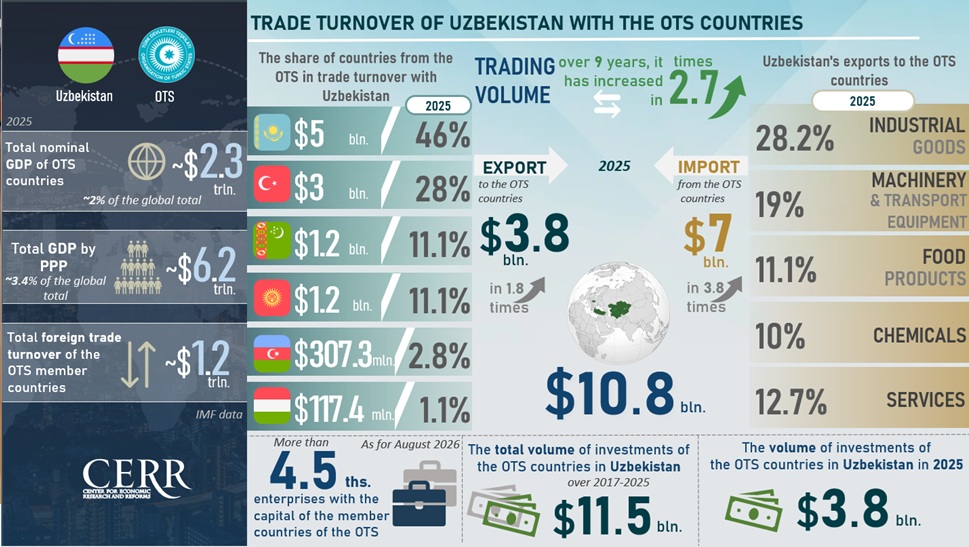
Uzbekistan has moved its economic cooperation with the Turkic states into a practical dimension
Ahead of the 13th Summit of the Organization of Turkic States, scheduled to be held in Ankara, economic cooperation within the OTS is acquiring new substance.
Water security in the turkic world: shared interests and common solutions
Water is a precious blessing that transcends national borders and has long connected peoples and civilizations.

Strengthening Transport Connectivity in Asia through the Development of the Trans-Caspian International Transport Corridor
Shifting international supply chains and expanding trade in Asia are driving demand for sustainable transport routes. For businesses, predictable delivery times, competitive rates, and reliable access to foreign markets are becoming increasingly important.