
What is the strength of cultural diplomacy in New Uzbekistan?

In recent decades, cultural diplomacy has become an important element of the foreign policy of many countries, including Uzbekistan. As a result of these efforts, there is an active expansion of interaction with foreign countries, sincere and respectful relations are being built with international organizations and diplomatic missions, and systematic joint spiritual and educational work has been established.
Our country has an ancient history, rich culture, centuries-old traditions and customs. Using your own cultural potential in foreign policy becomes one of the aspects of creating a positive image of the republic, increasing its authority on the world stage, and also allows you to more quickly solve not only internal, but also foreign policy problems. That is why our country actively uses cultural diplomacy in its foreign policy, which is based on mutual respect, exchange of values, art and traditions. Experts in the field of international relations study call cultural diplomacy a strategic tool that forms long-term contacts between peoples and influences the perception of a country in the world.
International organizations play a special role in promoting cultural diplomacy. Thus, on May 21, an informal summit of the Organization of Turkic States was held in Budapest (Hungary), the agenda of which included issues of strengthening interaction in the field of popularizing the invaluable cultural and historical heritage of the Turkic peoples.
Uzbekistan joined the association in 2019 and since then has regularly taken initiatives not only for political and economic cooperation, but also in the direction of cultural and humanitarian cooperation. Among the important tasks are the preservation and popularization of the Turkic heritage, the promotion of Turkic languages, the support of cultural exchanges and joint events.
It must be emphasized that the basis for the creation and evolution of UTGs is the common language and religion, historical and cultural ties, which allows us to strengthen the voices of countries in the international arena and popularize the values of peoples. It is no coincidence that the priority tasks of the UTG, in addition to strengthening trust and friendship between participants, are the expansion of interaction in the field of science, education, culture and tourism.
Under the auspices of the UTG there are six organizations, two of which act as platforms for the development of cultural and humanitarian ties. This is the International Organization of Turkic Culture (TURKSOY), headquartered in Ankara (Turkey), established on July 12, 1993 with the aim of reviving cultural and humanitarian ties between Turkic-speaking peoples. The organization itself has a scientific and educational orientation and promotes the culture of the Turkic peoples through numerous international projects. TURKSOY celebrates a special contribution to the treasury of culture, declaring every year in memory of one or another outstanding figure of Turkic culture. Among the significant initiatives of the organization is the annual declaration of one of the cities of the participating countries as the cultural capital of the Turkic world. This honorary title has already been awarded to the pearl of our country - Khiva.
Another organization operating under the auspices of the UTC and promoting the cultural agenda is the Turkic Culture and Heritage Foundation, headquartered in Baku (Azerbaijan). Created on the initiative of the Azerbaijani side in August 2012 with the aim of developing projects aimed at the revival, development and promotion of the culture and historical heritage of the Turkic peoples.
Promotion through affiliated structures of the OTG (TURKSOY, TURKPA, International Turkic Academy and the Turkic Culture and Heritage Foundation) of important cultural and humanitarian initiatives of Uzbekistan with an emphasis on the special historical role of the republic in the Turkic world is one of the priority tasks of the foreign policy of our state. And such an active position is not accidental: outstanding scientists and thinkers, writers and theologians lived on the ancient land of Uzbekistan, who made a huge contribution to the development of world civilization. Khorezmi, Ahmad Ferghani, Abu Rayhan Beruni, Ibn Sino, Mirzo Ulugbek and many others left a bright mark on history, and the works of the genius Alisher Navoi to this day serve as a unifying force of the Turkic world.
President Shavkat Mirziyoyev, speaking at the informal summit of the UTG on March 31, 2021, especially emphasized: “Great attention also requires an in-depth study of the invaluable contribution of our peoples to the development of secular sciences and their rich cultural heritage, conducting various studies and popularizing them throughout the world.” Thus, over the six years of participation in the UTC, together with the Secretariat of the organization, Uzbekistan held a number of major events: the international conference “The Role of the Kokand Khanate in the development of statehood and cultural heritage of the Turkic peoples”, the first Forum of Young Entrepreneurs with the participation of over 250 young businessmen from the UTC countries, the IV Forum of Young Leaders in Bukhara, declared the first Youth Capital of the Turkic World. At the initiative of our country, the Alisher Navoi International Prize was established for contribution to unity in the Turkic world.
2022 turned out to be the most active year, when our country hosted more than ten major events, including the First Meeting of Ministers of Agriculture and the Turkic Agricultural Forum. And in December 2023, Uzbekistan held a high-level international conference “Jadids: national identity, ideas of independent statehood.”
Tashkent supports a multifaceted strategy for bringing together the member countries of the UTC, relying on common historical roots and rich cultural heritage, seeking to develop projects in education, innovation and tourism. An example of this is the implementation within the framework of the UTC of such projects as the Union of Turkic Universities and the Orhun Exchange Program. Such initiatives contribute to the growth of academic mobility and strengthening scientific cooperation.
Today, the countries of the association have enormous institutional and practical potential for expanding multifaceted cooperation. In addition, initiatives in the cultural and humanitarian sphere provide an opportunity to demonstrate one’s own achievements and heritage, as well as jointly build a platform for cultural dialogue and knowledge exchange. In turn, the initiatives that Uzbekistan puts forward in the UTC are creative in nature and are not attempts to dominate or build “bloc alliances.” Such a pragmatic and balanced policy of Uzbekistan opens up new dimensions for the development of regional and international cooperation, creating the basis for establishing and developing mutually beneficial relations with foreign partners in the economy, trade, industry, investment and business.
The development of interstate relations within the Organization of Turkic States shows: ethnic, linguistic, and geographical community are a significant basis for the formation of close political, economic and cultural ties. Based on these motivations, the countries of the region strive to establish mutual foreign trade communications as a priority, to provide each other with support in ensuring access to markets, transit and in resolving other issues.
Initiatives put forward by President Shavkat Mirziyoyev at the summits of the Organization of Turkic States and aimed at promoting the culture of Uzbekistan, the invaluable heritage of the ancestors, which is the pride of all Turkic world deserve special attention. Thus, the head of our state, speaking about such great poets as Jalaliddin Rumi, Yunus Emro, Yusuf Khos Hajib, Nizami Ganjavi, Magtymguly, Firogi and Boborahim Mashrab, noted: the legacy of these cultural figures is the common spiritual wealth of all Turkic peoples.
And speaking the other day at an informal summit in Budapest, President Shavkat Mirziyoyev emphasized: “Deep study and popularization in the world of the heritage of our great ancestors, who made a huge contribution to world science and culture and are our pride, is an honorable and responsible task for all of us. In an effort to develop science and expand educational opportunities for the younger generation, we have enshrined in the Charter of the Turkic World the high spiritual principle “There is and cannot be any other salvation except knowledge.” The head of state also presented new initiatives. One of them is the opening of the International University of Turkic States in Tashkent. It is expected that leading professors and scientists from Turkic states will operate at the university, which will be a worthy contribution to increasing intellectual potential and creating new opportunities for young people.
It is important to understand that over the past decades the global cultural palette has greatly transformed, and therefore the demand for the development of cultural and humanitarian ties has increased. In a global community that is in conflict on a number of economic and political fronts, it is culture that has the greatest potential for bridging differences, increasing mutual understanding and improving international relations. Promoting the principles of cultural diplomacy is important for strengthening ties between countries and global sustainable development, contributes to the preservation and promotion of heritage, exchange of experience and knowledge, as well as the creation of new opportunities for creative development and mutual understanding.
Ranokhon Tursunova,
Assistant Professor at UWED, Doctor of Historical Sciences
Saodat Gladkikh,
independent researcher at the Coordination and Methodological
Center for Contemporary History of Uzbekistan at the Academy of Sciences of the Republic of Uzbekistan
Related news
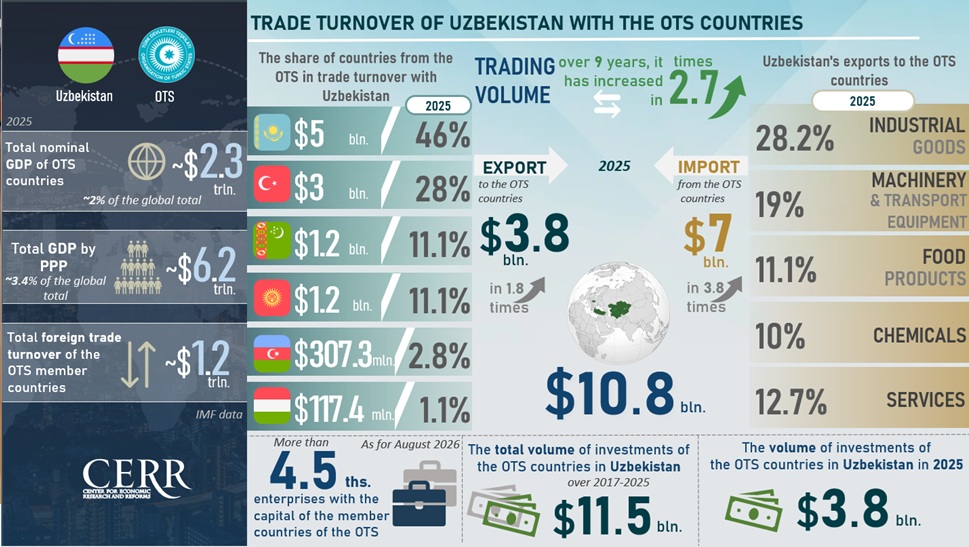
Uzbekistan has moved its economic cooperation with the Turkic states into a practical dimension
Ahead of the 13th Summit of the Organization of Turkic States, scheduled to be held in Ankara, economic cooperation within the OTS is acquiring new substance.
Water security in the turkic world: shared interests and common solutions
Water is a precious blessing that transcends national borders and has long connected peoples and civilizations.

Strengthening Transport Connectivity in Asia through the Development of the Trans-Caspian International Transport Corridor
Shifting international supply chains and expanding trade in Asia are driving demand for sustainable transport routes. For businesses, predictable delivery times, competitive rates, and reliable access to foreign markets are becoming increasingly important.