
Uzbekistan: from a vulnerable position to economic leadership in the region
In a world where geography often dictates economic destiny, Uzbekistan - one of the few double landlocked countries - demonstrates that limited location is not a death sentence. On the contrary, Uzbekistan is turning its Central Asian location into a strategic advantage, opening doors to international business, creating B2B interaction platforms and attracting billions of dollars in investment.
Geography as a challenge - and as a strategy
Being landlocked complicates logistics, increases the cost of exports and imports, and also requires development of multilateral transport routes. Instead of isolation, Uzbekistan is relying on international cooperation and diplomatic activity. Under the leadership of President Shavkat Mirziyoyev, the country has become a dynamic investment platform, actively integrating into global value chains.
In recent years, Uzbekistan has been turning this geographical challenge into an economic advantage - through an active foreign economic policy, large-scale investment diplomacy and a proactive approach to organizing business forums and B2B platforms.
Uzbekistan: an outpost of B2B diplomacy in Central Asia
In recent years, Uzbekistan has become an active initiator of major international business forums, summit meetings, regular B2B and G2B negotiations. These events become key points of convergence between Uzbek companies and foreign investors, creating the basis for joint ventures, direct investments and technology transfer.
Systemic work aimed at diversifying trade and economic ties and strengthening the investment climate has acquired a new scale within the framework of international visits of the country's leadership. During visits, for example, to the UAE, Turkey, Hungary, France, Germany, China, Azerbaijan, Saudi Arabia, Kazakhstan and other countries, dozens of business forums, round tables and B2B meetings were held with the participation of leading global companies - from ACWA Power and Masdar to Huawei, BYD and Saudi Aramco.
On these platforms, not only prospects were discussed, but also real agreements were concluded, joint working groups were created and projects were launched in energy, transport, pharmaceuticals, digital economy and logistics. These meetings became living proof of how targeted B2B diplomacy can be transformed into sustainable investment flows and technology transfer.
Climax: Tashkent International Investment, June 2025
Meetings with representatives were held at the event, which brought together more than 3,000 participants from 97 countries global corporations: Boeing, Visa, NASDAQ, Air Products, Morgan Stanley, Coca-Cola, Franklin Templeton, ACWA Power, Masdar, Total Energies, Linde, DataVolt, Veon, Meta, John Deere, SpaceX, EDF, Goldwind, Çalik Holding, Çengiz Holding. These companies represent leaders in aviation, financial technology, green energy, digital solutions and infrastructure.
The head of the EBRD Odile Renaud-Basso, the NDB Dilma Rousseff, 450 high-ranking guests, of which more than 300 were government representatives, took part.
In April 2025 in The EU-Central Asia Summit was held in Samarkand - a $13.2 billion package of investments in green energy and logistics was signed.
A number of bilateral forums were held: from South Asia to Europe, including: in Pakistan with the participation of Al Rafique Enterprises, Mehran Dates, Brighto Chemicals, FWO, Pakistan Mobile, TCS, Silk Way, Getz Pharm. Projects in the agricultural industry, logistics, and telecommunications were discussed.
In the UAE, they took part in Abu Dhabi Sustainability Week - priorities for green transformation of the economy were outlined. Masdar has become the flagship partner of Uzbekistan in the field of hydrogen energy, solar power plants and environmental technologies.
In Saudi Arabia in June 2025 - within the framework of the Foreign Investors Council, cooperation with ACWA Power, which is implementing billion-dollar projects in Karakalpakstan and Jizzakh, was deepened.
Accepted in Hungary Investment plan in the IT sector and digital economy.
In Vietnam, the organization of a business exhibition in Hanoi was discussed with an emphasis on industrial cooperation in textiles, electrical engineering and agricultural production.
Forums were also held with business circles in Japan (210 participants), Indonesia, Malaysia, Italy (forums on technical education, transport, textiles), Azerbaijan (SOCAR, PASHA Holding, Global Textile), Afghanistan (more than 1000 businessmen, 75 companies), Kyrgyzstan - over 100 companies held negotiations.
Investment results: from words to deeds
Results of the first half of 2025 years have become convincing confirmation of the effectiveness of this strategy. As part of the implementation of the State Investment Program, it was planned to absorb $18.7 billion in foreign investment, but actually attracted $20.99 billion, which is 135% higher than the same period last year. Of this, $18.8 billion was foreign direct investment, and another $2.2 billion was funds from international financial institutions.
Among the leading industries: energy (+106%), geology (1.7 times growth), road infrastructure (also 1.7 times growth) and healthcare (2 times growth). Successes are observed not only in Tashkent ($1.7 billion, an increase of 2.4 times), but also in the regions: Namangan region - $626.6 million, Navoi region - $358 million, Fergana region - $446 million, etc.
Particular attention is paid to investments in the regions of Uzbekistan: Karmana, Mirzo-Ulugbek, Almazar, Yunusabad and other districts have reached the mark of more than $200 million in disbursed funds. International partnerships also demonstrate serious dynamics: China – $7.6 billion, Turkey – $1.6 billion, UAE – $719 million, etc.
One of the clear results of the B2B format was the commissioning of 30 large facilities worth $2.5 billion with the creation of more than 3,200 jobs. The largest projects were the foundry and rolling complex of Uzmetkombinat JSC in Bekabad ($834 million) and the Mingyuan Silu Industry glass production in Jizzakh ($70 million).
Regional investment program: development with a human face
Investment expansion also extends to regions. Direct negotiations and B2B meetings with the participation of local authorities and investors have become an important tool for identifying local potential. As part of the approved State Regional Investment Program for 2025, it is planned to implement 8,012 projects worth $13.4 billion with the creation of 272.1 thousand jobs.
During the first half of the year, 3,464 projects worth $2.2 billion have already been introduced, providing 77.2 thousand jobs. More than 1,000 of them were implemented ahead of schedule. Among them: Terry Hot Textiles in Kasansay ($26.5 million, 650 jobs), VBM Fabrics in Andijan ($41 million, 500 jobs), Hiang Young Group in Kagan ($20 million, 300 jobs).
In the second half of the year, it is planned to launch more than 4,900 projects worth $11.6 billion with the creation of 210 thousand jobs. Among them are the UzAgroLogistic Centers logistics center in the Andijan region ($87.4 million, 1,200 places), the Terra Tex yarn production enterprise in Balikchi ($79 million, 1,500 places), and the Kumtex Invest textile cluster in Kumkurgan ($57.2 million, 860 places).
Geopolitics of logistics: diversification of transport corridors
The development of alternative transport routes is of particular importance for Uzbekistan as a landlocked country. In this context, the country is relying on the expansion and diversification of transport corridors: through Iran, Turkmenistan, Azerbaijan and the Caucasus to the ports of the Persian Gulf and the Black Sea, as well as through China and Kazakhstan to East Asian and European markets.
Multimodal logistics centers, dry ports and railway lines are being designed and developed, including within the framework of the Trans-Caspian International initiative transport route (TITR), as well as "China - Kyrgyzstan - Uzbekistan".
Conclusion
Uzbekistan, taking advantage of its geographical location, is strengthening direct interaction with key players in the fields of energy and ecology: Masdar, ACWA Power, Goldwind, Total Energies, Linde are investing in "green" energy, RES, RES and hydrogen solutions.
In the field of digital transformation: DataVolt, Veon, Meta, Visa, NASDAQ and IT Park - create the basis for digital platforms and ecosystems.
In infrastructure and logistics: John Deere, Çalik, Çengiz, SOCAR discuss railways, agricultural technology, industrial infrastructure.
The country actively uses B2B tools- Uzbekistan has created a sustainable model of investment cooperation through forums, G2B, B2B and meetings with investors, integrating business into the diplomatic agenda.
Uses geography as a fulcrum - the country uses its position for development transit corridors: China–CA–Europe, Iran–Turkmenistan–Caspian Sea, initiating projects of “dry ports” and multimodal hubs.
Focus on sustainability and innovation - investments are concentrated in strategic sectors: energy, IT, industry, healthcare.
The path chosen Uzbekistan, proves that even countries with limited geography and transit vulnerability can become points of growth. A skillful combination of strategic planning, investment diplomacy and direct B2B interaction allows the republic to implement large-scale projects, transform regions and integrate into global production chains. Uzbekistan offers an example of a new model - from a vulnerable position to economic leadership in the region. This is a challenge that has become an opportunity. And this is the main lesson for other landlocked developing countries.
IA “Dunyo”
Related news
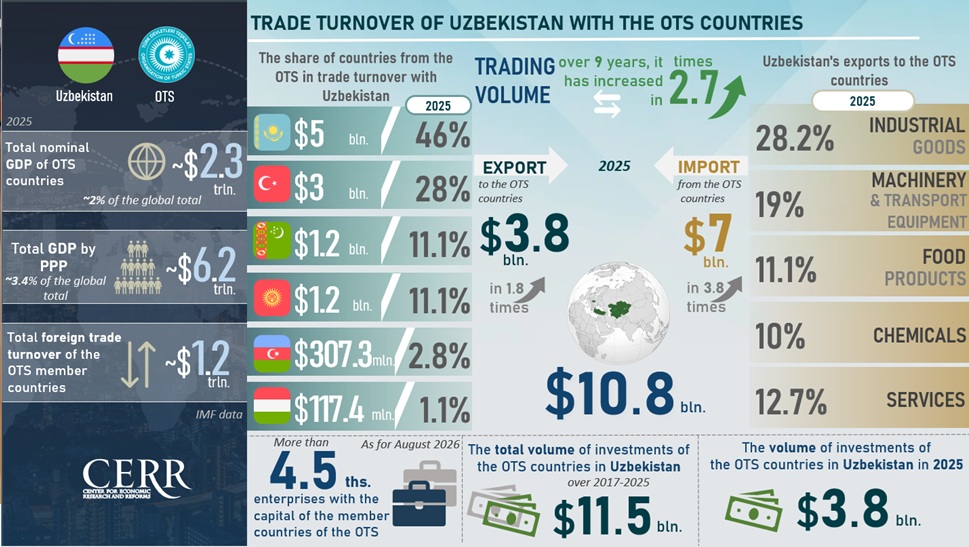
Uzbekistan has moved its economic cooperation with the Turkic states into a practical dimension
Ahead of the 13th Summit of the Organization of Turkic States, scheduled to be held in Ankara, economic cooperation within the OTS is acquiring new substance.
Water security in the turkic world: shared interests and common solutions
Water is a precious blessing that transcends national borders and has long connected peoples and civilizations.

Strengthening Transport Connectivity in Asia through the Development of the Trans-Caspian International Transport Corridor
Shifting international supply chains and expanding trade in Asia are driving demand for sustainable transport routes. For businesses, predictable delivery times, competitive rates, and reliable access to foreign markets are becoming increasingly important.