
Trans-Caspian route and the SCO: the strengthening role and prospects of Uzbekistan
In the context of global changes in world trade and logistics, Central Asian countries are becoming key links in the formation of new transport routes. Of particular importance among them is the Trans-Caspian route, which connects China, Central Asia, the Caspian Sea, the Caucasus and beyond to Europe.
Located in the heart of Central Asia, Uzbekistan is transforming from a state historically dependent on its northern neighbors into a key hub of new transcontinental corridors.
Two main elements define this transformation process: active participation in the Shanghai Cooperation Organization (SCO) and the strategic importance of the Trans-Caspian route. Their synergy creates unique opportunities to strengthen the regional and international status of Uzbekistan.
For Uzbekistan, the route through the Trans-Caspian route opens up an additional logistics route leading to Turkey through the ports of the Caspian Sea and the countries of the South Caucasus. Further, it provides access to European markets, expanding the geography of trade.
In recent years, Uzbekistan has been actively taking practical steps to develop new and modernize existing land and multimodal transport corridors covering the entire Eurasian region.
Among the most promising projects is the construction of railways in China - Kyrgyzstan - Uzbekistan and Uzbekistan - Afghanistan - Pakistan.
In the context of the integration of the Trans-Caspian route with the SCO infrastructure, the basis is being formed for the creation of a new network of multimodal transport corridors covering the entire Eurasian continent.
It should be noted that the key addition
to the Trans-Caspian corridor for Uzbekistan is theTrans-Afghan railway project (Uzbekistan - Afghanistan - Pakistan).
Complementarity of the two directions (Trans-Caspian
and Trans-Afghan) will allow the country to turn into a real “transport hub” of the region, connecting East and West, North and South.
Among them, the following directions can be distinguished:
"Countries of South Asia - Afghanistan - Central Asia - South Caucasus (Black Sea ports) - European Union
"China - Central Asia - Caucasus - Europe."
At the SCO summit held in 2024the year, the President of the Republic of Uzbekistan Shavkat Mirziyoyev, speaking at a meeting of leaders in Astana, noted the need to form a holistic and interconnected transport and transit system, as well as the relevance of further development of economic cooperation in harmonization of transport and logistics projects.
As a result of reforms aimed at developing the Trans-Caspian route, the volume of cargo transported between Uzbekistan and Europe across the Caspian Sea over the past 5 years has increased by 4 fold.
For the first half of 2025 of the year the volume of export-import cargo transportation of the Republic of Uzbekistan through the Caspian Sea
(towards Turkey, Europe, South America, Africa
and other regions) amounted to about500thousand. tons, which is 7% more
compared to the same period last year.
The Shanghai Cooperation Organization, which unites the giants China and Russia, as well as the Central Asian states, India, Pakistan and Iran, is an ideal platform for Uzbekistan to promote its transport initiatives.
In order to further develop trade and economic ties and increase the competitiveness of national transport corridors, the Ministry of Transport of the Republic of Uzbekistan is implementing a set of practical development measures international land transport routes, namely, "China - Kyrgyzstan - Uzbekistan - Turkmenistan - Iran - Turkey" with access to European ports with a length of 5,430 km.
This direction is one of the most promising transport corridors using land modes of transport. The route has a developed railway infrastructure, which makes it possible to organize the delivery of goods from the city of Kashgar (PRC) to Turkey by rail with access to European countries.
In addition, in addition to the classic routes through Turkmenistan and Kazakhstan, alternative connections with Iran, Pakistan and southern ports are being developed.
Underway work to create our own fleet on the Caspian Sea, which will speed up the delivery of goods and gain control over the logistics chain.
A special role is given to digital integration, namely, the introduction of electronic transport documents, unification of customs procedures, which can radically reduce delays and bureaucracy.
The Trans-Caspian route has significant potential for the development of transportation, but its attractiveness compared to other directions is hampered by a set of obstacles associated with multimodality and due to insufficiently developed infrastructure.
The SCO, in turn, offers the political platform, security mechanisms and funding potential necessary for the implementation of ambitious projects.
Successful synergy of these two areas will not only strengthen the economic sovereignty and prosperity of Uzbekistan, but will also take it to a qualitatively new level - from a regional player to a significant subject of Eurasian politics and economics, largely determining the future of Central Asia.
Ildar Yaushev,
Chief specialist of the Department
Center for the Study of Problems
Development of Transport and Logistics
Ministry of Transport of Uzbekistan
Related news
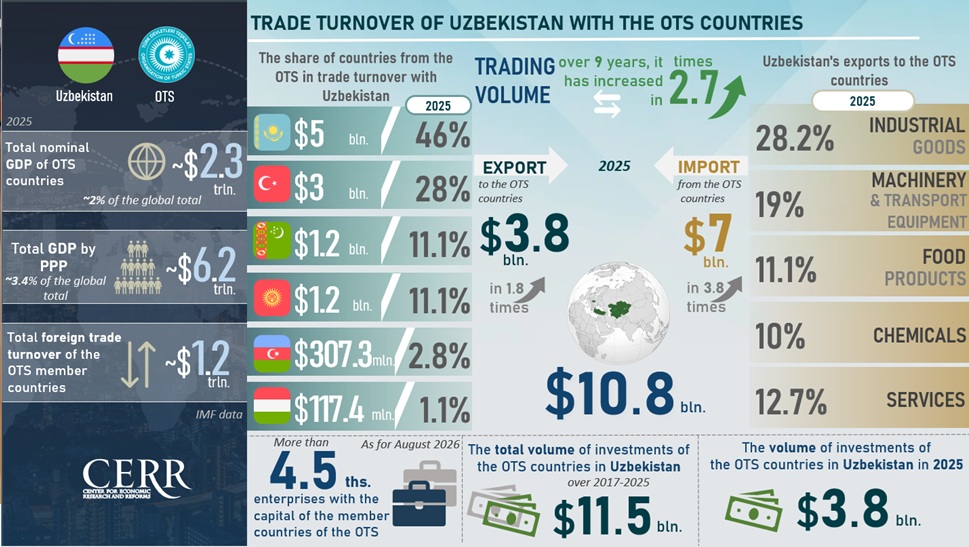
Uzbekistan has moved its economic cooperation with the Turkic states into a practical dimension
Ahead of the 13th Summit of the Organization of Turkic States, scheduled to be held in Ankara, economic cooperation within the OTS is acquiring new substance.
Water security in the turkic world: shared interests and common solutions
Water is a precious blessing that transcends national borders and has long connected peoples and civilizations.

Strengthening Transport Connectivity in Asia through the Development of the Trans-Caspian International Transport Corridor
Shifting international supply chains and expanding trade in Asia are driving demand for sustainable transport routes. For businesses, predictable delivery times, competitive rates, and reliable access to foreign markets are becoming increasingly important.