
Termez platform - dialogue in the name of ensuring security and stability in Central and South Asia

For centuries, Central and South Asia have been closely connected through trade, cultural and political processes. Geographical proximity and ancient trade routes contributed to an active dialogue between peoples and civilizations, the exchange of goods and culture, and the formation of a common historical and cultural image of the region. With the acquisition of independence, the Central Asian states gradually began to build their own foreign policy and economic strategies in relation to South Asia.
Given the importance of Central and South Asia, determined by their strategic location, wealth of natural resources, demographic potential and historical heritage, these regions are the subject of scientific research. Thus, from the point of view of the regional security complex, scientists consider Central and South Asia as two independent and equal regions. In this context, it is important to highlight the transformation of Afghanistan's role as a key element of the regional security complex, ensuring the interconnectedness and gradual rapprochement of South and Central Asia.
It should be noted that Uzbekistan, located in the heart of Central Asia, plays a key role in ensuring regional security and stability. At the same time, the country, actively promoting constructive foreign policy initiatives aimed at strengthening peace and cooperation in the region, strives to become a bridge between Central and South Asia. Realizing the demand for mutual relations between regions, in July 2021 in Tashkent, on the initiative of the President of the Republic of Uzbekistan Sh.M. Mirziyoyev held a high-level international conference “Central and South Asia: regional interconnectedness. Challenges and Opportunities”, at which it was proposed to develop and submit to the UN General Assembly a draft special resolution “On strengthening the interconnectedness between Central and South Asia”. As a result, in July 2022, UN member states unanimously approved the adoption of this resolution, which was another clear indication of the strengthening of the role and authority of our country in the international arena.
It is necessary to emphasize that the resolution invites states to join forces in combating common challenges and threats to stability and security in Central and South Asia, it is recommended to continue and develop cooperation between regions by expanding transport infrastructure and information and communication technologies, as well as the formation of new international transport corridors that open up convenient, sustainable, commercially viable, inexpensive, accessible, inclusive and safe routes to sea ports.
In these processes, Termez can become a unique platform for connecting two regions, both from the point of view of ensuring regional security and from the point of view of developing trade and economic relations. At the same time, the city of Termez, historically considered one of the centers of dialogue between peoples and civilizations, the development of trade, humanitarian and other ties, has occupied a strategically important position in the region for many centuries. Thus, during the era of the Kushan Empire, Termez was an important cultural center where various civilizations actively interacted. The city acted as a significant transmission hub for Buddhist art and literature, which spread widely throughout Central and South Asia. Moreover, from a geographical point of view, Termez was a connecting link between Central and South Asia. It was also one of the key points on the Great Silk Road, which connected East and West.
At the present stage, Termez serves as a starting point for the implementation of a number of transport and infrastructure projects, such as the Termez - Mazar-i-Sharif - Kabul - Peshawar railway, the Surkhan - Puli-Khumri power lines and others. In general, the significance of the Termez site is as follows:
Firstly, in the context of ensuring regional security and stabilitythe city of Termez has always occupied a central place. After the events of 09/11/2001, the Termez Strategic Air Transport Point was located here, which operated from 2002 to 2015 and provided humanitarian logistics for the International Security Assistance Force in Afghanistan. This experience further strengthened the city's importance as a safe crossing and supply point in times of military instability.
In addition, Termez is actively used as part of Uzbekistan's joint initiatives with international partners to combat terrorism, drug trafficking and cross-border crime. In this context, the “Friendship” bridge, connecting Uzbekistan and Afghanistan, plays an important role in ensuring control not only over the movement of people and goods, but also in monitoring illegal drug trafficking coming from Afghanistan, which is important for maintaining regional security(for example, employees of the Airitom border customs post in the Surkhandarya region in March 2022 stopped an attempt to smuggle a shipment of drugs totaling 154 kg and in February of this year - 612 kg).
At the same time, Termez is considered a platform for constructive resolution of border issues. Thus, from August 22 to 28, 2024, the next meeting of the working groups of the Joint Uzbek-Tajik Demarcation Commission was held in Termez. During the meeting, the continuation of joint work on agreeing on the passage of the project demarcation line of the Uzbek-Tajik state border was discussed, following which a corresponding protocol was signed.
Secondly, the trade, economic and logistic importance of the city of Termez, as the material basis for long-term peace and security in Central and South Asia, is due to its strategic location and modern logistics infrastructure. In particular, in 2022, the Termez Cargo Center terminal received the status of an international multifunctional logistics hub serving cargo flows to Afghanistan and the countries of South Asia. This, in turn, increased its status as an object of international humanitarian infrastructure (since 2025 it has been integrated into the network of UNHCR warehouses) and contributed to the expansion of the geography of humanitarian supplies (in 2022, an air delivery of humanitarian aid to flood victims in Pakistan was carried out from Termez; in 2021-2022, the UNHCR Regional Center for Humanitarian Logistics in Termez sent 217 trucks with basic necessities to Afghanistan). It is noteworthy that the infrastructure of Termez is actively used by international organizations to deliver food and medicine to South Asia, which helps reduce social tensions and prevents the escalation of conflicts caused by humanitarian crises.
In addition, the opening in August 2024 of the Termez International Trade Center, designed to create a favorable business environment and logistics, simplify administrative procedures and create conditions for entrepreneurs, on the one hand, enhances the economic attractiveness of the city, and on the other, stimulates the growth of economic cooperation between Central and South Asia. In this context, it should be noted that on the territory of the Center (with an area of 37 hectares, 500 meters from the border with Afghanistan), where 3 thousand retail outlets are located, a 15-day visa-free regime has been introduced for visitors.
In this direction, Termez is also considered an acceptable platform for conducting bilateral economic relations. So, in March and April of this year. Representatives of the Afghan delegation led by the Minister of Trade N. Azizi and the business community of Balkh province visited the city of Termez, where they held a meeting with the Uzbek side to develop bilateral trade and economic cooperation and expand cooperation in such sectors as agriculture, textile, pharmaceutical, food and mining industries.
Thirdly, the city is of no small importance Termez is considered to have cultural and humanitarian potential. Thus, in 2018, on the initiative of the President of the Republic of Uzbekistan, an educational center for citizens of Afghanistan was created. This educational institution is the only institution in the world that provides training exclusively for Afghans in both 17 areas of higher and 16 secondary specialized and vocational education. During its activities, about 700 citizens of Afghanistan were trained, of which more than 200 were girls.
The institution actively supports international relations and cooperation with donor countries and foreign organizations, such as UNDP, EU, Germany, Slovakia, India. Thus, in January 2023, on the basis of this educational institution, the “EU Knowledge Center” was opened for the education and training of Afghan citizens (this is a co-working space that provides a platform for collaboration, self-learning and establishing professional connections). In general, the creation of an educational center for Afghanistan in Termez will expand access to quality education for citizens of this country, as well as provide an educational environment and technology for professional training.
In summary, Central and South Asia, dynamically developing regions with sustainable economic growth and new development opportunities, have significant potential due to their rich resources, economic complementarity, demographic potential, common challenges and geographical proximity. At the same time, the efforts undertaken by Uzbekistan are aimed at integrating the two regions within a single space of cooperation, security and sustainable development.
In these processes, the Termez Site not only acts as a constructive mechanism for ensuring security and stability in Central and South Asia, but can also become an additional tool for the development of trade, economic and transport links between the regions. At the same time, security issues are considered a promising area of cooperation for both regions, including the fight against terrorism, extremism, drug trafficking, as well as the development of interaction in the fields of transport, tourism and education.
Asliddin Gulamov
ph.p.s. (PhD), Associate Professor
Related news
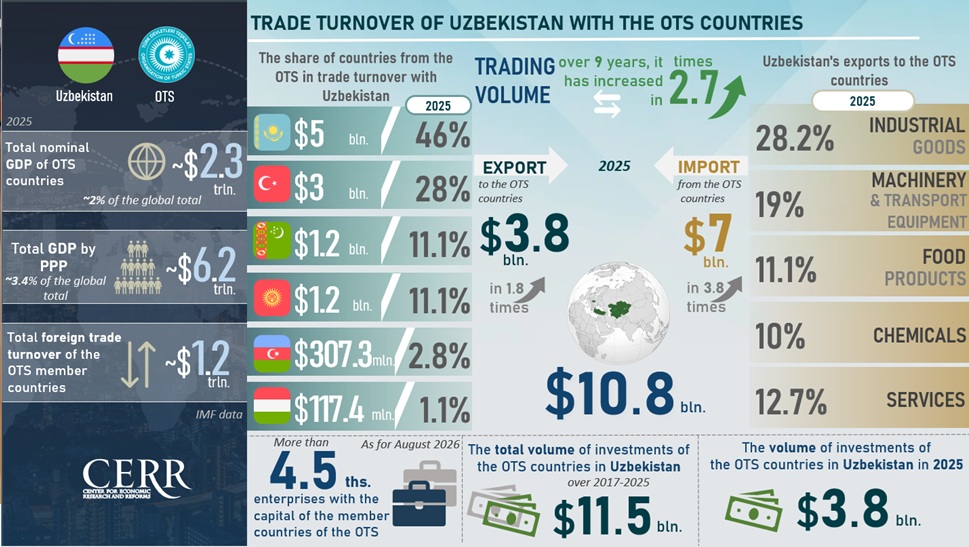
Uzbekistan has moved its economic cooperation with the Turkic states into a practical dimension
Ahead of the 13th Summit of the Organization of Turkic States, scheduled to be held in Ankara, economic cooperation within the OTS is acquiring new substance.
Water security in the turkic world: shared interests and common solutions
Water is a precious blessing that transcends national borders and has long connected peoples and civilizations.

Strengthening Transport Connectivity in Asia through the Development of the Trans-Caspian International Transport Corridor
Shifting international supply chains and expanding trade in Asia are driving demand for sustainable transport routes. For businesses, predictable delivery times, competitive rates, and reliable access to foreign markets are becoming increasingly important.