
Issues of combating corruption and economic offenses and improving compliance control were considered
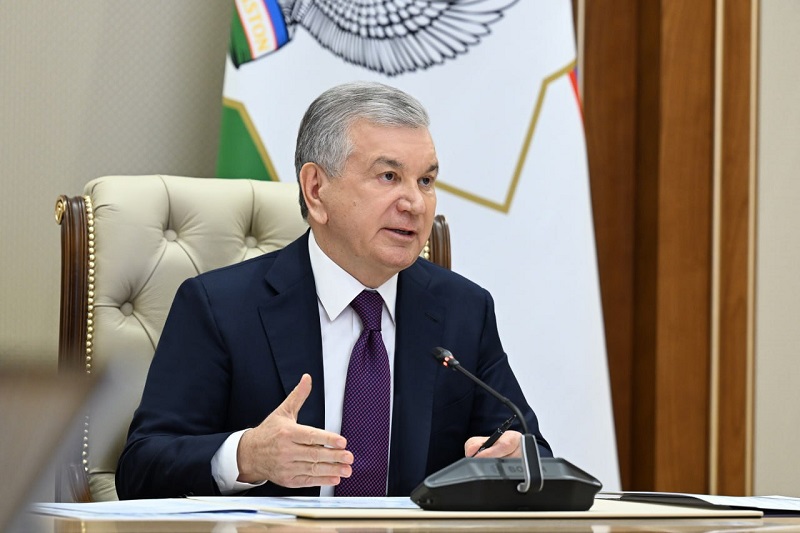
President Shavkat Mirziyoyev on December 10 got acquainted with the presentation on the work being done and further plans to combat corruption, improve and digitalize compliance control.
Corruption is one of the most serious crimes that damages the socio-economic development of societies. No country, region or community is completely protected from this phenomenon. Corruption undermines the development of entrepreneurship, science, education, healthcare and many other areas. A state in which corrupt practices are rooted cannot develop successfully.
From the very beginning of reforms in New Uzbekistan, based on a deep understanding of this threat, extensive work has been consistently carried out to prevent corruption, increase transparency and strengthen public control. The priority of state policy has become the promotion of preventive measures - not only eliminating the consequences, but also preventing the factors and causes of offenses.
It is no coincidence that this topic is being discussed right now: since 2004, at the initiative of the UN, the International Anti-Corruption Day is celebrated annually on December 9. This date serves as an opportunity to assess the effectiveness of the measures taken, analyze practical results and identify new tasks.
It is noted that over the past period the activities of compliance control structures in government bodies have been revised. Internal control units carried out more than 11 thousand inspections and prevented misuse of funds in the amount of 793 billion soums. Financial errors and violations amounting to almost 2 trillion soums were revealed, and 478 billion soums of damages were recovered.
Performance indicators (KPIs) of internal anti-corruption units have been approved. They carried out more than 700 inspections, monitoring and supervisory activities, identified violations worth 354 billion soums and prevented the misuse of about 550 billion soums. 1,397 cases of conflict of interest were established.
26 criminal cases were initiated against officials, 24 were brought to administrative and 148 to disciplinary liability.
It was separately emphasized that an intolerant attitude is consistently being formed in the healthcare systems, preschool and school education, cadastre, construction, as well as among civil servants to corruption, transparency in personnel policies is ensured and training is provided on special anti-corruption programs.
To take this activity to a new level, it is proposed to create an anti-corruption cluster. This system of interaction will promote close cooperation between the Anti-Corruption Agency, law enforcement agencies, the Accounts Chamber, the State Financial Control Inspectorate, internal control departments of departments, educational and research institutions, NGOs and the unification of their efforts.
Within the cluster, it is planned to exchange information, conduct joint events, monitor and evaluate results, which will create a holistic ecosystem and increase efficiency work.
During the presentation, special attention was also paid to digitalization and the introduction of artificial intelligence technologies.
Based on the integration of databases of various departments, it is planned to create a Risk Analysis Center to automatically identify corruption threats and cases of affiliation in public procurement. Plans are presented to completely digitalize the work of compliance departments and increase the efficiency of identifying risk factors.
The need to strengthen public control in decision-making is emphasized. In this regard, it was instructed to strengthen control over the open publication of documents in the E-qaror system and expand the possibilities of public control over the use of budget funds.
The importance of expanding the scope and effectiveness of preventive measures was separately noted.
It was proposed to create project offices involved in eliminating factors contributing to corruption. It was emphasized that work should be carried out primarily in areas with a high level of corruption crimes and bureaucracy, a large number of citizen requests and a low degree of digitalization. Based on the results of the activities of such offices, a report will be prepared and presented to the public.
It is noted that it is important to more actively involve the population in the process of fighting corruption: to expand initiative groups for monitoring the implementation of investment projects, to ensure the participation of community activists in monitoring construction work.
To stimulate complaints about facts of corruption, it is proposed to introduce mechanisms for issuing a protective order to informants and real encouragement. The establishment of a badge “For contribution to the fight against corruption” was initiated.
The President was also provided with information on measures taken to eliminate abuses in the administration of value added tax and combat economic offenses in various areas. Instructions were given to reduce the human factor and further transition to full automation of VAT accounting.
Responsible persons are instructed to pay attention to eliminating not only the consequences, but also the causes of economic offenses, to expand digitalization, remote control and international cooperation.
The need to strengthen prevention, increase financial and legal literacy, including through media resources, and constantly improve legislation in order to eliminate legal gaps that create conditions for violations is emphasized.
Related news
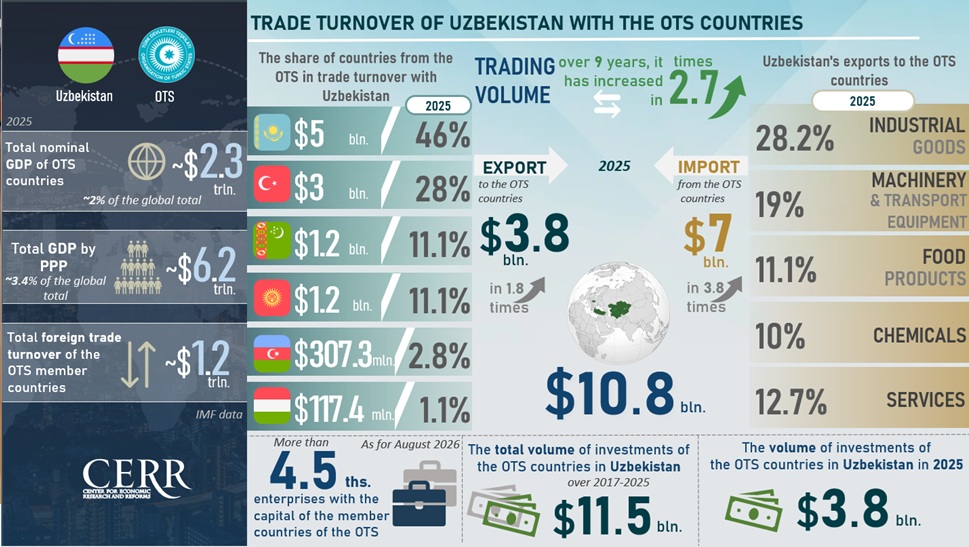
Uzbekistan has moved its economic cooperation with the Turkic states into a practical dimension
Ahead of the 13th Summit of the Organization of Turkic States, scheduled to be held in Ankara, economic cooperation within the OTS is acquiring new substance.
Water security in the turkic world: shared interests and common solutions
Water is a precious blessing that transcends national borders and has long connected peoples and civilizations.

Strengthening Transport Connectivity in Asia through the Development of the Trans-Caspian International Transport Corridor
Shifting international supply chains and expanding trade in Asia are driving demand for sustainable transport routes. For businesses, predictable delivery times, competitive rates, and reliable access to foreign markets are becoming increasingly important.