
Priority tasks for reducing poverty and ensuring employment have been identified
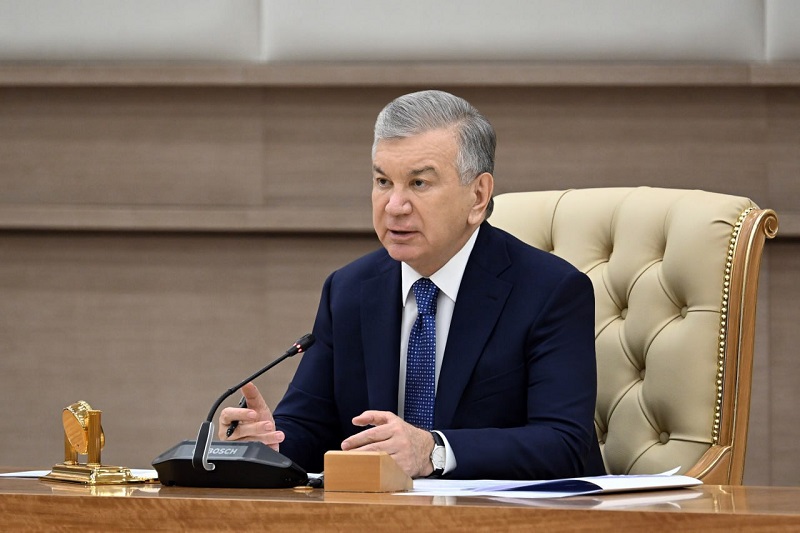
Under the chairmanship of President Shavkat Mirziyoyev, a video conference meeting was held on November 19, dedicated to summing up the work and priorities for the next year to reduce poverty and ensure employment population.
As noted, over the past period, the material and technical capabilities of regional and district khokims, as well as their employees, have been radically improved so that they properly organize this work at the grassroots level, identify new initiatives by visiting each mahalla and thereby improve people's lives.
Since the beginning of this year, the unemployment rate has decreased to 4.9 percent (last year this figure was 5.5 percent). In particular, in the cities of Bukhara, Kagan, Navoi, Zarafshan, Gazgan, Samarkand and Shirin, unemployment dropped below 4 percent, approaching the level of natural unemployment for the first time.
302 thousand needy families came out of poverty. It is expected that by the end of the year the poverty level will drop to 6 percent (from 8.9 percent last year).
In Khavast, Mirzaabad, Akaltyn, Dustlik, Pakhtakor, Farish, Bustan, Vabkent, Mirishkor, Mingbulak, Uzun and Pskent regions, the number of low-income families has decreased by up to 4.5 times. Previously, 105 thousand families who were in a difficult situation began to receive income.
This year, for the first time, 1,435 mahallas turned into “territories free from poverty.”
At the same time, they will criticize the fact that some district khokims, having significant resources and means, left this work to chance, did not provide people with ready-made projects, corresponding to their capabilities.
In this regard, it was decided to dismiss the khokim of the Denau region and his first deputy, the khokim of the Chirakchi region and his first deputy, and in relation to another 20 district khokims to take appropriate measures in the prescribed manner.
In general, since the beginning of the year, 261 responsible employees have been dismissed for irresponsible implementation of plans to reduce poverty and ensure employment, and in disciplinary action was taken against another 492 individuals.
It was emphasized that next year the main task of those responsible will be to reduce poverty and unemployment to less than 4.5 percent. For this purpose, 450 trillion soums of loans will be directed to the economy, of which 140 trillion soums are intended for small and medium-sized projects at the mahalla level.
The head of our state has identified the main directions for organizing work in this area.
The first is ensuring employment and income of the population through the construction sector.
Next year in the country It is planned to implement investment projects worth 675 trillion soums, of which 380 trillion soums are in the construction sector. It is planned to build multi-storey buildings with 140 thousand apartments.
It is noted that each khokim, effectively using these opportunities, can provide employment for at least 20-25 thousand people directly in the construction industry and about 10 thousand more people through the created infrastructure.
The main innovation is for the first time in 2026 20 trillion soums, intended for the development of mahalla infrastructure will be allocated directly to regional budgets.
The second direction is to increase the number of projects in the service sector to ensure employment.
It is emphasized that this sector provides high growth rates in our country. At the same time, it is indicated that the khokims of regions and districts do not fully use the opportunities of tourism, which has a significant impact on the dynamics of the service sector, to create jobs and increase the income of the population.
By improving the infrastructure of 150 mahallas with high tourism potential, it is possible to increase the volume of services to 10 trillion soums and employ 45 thousand people in the trade and service sector.
Thus, next year each of the 150 mahallas will be allocated from 3 to 5 billion soums for infrastructure development. District banks will allocate preferential loans of up to 150 million soums for the construction of guest houses in these settlements.
The importance of increasing the incomes of families in border and enclave areas by repairing roads leading to them, building guest houses, recreation centers, trade and service facilities there was emphasized. It was ordered to allocate 1 trillion soums for the implementation of projects for the construction of recreational facilities and services in these settlements.
In addition, 500 settlements were selected for the development of services along rivers and roads. District banks will provide loans in the amount of up to 1 billion soums for the implementation of projects in such places, subject to the creation of at least 5 permanent jobs.
This year alone, 255 24-hour streets were put into operation. They enabled 11 thousand service sector facilities to operate and provided employment for about 27 thousand residents. Next year it is planned to create 200 more such streets.
The khokims were allocated up to 4 billion soums for each street, provided that they create a clear “road map” and begin work within a month.
Enterprises that have created their own brands in the areas of public catering, trade and services intend to open 100-150 branches throughout the republic.
Regional khokimiyats have been instructed to assist national brands in this matter. If these companies express their willingness to independently train employees for the new branch that is opening, the costs for this will be covered from the Employment Fund. To support brands that want to expand their branches, new financial instruments will be introduced, for which 500 billion soums will be allocated in 2026.
The third direction is to increase the number of permanent jobs through the implementation of industrial projects.
Next year, regional enterprises plan to produce industrial products worth $52 billion. It was noted that responsible persons must implement 3.5 thousand projects worth $22 billion in local industries, which will create 130 thousand permanent jobs.
Currently, 400 mahallas specialize in furniture production, crafts and clothing. If entrepreneurs are provided with additional space, each will be able to employ 5-10 more people.
In this regard, district khokims have been instructed to open 50 micro-industrial centers in such specialized mahallas next year, providing employment for 10 thousand people. 200 billion soums will be allocated for the infrastructure of these centers.
The fourth direction is increasing the population's income through agriculture.
As part of poverty reduction, 232 thousand hectares of land were allocated to the population, thanks to which 770 thousand people received a source of income. However, a third of them have low income due to a lack of experience, quality seeds and difficulties in selling products on the market.
In this regard, it was ordered to extend the experience of the School of Homestead Farming of the Termez District to all regions, organizing at least 5 such schools in each in order to train people renting land to grow highly profitable crops. To guarantee the sale of products grown on leased land, export cooperatives will be created.
The fifth direction is strengthening social protection for families in need.
Starting from the new year, the project “Equal Opportunities - Inclusive Employment” will be implemented, within the framework of which it is planned to employ 40 thousand people with disabilities. They will be provided with an interest-free loan of up to 30 million soums from the Employment Fund.
For families at risk of falling back into poverty, social support and benefits will be maintained. For 6 months, they will continue to receive financial assistance and child benefits, reimbursement of expenses for kindergartens and clubs, as well as provide 110 types of social services and assistance for 12 months, including the issuance of referrals for treatment.
In addition, groups of families at high risk of falling into poverty due to a difficult life situation will be identified in advance, with subsequent provision of targeted assistance to them.
Issues of legalization of employment were also raised.
– We are starting to implement major goals with specific financing. If ministers, their territorial administrations and departments, khokims of regions and districts, and, most importantly, the makhalla seven do not actively engage in work, there will be no changes, said the head of our state.
The Prime Minister was instructed to set the tasks determined at the meeting as key performance indicators (KPIs) for ministers and khokims for 2026.
At the meeting, reports were heard from heads of regions and industries, as well as the opinions of entrepreneurs.
Related news
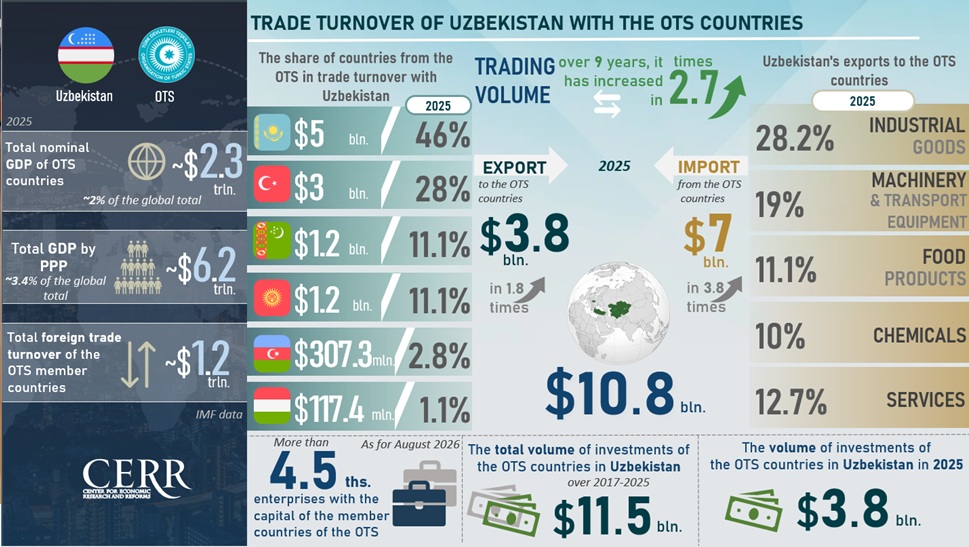
Uzbekistan has moved its economic cooperation with the Turkic states into a practical dimension
Ahead of the 13th Summit of the Organization of Turkic States, scheduled to be held in Ankara, economic cooperation within the OTS is acquiring new substance.
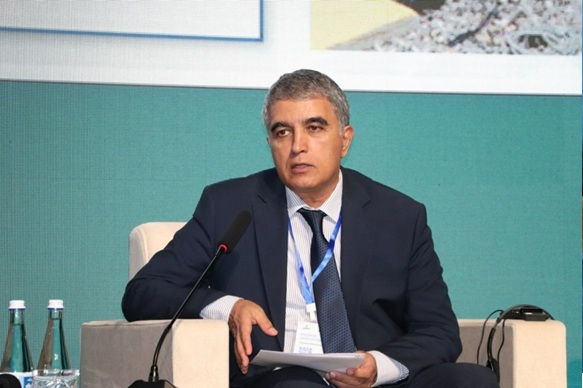
Water security in the turkic world: shared interests and common solutions
Water is a precious blessing that transcends national borders and has long connected peoples and civilizations.

Strengthening Transport Connectivity in Asia through the Development of the Trans-Caspian International Transport Corridor
Shifting international supply chains and expanding trade in Asia are driving demand for sustainable transport routes. For businesses, predictable delivery times, competitive rates, and reliable access to foreign markets are becoming increasingly important.