
New opportunities for the development of local industry have been identified

On May 26, a video conference meeting was held under the chairmanship of the President of the Republic of Uzbekistan Shavkat Mirziyoyev on priority tasks for the development of local industry.
In conditions of global instability, each state first takes measures to protect the industries that provide the largest number of jobs. In our country, such industries include the textile industry, the production of building materials and furniture - they employ almost 1 million citizens.
In the first four months of this year, industrial production in the country increased by 6.3 percent and reached 290 trillion soums. The volume of exports increased by 20 percent and amounted to 6 billion 350 million dollars.
Issues of supporting and developing local industry were discussed at the meeting. An analysis of the current situation by region and industry was carried out, and existing shortcomings were identified.
For example, in the textile industry, almost 7 thousand entrepreneurs produce over 500 types of products. Some of them supply clothing to well-known international brands. However, despite the quality guidelines, many manufacturers cannot officially confirm this. To date, only 244 enterprises have international certificates. Most of them are located in Tashkent and in the regions of the Fergana Valley, in other areas they can be counted on one hand.
According to the Presidential decree adopted in February of this year, the state compensates not only the costs of obtaining international certificates, but also the costs of adapting production to the relevant requirements. Based on this, the task has been set to bring these opportunities to entrepreneurs and increase the number of certified enterprises in each region.
The head of state put forward an important initiative - to create a company in Uzbekistan to support national brands. This structure will involve brand managers, designers and marketers from abroad who will help bring domestic brands to the world market. Products with international certificates and competitive quality will receive a quality mark and be promoted abroad.
Currently, there are no shopping centers in the country where exclusively national goods are sold. In this regard, the construction of “Mall of Uzbekistan” complexes will begin in cities. Shops in these complexes will be leased to entrepreneurs at minimal prices. Such centers will provide a wide choice for buyers and will be convenient for foreign tourists.
In the current difficult situation, deep processing of our own raw materials and increasing added value is of particular importance. In this direction, a factoring system has been introduced for manufacturers of finished products, for which $100 million has been allocated.
Continuing these measures, textile enterprises will be allowed to purchase yarn under factoring conditions in a simplified manner.
Another promising area of local industry is the production of furniture. There are 7.5 thousand enterprises in this sector, of which 920 were created last year alone. Last year, furniture worth 6 trillion 700 billion soums was produced, exports amounted to $20 million.
Domestic entrepreneurs and artisans have the potential to achieve even higher figures. Many people want to move from manual labor to industrial production. In this regard, individual entrepreneurs in the furniture industry will be allowed to hire up to 5 workers.
Young entrepreneurs who want to start or expand their activities in this direction will be issued loans of up to 5 billion soums for a period of 7 years at 18 percent per annum.
In Sharof-Rashidov, Yanginamangan, Pastdargom, Urtachirchik, Kuva, Buvaydin, Yunusabad and Furniture centers will be created in the Uchtepa district based on the experience of the Khankinsky district.
Small business representatives in this area may encounter difficulties when importing materials from abroad. In order to support entrepreneurs, reduce transportation costs and ensure the supply of raw materials at affordable prices, a centralized supply of wood and wood materials will be organized. At the same time, the creation of a monopoly will not be allowed - on the contrary, the choice on the market will expand. Entrepreneurs will be able, at their discretion, to purchase this cheaper wood or raw materials from other suppliers or import them themselves.
For 14 types of raw materials, fittings and accessories, a preferential customs duty of 1 percent will be established for a period of three years.
To stimulate the export activity of furniture makers, the costs of obtaining international certificates will be compensated, as well as 50 percent of the salaries of foreign designers, marketers and production engineers. The amount of compensated rental space at international exhibitions will be increased from 20 to 40 square meters.
Jewelry, which has long been valued in our country, today can become an additional driver of the economy. Last year, production in this industry exceeded $200 million, and exports grew by 17 percent, reaching $92 million. However, even this represents only a small part of the country's potential, where more than 100 tons of gold are mined annually.
In this regard, additional benefits are also provided in the jewelry industry. Jewelers will be able to officially engage in the trade of gold products as individual entrepreneurs.
The costs of attracting foreign specialists in the amount of up to 2.5 thousand dollars will be reimbursed, subject to the training of at least 5 students. The industry also plans to transition to an industrial level of production and support national brands.
Imported equipment and components for jewelry production will be exempt from customs duties. The previously established procedure for purchasing gold in installments from the Navoi and Almalyk mining and metallurgical plants will be extended for another 3 years.
Expenditures of up to 30 thousand dollars for the purchase of designs and shapes from well-known brands will also be compensated. Based on the experience of Turkey, Dubai and Egypt, jewelry centers have already opened in Tashkent, Andijan and Khiva. In the future, similar complexes will be gradually created in other regions.
For a sustainable supply of raw materials, the volume of gold listed on the exchange will increase from 6 to 8 tons. Gold reserves will be created in all regions.
Instructions have been given to reduce the share of the shadow economy in the jewelry industry and stimulate legal activities.
In the context of a large-scale construction boom in the country, high demand for building materials remains. About 10 thousand enterprises operate in this area today. The main objective is to ensure high quality products and their competitiveness.
It was noted that it is necessary to make greater use of local building materials and support this initiative by providing revolving loans to developers.
On the Shaffof Qurilish platform, a register of enterprises producing construction materials will be created, and a quality rating will be introduced.
Reducing production costs is impossible without increasing energy efficiency. In this regard, the need to analyze energy-consuming areas and introduce innovative, cost-effective solutions was emphasized.
At the end of the meeting, proposals from responsible managers and entrepreneurs on the issues discussed were heard.
Official website of the President of the Republic of Uzbekistan
Related news
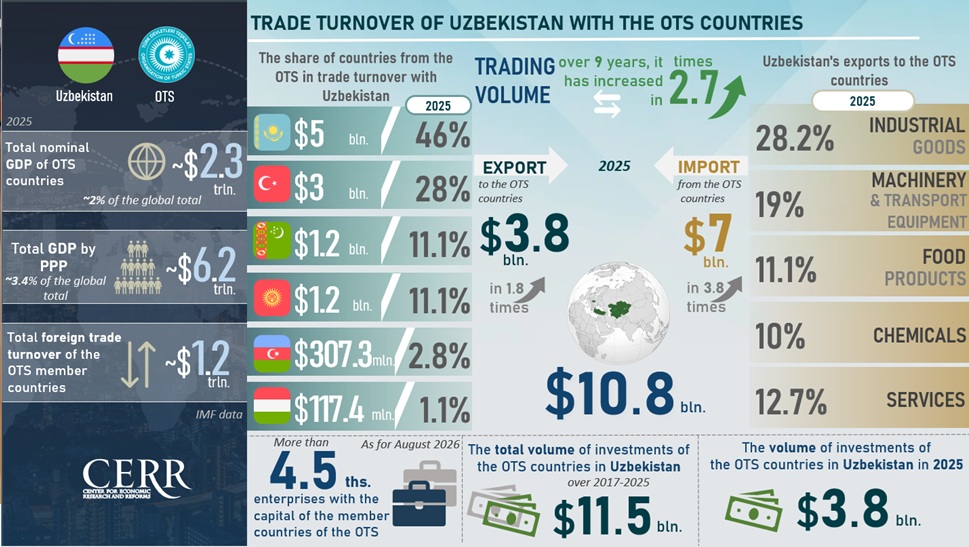
Uzbekistan has moved its economic cooperation with the Turkic states into a practical dimension
Ahead of the 13th Summit of the Organization of Turkic States, scheduled to be held in Ankara, economic cooperation within the OTS is acquiring new substance.
Water security in the turkic world: shared interests and common solutions
Water is a precious blessing that transcends national borders and has long connected peoples and civilizations.

Strengthening Transport Connectivity in Asia through the Development of the Trans-Caspian International Transport Corridor
Shifting international supply chains and expanding trade in Asia are driving demand for sustainable transport routes. For businesses, predictable delivery times, competitive rates, and reliable access to foreign markets are becoming increasingly important.