
New economic agenda of the Turkic world: Uzbekistan sets the strategic vector for the development of UTG
The modern world economy is in a state of deep transformation. Global competition for markets is intensifying, shifts in logistics routes are taking place, and new growth centers are emerging. Against this background, risks and uncertainties are increasing, which requires countries to be flexible and capable of coordinated action.
Under such conditions, regional associations are becoming increasingly important. They become not only political platforms, but also important economic pillars capable of ensuring sustainable development in conditions of instability.
A striking example of the evolution of such an association is the Organization of Turkic States (OTS).Initially focused on cultural and humanitarian cooperation, today it is rapidly transforming into a full-fledged economic community.
This is confirmed by the macroeconomic indicators of the OTS. The combined GDP of member countries reached$2.1 trillionin 2024, and domestic trade grew from$30.9 billion. in 2022 to$45 billion. in 2024. The increase of 45% over two years significantly exceeds the world average and indicates increasing economic integration.
The region of Central Asia makes a particularly noticeable contribution to this growth. Despite the fact that Turkey remains the largest UTG economy, it is Central Asia, and in particular Uzbekistan, that is demonstrating the most dynamic development. In 2024, the economy of Uzbekistan showed steady growth, increasing by6%.
And already in the first quarter of this year. The country's GDP increased by6.8%compared to the same period last year. Key sectors made the greatest contribution to growth: the service sectorincreased by7%, construction - by10.7%, industry - by6.5%.
These indicators emphasize the growing role of Uzbekistan as an engine of economic growth within the framework of the OTG and confirm its readiness not only to demonstrate its own successes, but also forms the strategic agenda of the entire Turkic world, proposing initiativesthat can set a long-term vector of development for the entire association.
At the informal summit of the UTG, held on May 21 of this year. in Budapest, President of Uzbekistan Sh.M. Mirziyoyev proposed to create a Unified Investment Portal - a digital platform that will accumulate information about priority industries, investment projects and available investment opportunities. Such a system will provide transparent and understandable conditions for both domestic and international investors, thereby increasing the overall investment attractiveness of the region.
Developing the topic of investment integration, the Head of State noted that the next step would be the establishment of a joint venture company, focused on supporting start-ups and high-tech projects. This initiative is especially relevant for the countries of Central Asia, where access to long-term capital remains limited.
Venture mechanisms not only allow sharing risks, but also stimulate innovative development - a necessary condition for the transition to the economy of the future.
The growing attractiveness of the region for investors is also confirmed by figures: foreign direct investment in UTG countries in 2023 reached $50 billion, which is 66% higher than in 2017. At the same time, the number of joint ventures almost doubled - from53 thousand. up to 92 thousand., which indicates an increase in trust and closer economic cooperation between countries.
These positive trends are especially noticeable in Uzbekistan: since the beginning of 2024, over 500 new enterprises have been created here with the capital of the UTC member countries, and their total number has reached 4 thousand. – which is 28.8% of all enterprises with foreign participation in the republic.
Industrial cooperation becomes a logical continuation of the investment agenda. Uzbekistan proposed to develop anIndustrial cooperation program for the creation of large production capacitiesin the chemical, energy, mining, light, pharmaceutical, leather and footwear, food and construction industries. This will make it possible to build cross-border production chains, optimizing costs and speeding up project implementation.
According to the UN, cooperative models can reduce pre-production time by 14-20 months and reduce costs by up to 70%compared to stand-alone implementation. This creates not only economic benefits, but also a powerful social effect: new jobs are created, the export potential of the region increases.
Pharmaceutics looks especially promising, where joint ventures can not only meet domestic needs, but also enter foreign markets, including the Middle East and Africa.
The development of industrial cooperation between the UTG countries is highlighted as one of the priority areas in the Strategy for the Development of the Turkic World until 2040. An important tool for this is the Turkic Chamber of Commerce and Industry, which effectively helps strengthen cooperation between entrepreneurs.
However, without the development of modern infrastructure, it is impossible to ensure sustainable industrial and trade interaction. Therefore, the creation of effective transport corridorsEast-WestandNorth-Southbecomes a strategic priority for UTGs. Along with this, it is important to accelerate the implementation of simplified customs procedures that eliminate unnecessary administrative barriers.
In the context of solving these problems, the President of Uzbekistan took the initiative to hold a customs clearance in November of this year. in Tashkent International Forum on Multimodal Transport and Logistics of Turkic States, which will become an important platform for developing coordinated approaches and strengthening industry partnerships.
The forum is especially relevant, given that today cargo transportation between UTG countries faces a number of serious problems - from congestion of existing routes to the lack of modern logistics hubs and service infrastructure.
According to Western experts, reducing customs clearance time by just one day can increase trade turnover by 3–5%. Thus, investment in infrastructure is not just a support for trade, but also the key to accelerated growth of the entire regional economy.
Among the key initiatives voiced by the Head of Uzbekistan, the proposal to adopt a Practical Program for Expanding Trade deserves special attention. Its implementation can significantly enhance the economic dynamics within the UTC, creating additional incentives for expanding trade turnover between the participating states.
An important element of the successful implementation of this program is becoming development of modern digital tools that help simplify and accelerate foreign economic activity.
In this context, the initiative of the President of Uzbekistan on the creation of the online platform “Turk-Trade”, a unified digital platform for trade participants within the UTC, plays a key role. Its goal is to unite manufacturers, investors and buyers into a common ecosystem where it is possible to conclude transactions in real time, track logistics and exchange information.
Such a system is of particular importance for small and medium-sized businesses (SMEs) - the basis of the economies of the Turkic countries. Thanks to digital solutions, SMEs gain access to new markets without significant costs, which increases competitiveness and stimulates entrepreneurial activity.
In generalthe proposals voiced by the Head of Uzbekistan can be considered as the starting point of a large-scale institutional transformation of the Organization. The country is taking on the role of not just an active participant, but an initiator of systemic changesforming a new architecture of regional interaction.
The key elements of this new agenda are an economy based on digital solutions, co-production, modernization of logistics and investment cooperation. All this creates a solid foundation for sustainable, competitive and mutually beneficial growth of the countries of the Turkic world.
The importance and relevance of these initiatives will be confirmed by the upcoming OTG summit, which will be held in early October of this year. in Baku. Here, the heads of state will discuss priority areas of regional cooperation, and for Uzbekistan this will be a special opportunity to promote key initiatives in the areas of digital economy, joint production and investment cooperation.
Shavkat Alimbekov,
leading scientist Fellow
International Institute of Central Asia
Related news
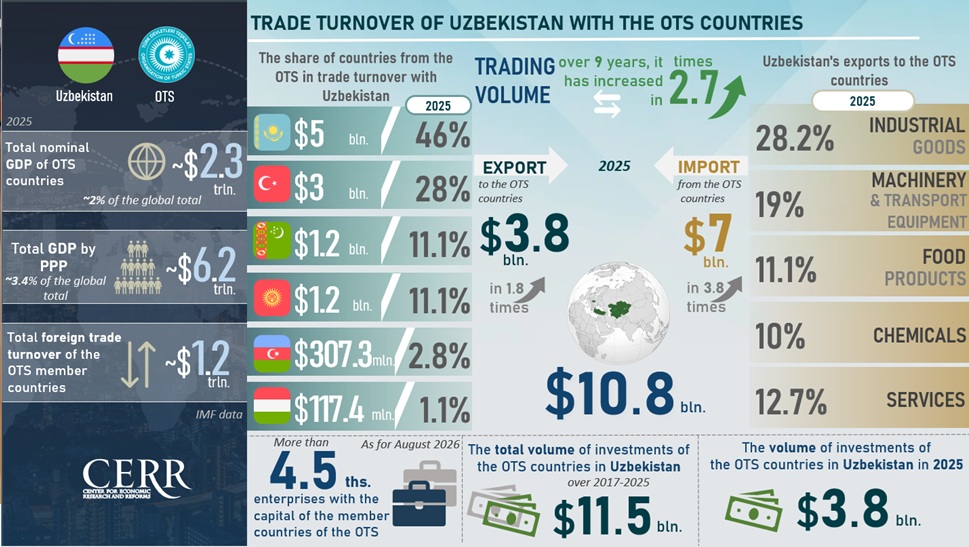
Uzbekistan has moved its economic cooperation with the Turkic states into a practical dimension
Ahead of the 13th Summit of the Organization of Turkic States, scheduled to be held in Ankara, economic cooperation within the OTS is acquiring new substance.
Water security in the turkic world: shared interests and common solutions
Water is a precious blessing that transcends national borders and has long connected peoples and civilizations.

Strengthening Transport Connectivity in Asia through the Development of the Trans-Caspian International Transport Corridor
Shifting international supply chains and expanding trade in Asia are driving demand for sustainable transport routes. For businesses, predictable delivery times, competitive rates, and reliable access to foreign markets are becoming increasingly important.