
New Central Asia and the role of Uzbekistan in regional transformation
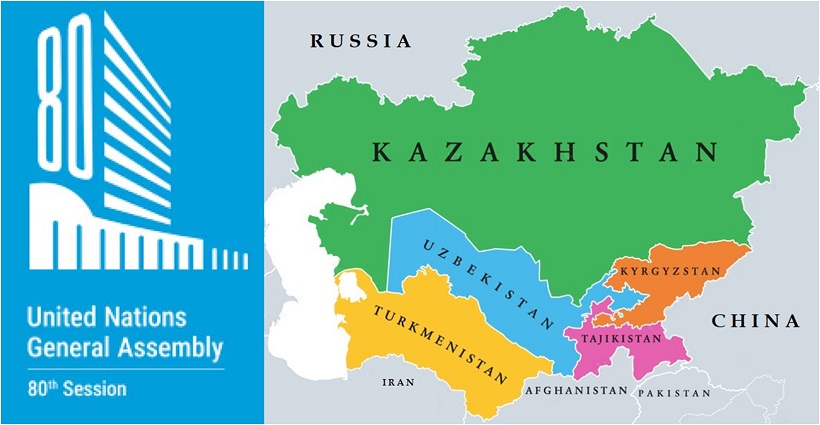
For Uzbekistan, the anniversary session of the General Assembly became not just a diplomatic event, but an opportunity to confirm its new international status - an active participant and initiator of regional and global processes.
Since joining UN in 1992, Uzbekistan has gone from a young independent state to a recognized partner promoting initiatives that meet the interests of the entire region. Today, there are 25 UN offices and agencies in the country, implementing more than 160 projects worth over $175 million. These programs cover key areas - education, health, gender equality, poverty alleviation, sustainable development and digital transformation. All this reflects the gradual strengthening of Uzbekistan’s institutional presence in the UN system and its desire to combine national reforms with international obligations.
2016 was a turning point in foreign policy - the beginning of a new course based on the principles of openness, dialogue and good neighborliness. It was from this time that Tashkent began to formulate its own agenda. President Shavkat Mirziyoyev, speaking at sessions of the UN General Assembly, outlined a strategic goal - to transform Central Asia into an area of sustainable development, mutual trust and partnership.
The first step in this direction was the 2017 Samarkand Conference under the auspices of the UN, which laid the foundation for the concept of the “Samarkand Spirit”. This format, based on the principles of equality, mutual benefit and open discussion of regional issues, became the prototype of a new model of regional interaction. The adopted Conference Communiqué formed the basis of the UN General Assembly resolution “On strengthening regional and international cooperation to ensure peace, stability and sustainable development in Central Asia.” For the first time, the region was presented on the global stage as a single geopolitical space, united by common interests and responsibility for the future.
Since then, Uzbekistan has put forward a number of key international initiatives, enshrined in 13 General Assembly resolutions, most of which directly relate to Central Asia: sustainable tourism, environmental innovation in the Aral Sea region, interconnectedness of Central and South Asia, the fight against drug trafficking and sustainable development. This systemic approach reflects a new vision - a transition from participation to creation, from national policy to regional strategy.
A new stage of diplomatic activity also emerged at the 80th anniversary session of the UN General Assembly. The speech of the President of the Republic of Uzbekistan caused a wide international response, as it contained a comprehensive strategic agenda focused on Central Asia. The head of Uzbekistan emphasized that “the process of forming a new Central Asia has begun in the region - a zone of sustainability, cooperation and responsibility.” Among the initiatives he put forward are the holding, under the auspices of ECOSOC and UNCTAD, of an international forum on the development of the economies of Central Asia, the creation, jointly with UNIDO, of a regional hub on green technologies, the adoption of a program for the rational use of water resources, and the holding of the World Forum on Water Conservation in Uzbekistan. These initiatives are aimed at creating a new infrastructure for regional interaction - technological, environmental and humanitarian.
Particular attention in the speech was paid to strengthening transport connectivity. The President proposed adopting a UN General Assembly resolution on the development of international transport and energy corridors passing through Afghanistan. This approach allows us to consider transport not just as an economic factor, but as a tool for integration and stabilization of the region. Along with this, Uzbekistan took initiatives to create a regional office of the UN Counter-Terrorism Office, establish a World Youth Movement for Peace and hold a World Vocational Education Summit. All these proposals are united by one idea - the formation of a sustainable architecture of the world based on education, humanism and social inclusion.
In parallel with his speech at the General Assembly, President Sh. Mirziyoyev held a meeting with UN Secretary-General Antonio Guterres. The parties noted the unprecedentedly high level of partnership. Separately noted was the preparation of a new five-year Cooperation Program. Uzbekistan has been elected to ECOSOC, the Human Rights Committee and the Statistical Commission, and also actively interacts with UNESCO, UNIDO, UNDP, UNFPA and UNICEF. A. Guterres highly appreciated the speech of our Leader, emphasizing the importance of his initiatives to achieve the Sustainable Development Goals, the development of digital technologies, artificial intelligence, youth policy and enlightened Islam.
Tashkent's regional activity coincided with a change in the geopolitical balance around Central Asia. In the current conditions, Uzbekistan is consistently building multi-vector diplomacy based on the principles of mutual respect and pragmatism. This approach allows international cooperation to be used to strengthen regional resilience rather than increase dependence on external centers of power.
Against this background, Uzbek diplomacy has turned into a model of “smart regionalism” - a policy in which domestic modernization and international activity form a single strategy. Uzbekistan demonstrates that Central Asia can be not an arena of geopolitical rivalry, but a space of synergy and joint development. In essence, we are talking about the region’s transition from the status of an object of interest to the role of an independent participant in the global dialogue.
Sh. Mirziyoyev clearly outlined that without a stable Central Asia, global stability is impossible. Therefore, Uzbekistan is relying not on declarations, but on specific mechanisms - climate, water, transport and humanitarian initiatives, supported by real actions. The creation of the UN Multi-Partner Trust Fund for the Aral Sea region, the development of “green” zones, programs to combat childhood oncology and digital initiatives all reflect the country’s transition from national reforms to international responsibility.
At the same time, Tashkent has consistently promoted the principles of equality and inclusiveness in international relations, advocating for expansion of the UN Security Council so that developing countries receive fairer representation in decision-making processes. This shows that Uzbekistan is not limited to regional issues, but seeks to participate in the global reform of the international system.
The 80th session of the UN General Assembly confirmed that Central Asia is no longer perceived as a peripheral zone. It is becoming a new hub for regional sustainability, with Uzbekistan playing the role of a key coordinator connecting local initiatives with global goals. Uzbekistan is not just adapting to global dynamics, it is making its own contribution to shaping the future of the international system based on cooperation, trust and responsibility.
Shavkat Mirziyoyev’s speech in New York became a symbol of the transition from a policy of observation to a policy of creation. Tashkent offered the world not abstract slogans, but a concrete road map of action covering green technologies, water diplomacy and the youth movement for peace. In an era when the global system is looking for new supports, Central Asia is becoming an example of how a region, long considered a periphery, is able to offer the world its own concept of sustainability and mutual trust. In this process, it is Uzbekistan that sets the tone, forming a new culture of international cooperation and defining the parameters of regional transformation for the years ahead.
Azamat Toshev,
Head of Department
International Institute of Central Asia
Related news
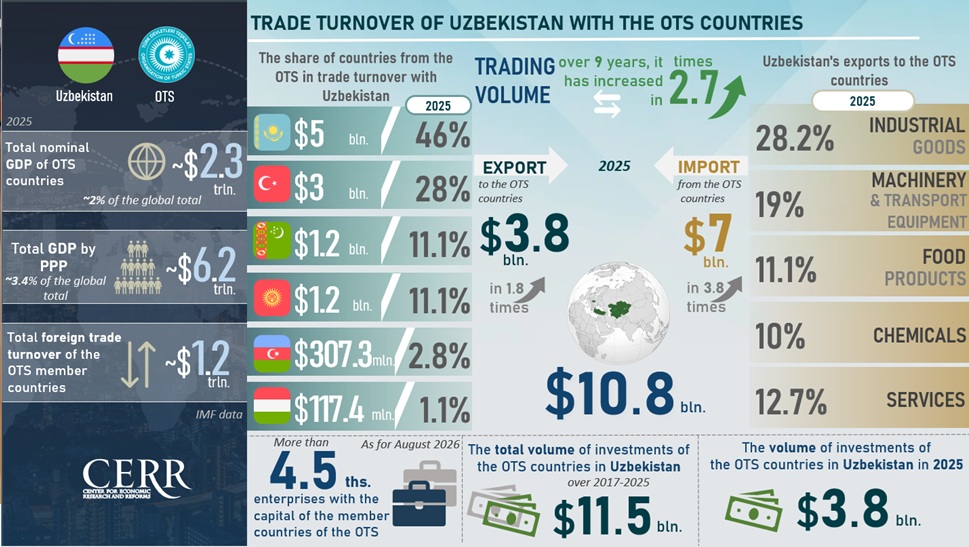
Uzbekistan has moved its economic cooperation with the Turkic states into a practical dimension
Ahead of the 13th Summit of the Organization of Turkic States, scheduled to be held in Ankara, economic cooperation within the OTS is acquiring new substance.
Water security in the turkic world: shared interests and common solutions
Water is a precious blessing that transcends national borders and has long connected peoples and civilizations.

Strengthening Transport Connectivity in Asia through the Development of the Trans-Caspian International Transport Corridor
Shifting international supply chains and expanding trade in Asia are driving demand for sustainable transport routes. For businesses, predictable delivery times, competitive rates, and reliable access to foreign markets are becoming increasingly important.