
Multilateral trading system and new opportunities for Uzbekistan within the SCO
The 21st century has become a time of profound transformations in the world economy. Traditional trading models no longer provide sustainable growth, and value chains are being redistributed towards new centers of power. In conditions of global turbulence, countries are increasingly turning to regional formats of cooperation, where not only the interests of neighbors are taken into account, but also mechanisms for collective protection from external shocks are created.
Against this background, the Shanghai Cooperation Organization (SCO) is gradually transforming from a predominantly political and security association into a platform for building sustainable economic ties. The “Road Map for the Development of Multilateral Trade within the SCO”, adopted in 2024, became the starting point for the formation of a new approach to integration.
Uzbekistan occupies a special place in these processes, which is not only actively developing its industrial potential, but is also becoming an important hub of transit and logistics routes between the East and the West.
SCO "Road Map": a new stage of integration
In July 2024, at a summit in Astana, the heads of the SCO member states approved a large-scale document aimed at developing multilateral trade. It sets out such priorities as:
- digitalization of trade procedures and the introduction of electronic platforms;
- development of mutual settlements in national currencies;
- formation of general rules for certification and standardization of products;
- support for exhibitions and fairs activities;
- creation of mechanisms for insurance and financing of foreign economic activity.
These steps are important not only for deepening regional cooperation, but also for protecting the economies of the SCO countries from external shocks, including trade wars and instability in world markets.
For Uzbekistan, which in recent years has been actively diversifying exports and striving to to gain a foothold in new markets, this “Road Map” opens up additional opportunities.
Uzbekistan in the regional trade system
Today, the foreign economic activity of Uzbekistan is showing steady growth. At the end of 2024, the country's trade turnover exceeded 65 billion US dollars, having increased by more than 20% compared to 2023.
Exports amounted to 23.8 billion dollars (+15%), and imports reached 41.2 billion dollars (+23%). This dynamics is explained both by the growing needs of the domestic market and by an increase in the supply of industrial products to foreign markets.
Thus, Uzbekistan is gradually moving away from dependence on raw materials, forming the appearance of an industrially developed country.
Dynamics of trade with the SCO countries
An important place in foreign economic policy Uzbekistan is focused on cooperation with the SCO countries, which in 2024 accounted for more than 60% of the country’s total trade turnover. The overall dynamics show steady growth and diversification of areas: both in the geography of trade and in the product structure.
The largest positions are in China, with which the volume of mutual trade reached $14.2 billion, an increase of 25% over the year. Exports in this direction amounted to $3.6 billion, the basis of which is provided by textile products, copper, uranium and agricultural products. At the same time, imports from China reached $10.6 billion, dominated by machinery, equipment and electronics. The Russian vector also plays a significant role: trade turnover with Russia amounted to $11.5 billion (+20%), in which Uzbek exports are represented mainly by agricultural products, textiles and chemicals, while imports are formed by oil, gas, metallurgical products and cars.
Other partners also show positive dynamics. Thus, the volume of trade with India amounted to 980.3 million dollars (+28.8%), where exports are estimated at 126 million (+13%), and imports at 853.5 million (+31%). The largest share in exports in this direction is occupied by chemical products (55.4%), services (32.8%), non-ferrous metals (2.6%), natural shellac (1.8%) and electrical equipment (1.2%) also occupy significant positions. Mutual trade with Pakistan amounted to about $400 million (+30%), where a significant part of exports is formed by textiles, agricultural products and pharmaceuticals, and imports by medicines, plastics and paper.
Indicators with the states of Central Asia are also actively growing. For example, trade turnover with Kazakhstan exceeded $5 billion (+18%), reflecting the strengthening of cooperation projects in the metallurgy, chemical industry and transport sectors. The total volume of trade with Kyrgyzstan and Tajikistan exceeded $2.5 billion (+15%), which confirms the deepening of regional economic integration.
Thus, statistics clearly demonstrate: the SCO for Uzbekistan is not only a diplomatic platform, but also a real, growing market, opening up new opportunities for increasing exports, attracting investments and deepening industrial cooperation.
New trends: digitalization, logistics and investment
Digital technologies are playing an increasingly important role in global trade. Uzbekistan is actively developing electronic platforms to simplify export procedures. In 2024, the E-export system was launched, which allows companies to process documents remotely and access international trading platforms.
Logistics remains an important element. The expansion of the China-Kyrgyzstan-Uzbekistan railway route, as well as participation in the Trans-Caspian International Transport Corridor project, opens up new opportunities for transit. Already today, more than 10% of all cargo flows in Central Asia pass through the territory of the republic.
Investments also strengthen industrial potential. In 2024, the economy of Uzbekistan received over $11 billion of foreign direct investment, a significant portion of which came from joint projects with China, Russia and the Gulf countries.
Prospects and forecasts
Experts note: if current growth rates are maintained, by 2030 the volume of foreign trade of Uzbekistan may exceed 100 billion dollars, and exports - 40 billion dollars. At the same time, more than 65% of trade will be with the SCO countries.
Promising areas will be:
- deepening industrial cooperation (mechanical engineering, pharmaceuticals, chemistry);
- development of green energy and export of renewable resources;
- expansion of food supplies to the markets of India, China and the Middle East;
- formation of Uzbekistan as a transport and logistics hub in the region.
Conclusion
The multilateral trading system within the SCO is becoming a key tool for adapting to the new world reality. The adopted Road Map not only established common guidelines, but also created a practical basis for cooperation.
For Uzbekistan, participation in these processes is an opportunity to transform from a transit link into a full-fledged industrial and commercial center of Central Asia. Figures of growth in trade turnover, diversification of exports and active attraction of investments show: the country is confidently moving towards integration into the world economy on new principles - through equal partnership, digitalization and openness.
That is why the future of Uzbekistan and the entire region is increasingly associated with the SCO - an organization where the multilateral trading system is turning into a real driver of development.
Related news
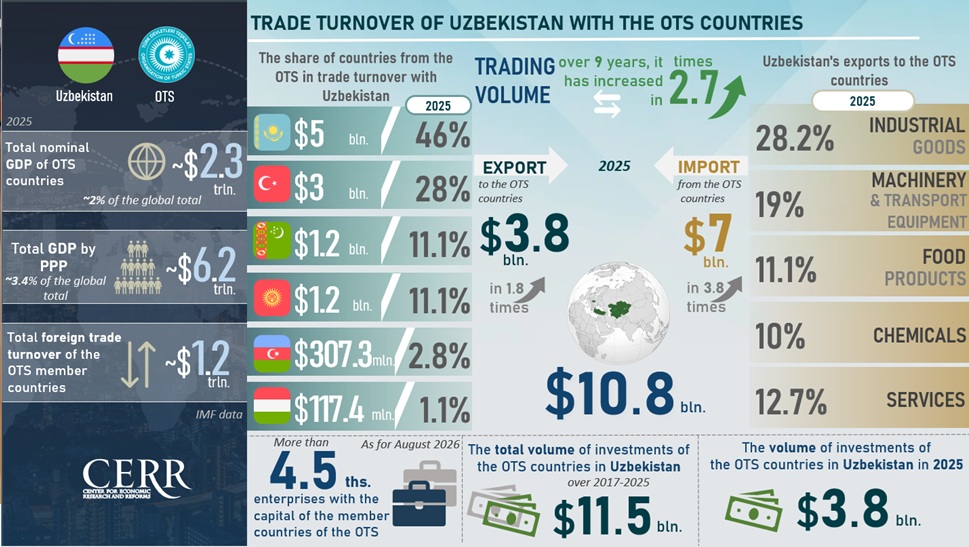
Uzbekistan has moved its economic cooperation with the Turkic states into a practical dimension
Ahead of the 13th Summit of the Organization of Turkic States, scheduled to be held in Ankara, economic cooperation within the OTS is acquiring new substance.
Water security in the turkic world: shared interests and common solutions
Water is a precious blessing that transcends national borders and has long connected peoples and civilizations.

Strengthening Transport Connectivity in Asia through the Development of the Trans-Caspian International Transport Corridor
Shifting international supply chains and expanding trade in Asia are driving demand for sustainable transport routes. For businesses, predictable delivery times, competitive rates, and reliable access to foreign markets are becoming increasingly important.