
SCO investment projects in Uzbekistan: from industry to tourism
Uzbekistan in recent years has secured its status as one of the most dynamically developing economies in the Shanghai Cooperation Organization (SCO) space. The republic is becoming not only an active participant in trade flows, but also a key platform for the implementation of large-scale investment initiatives. Geographical location, political stability, large-scale reforms and a favorable investment climate ensure a steady influx of capital from all member states of the organization.
At the end of 2024, Uzbekistan’s foreign trade turnover with the SCO countries amounted to $32.5 billion, an increase of 1.4% compared to the previous year. Already in January–July 2025, this figure increased by 15% and reached $20.8 billion, including $5.7 billion in exports and $15.1 billion in imports. This is not just an increase in trade turnover, but also evidence of deepening integration with key partners.
Expansion of investment presence
The dynamics of investment are no less indicative. Since the beginning of 2025, more than 1,300 new enterprises have appeared in Uzbekistan with the participation of capital from SCO countries, and their total number has exceeded 9,900, which is 15% more than at the beginning of the year. At the same time, the increase in the number of companies with 100% foreign capital is especially noticeable - over 18%. This confirms investors’ confidence in the national jurisdiction and their willingness to develop business in Uzbekistan both on an independent basis and in the format of joint ventures.
Russia and China remain the largest sources of investment: Moscow is traditionally strong in industry, energy, metallurgy and mechanical engineering, while also developing digital technologies, while Beijing acts as a driver of innovation, actively investing in IT, green energy and transport projects. The total portfolio of Chinese investments has exceeded $60 billion, including the automotive industry and joint production of electric cars. Russian business, in turn, is strengthening its position in the oil and gas sector, mechanical engineering and education, creating a stable base for cooperation.
Kazakhstan occupies a special place thanks to mutual investments: more than 1,100 companies with Kazakh capital operate in Uzbekistan, while Uzbek business is active in the neighboring country. This symmetrical format of cooperation forms a single economic space, especially in the field of logistics and digitalization. Belarus, Tajikistan and Kyrgyzstan are represented by smaller investments, but make a significant contribution to mechanical engineering, energy, trade and services. Iran and India are strengthening their positions in industry, pharmaceuticals and high-tech industries, Pakistan - in textiles, agriculture and trade. These areas complement each other, creating a diversified investment map.
New vector - tourism
In addition to industry and energy, attention is paid to the development of tourism. The SCO countries are investing in hotels, tourist complexes and transport infrastructure. The rich historical and cultural heritage of Uzbekistan turns the industry into a new driver of cooperation. The creation of tourism clusters in Samarkand, Bukhara and Khiva can attract millions of travelers and in the future bring comparable income to industry.
Result
The experience of recent years shows that investments from the SCO countries cover almost all spheres of the economy of Uzbekistan - from heavy industry and mechanical engineering to pharmaceuticals, digital technologies and tourism. Russia is forming a solid industrial foundation, China is setting an innovative vector, Kazakhstan is expanding logistics and digital projects, other states are strengthening their niches in the energy, agricultural sector and services.
The main conclusion is obvious: Uzbekistan is becoming an economic bridge between East and West, and partnership within the SCO is turning into a strategic guarantee of sustainable development, opening the way to diversification of industries, growth in the number of enterprises and expansion of technological potential.
Related news
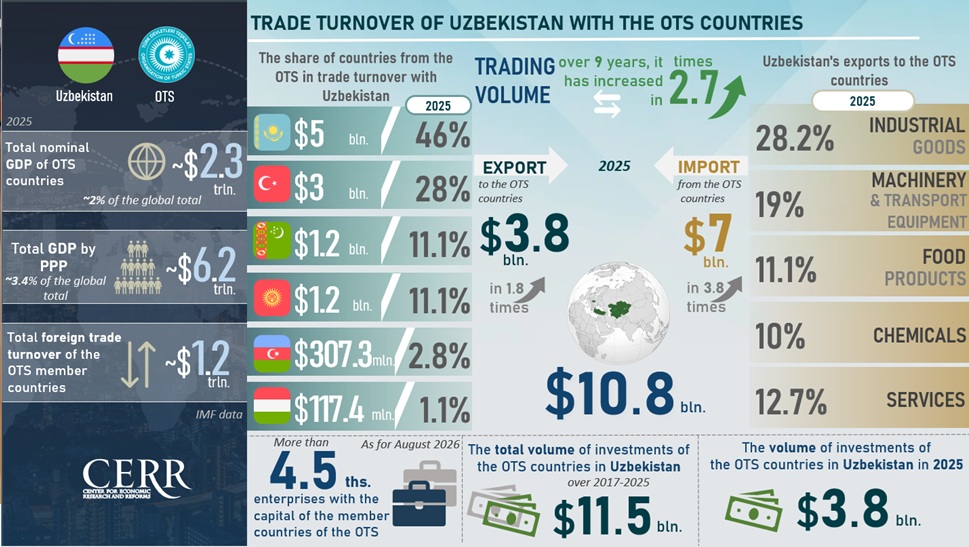
Uzbekistan has moved its economic cooperation with the Turkic states into a practical dimension
Ahead of the 13th Summit of the Organization of Turkic States, scheduled to be held in Ankara, economic cooperation within the OTS is acquiring new substance.
Water security in the turkic world: shared interests and common solutions
Water is a precious blessing that transcends national borders and has long connected peoples and civilizations.

Strengthening Transport Connectivity in Asia through the Development of the Trans-Caspian International Transport Corridor
Shifting international supply chains and expanding trade in Asia are driving demand for sustainable transport routes. For businesses, predictable delivery times, competitive rates, and reliable access to foreign markets are becoming increasingly important.