
Uzbekistan's initiatives to combat climate change and environmental stability
Today, the most important problem on a global scale, of course, has become the environmental problem. Almost all countries face the negative consequences of climate change, water shortages and air pollution. Unfortunately, environmental problems threaten people's lives and health. Thus, according to WHO, between 4.2 and 7 million people die from air pollution around the world every year. Around the world, 2.7 billion people experience water scarcity for at least one month of the year.
Therefore, more than ever, countries are not only striving, but also forced to implement practical measures to ensure environmental safety. Realizing that they cannot cope with such global problems alone, countries are taking steps towards international cooperation.
The Republic of Uzbekistan is actively promoting on the international agenda the idea of the need to increase the efficiency of cooperation between states. A striking example is the speech of the President of the Republic of Uzbekistan Sh. Mirziyoyev at the 80th session of the UN General Assembly.
The head of state specifically focused on the problem of climate change. Indeed, climate change has become a negative consequence of anthropogenic impact. According to open sources, 2024 was recognized as the hottest year in human history. As a result, the concentration of greenhouse gases has become high, trapping the sun's heat and leading to global warming. In connection with these countries, it is necessary to coordinate efforts to limit greenhouse gas emissions (in Uzbekistan, a separate Law on this matter was adopted in July of this year). In particular, Uzbekistan's initiative is aimed atimplementing the goals of the Paris Agreement, which provides for a commitment to gradually reduce annual greenhouse gas emissions.
Speaking of climate change, an increase in climate migration has been noted. In this regard, the creation of a specific international mechanism and legal framework was proposed. In our opinion, this issue should be resolved at the level ofan international act, which should be adopted under the auspices of the UN. Since this issue is connected not only with ecology, but with socio-economic problems, because flows of “climate migrants” can cause other problems related to employment, social security and adaptation. Countries should address the root causes of climate migration: take effective measures to mitigate environmental impacts, create favorable living conditions, etc. These mechanisms must be regulated within the framework of the mentioned international act.
Traditionally, the President of the Republic of Uzbekistan raised the issues of the negative consequences of the drying up of the Aral Sea. The Head of State has repeatedly raised this issue from the UN rostrum (at the 72nd, 75th, 76th, 78th sessions of the UN General Assembly, the problems of the Aral Sea region and the environmental situation in connection with the drying up of the Aral Sea were raised). Thanks to the efforts of Uzbekistan, the UN General Assembly resolution “On declaring the Aral Sea region a zone of environmental innovation and technology” was adopted. The Action Plan and Program of Measures for sustainable socio-economic development, employment and improving the living standards of the population are being implemented. Uzbekistan is actively working to restore the Aral Sea ecosystem. In recent years, plants have been planted on the bottom of this sea with a total area of 2 million hectares. In the first half of this year alone, forest plantations were created on 701 hectares and terraces on 41 hectares. It is expected that by 2030, up to 80% of the entire territory will be covered with green space. Overall, the attention of the international community is important. Because the drying up of the Aral Sea caused about 150 million tons of salt to rise into the air every year. According to experts, the harm from this is felt not only in the region, but also in Antarctica.
One of the important problems noted by the President is the scarcity of water resources. Currently, more than two billion people in the world do not have access to clean drinking water. For Uzbekistan, solving the water shortage problem is becoming a matter of life and death. In this regard, it was proposed to hold a World Forum on Water Conservation in Uzbekistan. Within the framework of the forum, it is proposed to identify the water crisis as a serious threat to sustainable development. Therefore, it is proposed to adopt a separate road map for the introduction of innovative technologies at the global level. This initiative is important, since it is the joint solution to the problem of water shortage, especially with transboundary water use, that is relevant. A unified approach within the framework of international cooperation will help mitigate the consequences of water shortages in the future.
The systemic proposal of the President of the Republic of Uzbekistan is the adoption of the Global Pact for Broad International Partnership. This pact is a logical implementation of the Sustainable Development Goals (SDGs). The pact makes it possible to solve environmental problems on the basis of agreements, exchange of knowledge and experience, defining mechanisms of financing and control. In addition, the pact will reinforce the approach that the environment is a “global public good.” In general, international acts have a positive characteristic and influence in practice. Thus, the Montreal Protocol on Substances that Deplete the Ozone Layer showed that a coordinated global response can lead to the restoration of the natural process. Research has shown that, thanks to reduced concentrations of harmful emissions, global radiative forcing fell five years earlier than predicted.
The above proposals are important from the point of view of international cooperation between countries to ensure environmental safety and well-being. This is also important for our country. After all, 2025 has been declared in Uzbekistan as the “Year of Environmental Protection and Green Economy” and a corresponding state program has been adopted. The implementation of the goals of this program in conjunction with international initiatives will ensure stability and a favorable environment.
Abdulaziz Rasulev
Doctor of Law, Professor,
Scientific Secretary of the Institute of Legislation
and legal policy under the President of the Republic of Uzbekistan
Related news
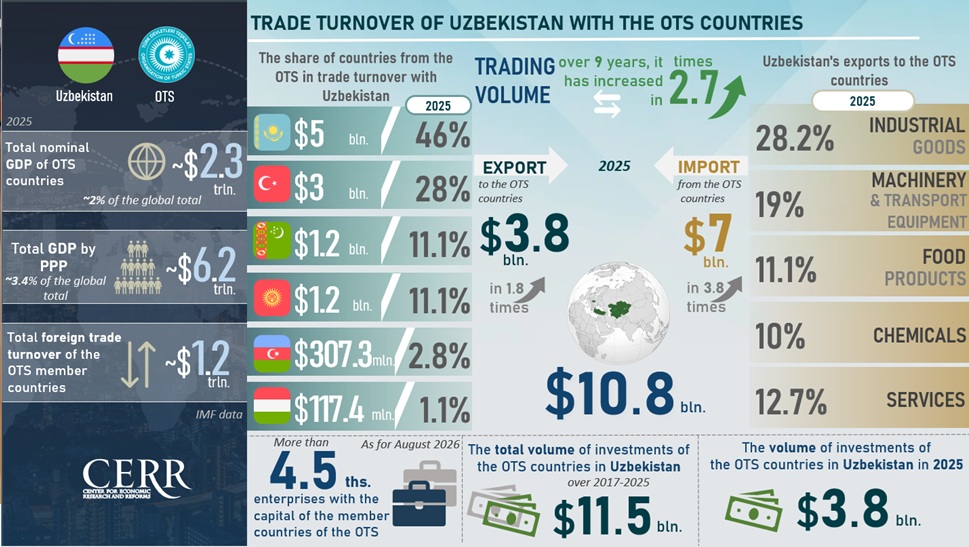
Uzbekistan has moved its economic cooperation with the Turkic states into a practical dimension
Ahead of the 13th Summit of the Organization of Turkic States, scheduled to be held in Ankara, economic cooperation within the OTS is acquiring new substance.
Water security in the turkic world: shared interests and common solutions
Water is a precious blessing that transcends national borders and has long connected peoples and civilizations.

Strengthening Transport Connectivity in Asia through the Development of the Trans-Caspian International Transport Corridor
Shifting international supply chains and expanding trade in Asia are driving demand for sustainable transport routes. For businesses, predictable delivery times, competitive rates, and reliable access to foreign markets are becoming increasingly important.