
Harvard Growth Lab: in 5 years, Uzbekistan has risen in the ranking of economic complexity by 25 positions

The Center for Economic Research and Reform conducted an analysis of the Harvard Growth Lab's Economic Complexity Index. According to the data, Uzbekistan's economy is showing strong growth, with exports increasing by an average of 20.5% per year, which is significantly higher than the growth rates of the countries in the region.
Harvard University's Growth Laboratory published the results of the Economic Complexity Index(ECI), which provides a ranking of countries based on technological complexity and diversification exports.
Analysts at Harvard Growth Lab (an interdisciplinary project at Harvard University) in April of this year. updated the Atlas of Economic Complexity, adding data for 2023 and presented a ranking of countries by the value of the Economic Complexity Index, which includes 145 economies of the world.
Uzbekistan has significantly improved its position in the Economic Complexity Ranking, rising by 25 places over the past 5 years and taking 80th place among 145 countries.
Uzbekistan took 80th place in the ranking, Turkey – 44th place (improved 5 positions), Vietnam – 53rd place (no changes), Kazakhstan – 84th place (lost 6 positions), Russian Federation – 94th place (lost 5 positions), Tajikistan – 124th place (improved by 5 positions), Turkmenistan – 126th place (lost 12 positions). The TOP 3 countries included: 1st - Switzerland, 2nd - Japan, 3rd - Singapore.
The country's economy is showing steady growth, with exports increasing by an average of 20.5% per year, which significantly exceeds the growth rates in other countries in the region. At the same time, non-oil exports grew by 21.9% per year, outpacing the world average growth.
The largest contribution to export growth over 5 years has been made by industrial goods of secondary processing. Among more difficult-to-manufacture products, transportation (89%), industrial equipment (77%), electrical engineering (59%) showed strong growth rates.
Uzbekistan added 67 new products to its export portfolio, bringing in $2.1 billion and confirming its successful strategy of diversification and increased competitiveness. These products generated $59 in per capita income in 2023.
Harvard Growth Lab estimates that Uzbekistan has 162 products with competitive advantages in the global market, highlighting its potential in the global economy.
Economic growth forecasts to 2033
The average annual growth rate of the Uzbekistan economy until 2033 is expected to be 5.6%, which is the second in the world in terms of growth rates.
In Vietnam, the average annual growth rate in the next decade will be 4.8%, Tajikistan - 4%, Kyrgyzstan - 3.9%, Georgia - 3.6%, Kazakhstan – 3.6%, Armenia – 3.3%, Bangladesh – 3%, Turkmenistan – 2.7%, Belarus – 2.4%, Azerbaijan – 2.2%, Russia – 1.1%.
Uzbekistan continues to work on the structural transformation of the economy, directing resources from less productive sectors such as agriculture, into more highly productive ones, such as electronics and mechanical engineering.
Public and Media Relations Sector
Center for Economic Research and Reform
Related news
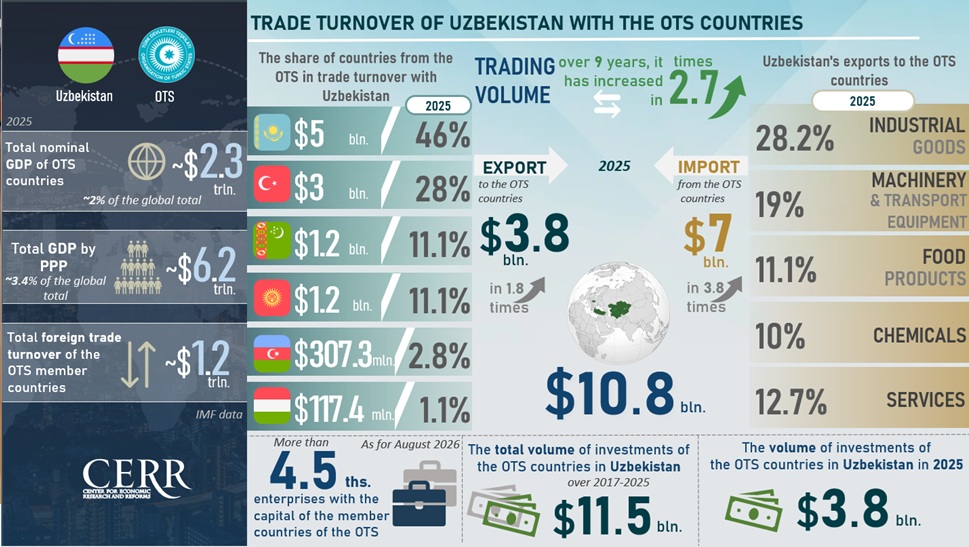
Uzbekistan has moved its economic cooperation with the Turkic states into a practical dimension
Ahead of the 13th Summit of the Organization of Turkic States, scheduled to be held in Ankara, economic cooperation within the OTS is acquiring new substance.
Water security in the turkic world: shared interests and common solutions
Water is a precious blessing that transcends national borders and has long connected peoples and civilizations.

Strengthening Transport Connectivity in Asia through the Development of the Trans-Caspian International Transport Corridor
Shifting international supply chains and expanding trade in Asia are driving demand for sustainable transport routes. For businesses, predictable delivery times, competitive rates, and reliable access to foreign markets are becoming increasingly important.