
Reported on international cooperation projects in agriculture

President Shavkat Mirziyoyev On March 3, I got acquainted with the presentation on the development of international cooperation in the field of agriculture.
Reforms aimed at increasing efficiency and developing market mechanisms are being actively carried out in the agricultural sector of our country. Advanced agricultural technologies and scientific achievements are being widely introduced into the industry.
Recently, a group of specialists visited China, Italy and Japan, where they studied the experience of scientific institutes, large companies and farms. As a result, new cooperation plans have been developed.
As you know, the key factor in high yields is seed production. The Chinese Academy of Agriculture has rich experience in seed production and nursery. There are 14 scientific institutes and 55 seed farms in Uzbekistan, but significant gaps remain in the development of new varieties and the introduction of agricultural technologies. Due to the low efficiency of local seeds, farmers prefer to use foreign varieties.
In this regard, on the basis of the Agricultural Services Center in the Yukorichirchik region, it is planned to create a seed production and nursery system based on Chinese experience. This will attract $200 million in investments, and the creation of varieties of cotton, wheat, rice, corn, grapes and fruit crops will be established. An exemplary territory will be created with a full growing cycle - from obtaining seedlings to planting them, plant protection, harvesting and subsequent processing using modern technology and drones.
One of the pressing issues for the agricultural sector remains the training of qualified personnel. Italy's experience in this area is noteworthy. In particular, the University of Bologna occupies an important place in providing personnel to European countries. Scientific institutes in Italy are actively collaborating with the private sector, creating customized and commercializing quality varieties of agricultural crops.
To study this experience, it is planned to send 200 young people to the universities of Bologna, Tuscia, Ferrara and Pisa this year. The University of Tushiya proposed to annually train 30 food technologists on the basis of grants and contribute to the organization of training in Uzbekistan.
Programs for combining study and work have proven themselves well in the world. So, last year, the Samarkand Agrarian Institute and the International University of Agriculture sent a group of students for an internship in Germany and the UK. Japanese language learning centers are being created at the Tashkent State Agrarian and International Agricultural Universities, Fergana Institute of Food Industry to send students to Japan.
Having supported the presented plans, the head of state emphasized the need to expand cooperation also with Hungary, the Netherlands, Canada, Australia and South Korea - countries with a developed agro-industrial sector. The Ministry of Agriculture has been instructed to develop a program to increase the number of innovative projects in the regions.
Official website of the President of the Republic of Uzbekistan
Related news
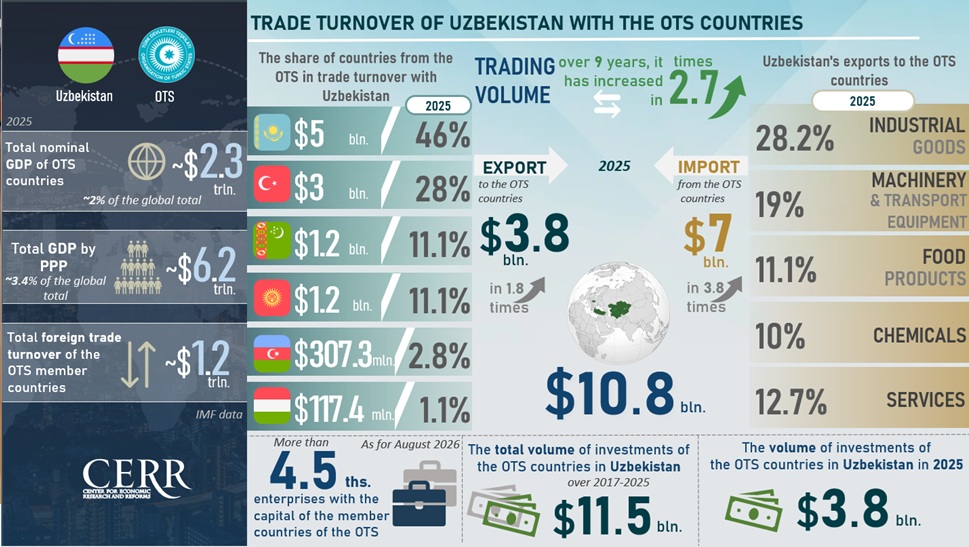
Uzbekistan has moved its economic cooperation with the Turkic states into a practical dimension
Ahead of the 13th Summit of the Organization of Turkic States, scheduled to be held in Ankara, economic cooperation within the OTS is acquiring new substance.
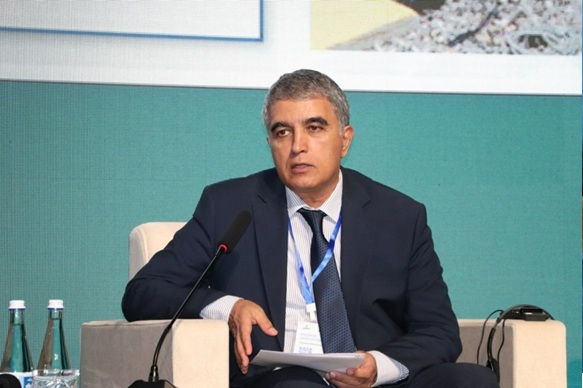
Water security in the turkic world: shared interests and common solutions
Water is a precious blessing that transcends national borders and has long connected peoples and civilizations.

Strengthening Transport Connectivity in Asia through the Development of the Trans-Caspian International Transport Corridor
Shifting international supply chains and expanding trade in Asia are driving demand for sustainable transport routes. For businesses, predictable delivery times, competitive rates, and reliable access to foreign markets are becoming increasingly important.