
The goal of Uzbekistan is to provide all irrigated lands with water-saving technologies by 2030
Ten years ago, during meetings with international experts, an alarming question was discussed: how will climate change, reduced precipitation and the melting of centuries-old glaciers affect Central Asia? It was predicted that by 2025 the region's water resources could be reduced by five percent, and by 2030 by 10 percent, and the population would experience water shortages.
The President of Uzbekistan set the most important task for the water management system - to provide the people with water and make up for its deficit caused by climate change and other factors.
Thanks to the measures implemented, seven billion cubic meters of water were saved in 2023, and eight billion cubic meters of water in 2024. In 2025, this figure should reach 10 billion cubic meters. This corresponds to the volume of water that was previously predicted to be in short supply. By 2030, it is planned to save up to 15 billion cubic meters annually.
Once in Nukus, due to groundwater and salts, almost no grass grew along the roadsides, not to mention flowers. At the initiative of the President of Uzbekistan, concreting of the Dustlik canal, passing through the city, began in 2017. The phased construction of the Nukus collector has begun. And in a short period of time, tangible results were achieved: water filtration in the canal decreased, and the groundwater level dropped. Today, the streets of Nukus, fragrant with flowers, are unrecognizable.
Previously, due to the excessive rise of groundwater in Gulistan, even the issue of moving the administrative center of the Syrdarya region to the city of Yangier was considered. The leader of the country took the solution to the problem under personal control, and the necessary funds were found. As a result of the reconstruction and concreting of the canal passing through Gulistan, water filtration has decreased, vertical drainage wells have been built, irrigation and reclamation work have been carried out, and the groundwater level has noticeably decreased.
And there are many such examples. In Urgench, thanks to the concreting of the Shovot canal, as well as in the almost swampy Naryn region, through the construction of vertical wells, it was possible to solve long-term problems associated with high groundwater levels.
At the initiative of the President of the country, large investments are being attracted to the water sector. With the participation of the Islamic Development Bank (IDB), the Toshsoka canal system in the Khorezm region is being modernized; With funds from the World Bank, canals are being reconstructed in the Fergana Valley, thanks to cooperation with the Asian Development Bank - in the Bukhara region, and IDB loans - in the Surkhandarya region. As a result, in these regions, the groundwater level decreased by 0.3-0.5 meters compared to long-term averages, and the efficiency of the canals increased significantly.
The main thing is that the water supply to irrigated lands has improved. In many places, thousands of small pumping stations are no longer necessary because water is now supplied by gravity. This allowed saving energy and operating costs.
On November 29, 2023, at a video conference on measures for the rational use of water resources and reducing their losses, the head of state especially emphasized the need for concreting canals and irrigation ditches.
According to calculations, about 14 billion cubic meters of water are lost annually in irrigation systems with natural cover (36 percent) without any economic benefit. That is why in the water sector, 2024 was declared a high-impact year for concreting canals. The State Budget allocated 676.7 billion soums for the reconstruction of 555 km of canals. Clusters and farms put in order and concreted 13.5 thousand kilometers of internal irrigation networks.
These are not just dry numbers. Behind them is the well-being of the people and abundance at every dastarkhan.
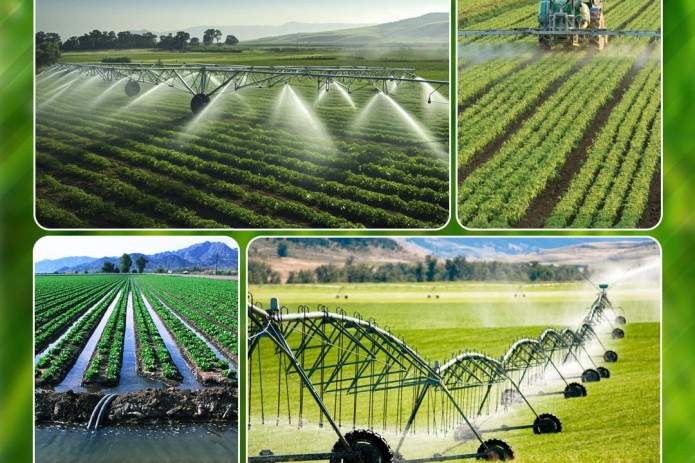
Until quite recently, there was a misconception that drip irrigation is not suitable for the conditions of Uzbekistan and in our hot climate the traditional method of irrigation along furrows is the most optimal. Nevertheless, of the 4.3 million hectares of irrigated land, about half have been covered by water-saving technologies over the past seven years.
In support of this policy, seven decrees and resolutions of the President of Uzbekistan have been issued over this period, stimulating the implementation and development of water-saving solutions. Previously, equipment and components for it were imported from abroad. In 2019, there were only two or three enterprises in the country dealing with such technologies. Today there are more than 60 of them. Localization of production has reduced costs by 20 percent per hectare, and also provided local service. In 2024 alone, through the use of water-saving technologies, 2.5 billion cubic meters of water were saved.
If it were not for the requirements of the head of state and loans and subsidies, we might still continue to reassure ourselves that certain types of water-saving technologies are supposedly not suitable for our conditions.
We have an ambitious goal - to By 2030, provide all irrigated lands of the republic with water-saving technologies. There are only a few years left to achieve this indicator.
Uzbekistan is taking the lead in introducing water-saving technologies and applying modern methods of water resource management among the countries of the region.
“We urge you to join forces and launch a Regional Program for the introduction of water-saving technologies in Central Asia,” said the President of our country, speaking at the Samarkand International Climate Forum.
By the way, thanks to the created conditions, this year a new movement has emerged among leading domestic farmers: an increasing number of farms are switching to solar technologies in order to use water-saving technologies panels.
Frankly speaking, about 70 percent of all budget funds allocated to the water sector are spent on electricity, which is almost seven billion kW/h, used to operate about 1,700 pumping stations.
Thanks to the measures taken, in 2017 consumption was 8.3 billion kW/h, in 2024 it decreased up to 6.5 billion kW/h.
At a video conference on measures for the rational use of water and energy resources, as well as reducing losses in agriculture, held on November 7, 2024, the head of state emphasized: in recent years, large pumping stations such as Karshi, Amu-Bukhara and Amu-Zang have been modernized at the expense of a billion dollars. However, due to the wear and tear of medium and small pumps, the cost of water continues to rise.
Taking into account such problems, the next tasks were identified during the meeting. And 2025 has been declared the Year of Increasing the Efficiency of Pumping Stations in the Water Sector.
As the President of the country noted, digitalization is the only way to fundamental changes in the field: it ensures transparency, accuracy and prevents corruption.
Taking into account the tasks outlined in the Strategy “Uzbekistan - 2030” and the Concept for the development of the water sector of the Republic of Uzbekistan on
2020-2030, large-scale work has been done in the field of digitalization of water management and a number of technological solutions have been implemented. Thus, to monitor water resources online, “Smart Water” systems were installed at 13,174 water-measuring posts of reservoirs and irrigation systems; to control the groundwater level and the degree of soil mineralization at 10,296 reclamation wells - Diver devices; at 1,748 pumping stations - water consumption monitoring devices; 96 large water management facilities were transferred to automatic control.
The Center for Digitalization of Water Management was established under the Ministry of Water Resources, and the Suv hisobi and Nasos stansiyalari information systems were created. The Decree of the President of the country “On priority measures for the implementation of the Program “From Poverty to Prosperity” dated September 23, 2024 became a striking example of the state’s care for the people. The document provides for the allocation of 3.2 trillion soums to improve irrigation of household plots, ensure a stable supply of electricity, improve the quality of the Internet, repair internal roads and modernize other infrastructure in the 1000 most needy mahallas.
The President of Uzbekistan defends the idea that people should live well not tomorrow, but today. As part of the “From Poverty to Prosperity” Program, large-scale projects are being implemented in 2025: 1,882 km of irrigation networks worth 1.1 trillion soums were concreted at 864 sites; 185 km of flume networks, 380 km of pipelines, 818 irrigation wells were built; 421 pumping units were installed. Water supply has been improved on 77.5 thousand hectares of household lands in 467 thousand houses in mahallas with water shortages.
Yes, life is not without difficulties. And times are different: sometimes there is not enough water, and sometimes there is plenty of it. But, be that as it may, the people of Uzbekistan deserve peace and tranquility. Fortunately, he has a leader who thinks about everyone who lives on this earth. It is thanks to the far-sighted policy of the President of the country that we have embarked on the path of sustainable development, and the life of the people is becoming more prosperous from year to year.
Shavkat Khamrayev,
Minister of Water Resources of Uzbekistan
Related news
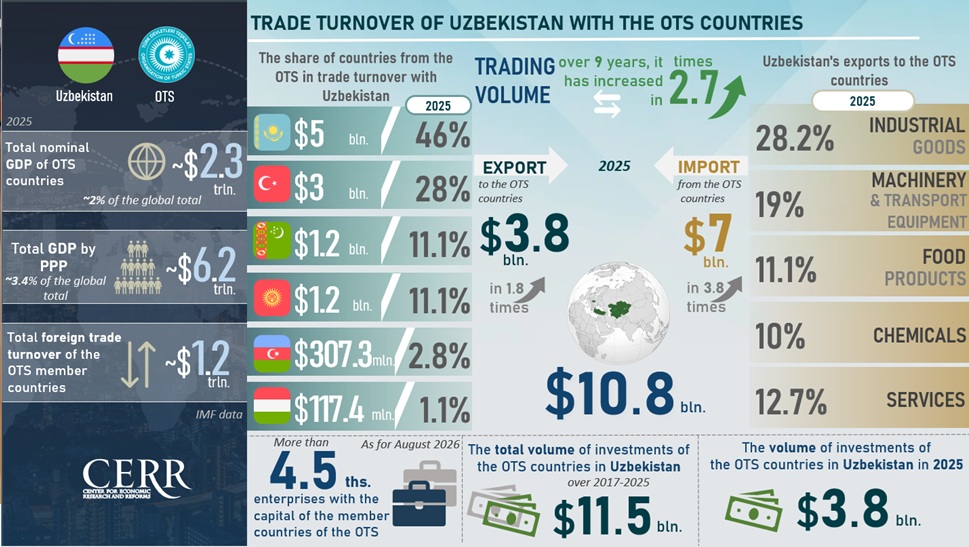
Uzbekistan has moved its economic cooperation with the Turkic states into a practical dimension
Ahead of the 13th Summit of the Organization of Turkic States, scheduled to be held in Ankara, economic cooperation within the OTS is acquiring new substance.
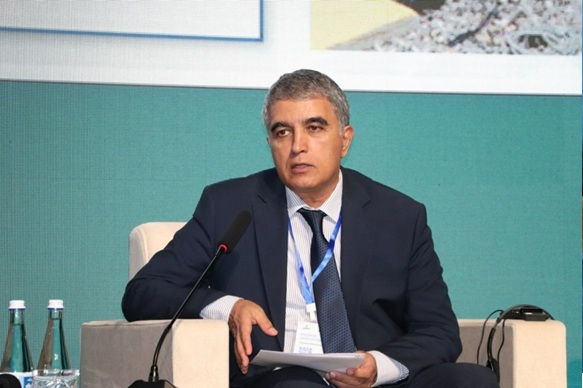
Water security in the turkic world: shared interests and common solutions
Water is a precious blessing that transcends national borders and has long connected peoples and civilizations.

Strengthening Transport Connectivity in Asia through the Development of the Trans-Caspian International Transport Corridor
Shifting international supply chains and expanding trade in Asia are driving demand for sustainable transport routes. For businesses, predictable delivery times, competitive rates, and reliable access to foreign markets are becoming increasingly important.