
Belgian vector of Uzbekistan
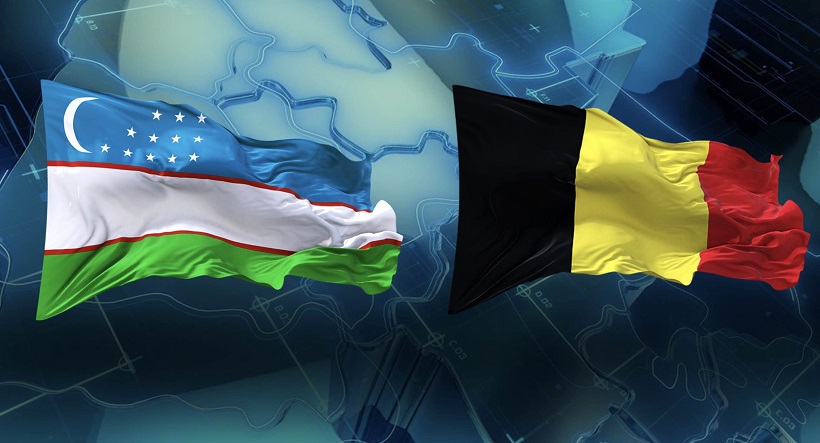
In October, the President of Uzbekistan Shavkat Mirziyoyev will visit the Kingdom of Belgium, during which important decisions are expected that will determine a qualitatively new level of relations between Uzbekistan and the European Union, in particular, will sign an Agreement on Enhanced Partnership and Cooperation.
In recent years, Uzbekistan has been dynamically building a new configuration of relations with Europe, as an important element of sustainability in modern conditions of geopolitical tension and economic instability. Every year, ties between Uzbekistan and European countries are expanding, and areas of cooperation are diversifying, which is facilitated by the reforms carried out in the country.
Formation of a new history of relations
After Uzbekistan gained independence, its relations with the EU developed quite dynamically. In 1992, a Memorandum of Understanding was signed between the Government of Uzbekistan and the EU Commission, and in 1994, diplomatic relations with the EU were established. The basis for cooperation was the Partnership and Cooperation Agreement (PCA) signed in June 1996, which came into force in 1999. However, at a certain period, interaction with European countries experienced certain difficulties due to the insufficient level of democratic transformations in Uzbekistan.
With the election of Shavkat Mirziyoyev as President of Uzbekistan, the situation changed dramatically. Already in 2017, Stefano Manservisi, Director General for International Development and Cooperation of the European Commission, who visited Tashkent, said that “the EU considers Uzbekistan as a strategic partner.” The large-scale democratic and economic reforms launched in the country made it possible to solve many previously unsolvable problems in a short time. Forced labor was completely eradicated, and reforms in the cotton sector made it possible to completely eliminate cotton exports.
As reforms progressed in Uzbekistan, the regulatory framework for relations with European countries quickly expanded. If earlier Uzbekistan and the EU provided each other with most favored nation treatment in accordance with the PCA, then in April 2021 the European Union granted Uzbekistan the status of a beneficiary of the “Generalized System of Preferences GSP+”, and in 2022 a new “Enhanced Partnership and Cooperation Agreement” was initialed.
With the beginning of reforms in Uzbekistan, things have changed dramatically. not only domestic politics, but also the architecture of international relations. Closer interaction with neighbors in the region - the countries of Central Asia - came to the fore, and active interaction with European countries was identified as one of the most important areas, and it is this vector of cooperation that has been steadily expanding in recent years.
Only this year, during the corresponding visits, strategic partnership relations were established with France, Italy, Slovakia, and issues of further expansion of the strategic partnership were already considered with Hungary. In addition, the President of Uzbekistan visited Slovenia, the Prime Minister of Italy and the President of Bulgaria visited Uzbekistan.
The key event in strengthening relations between Uzbekistan and Europe, as well as Europe and Central Asia in general, was the first EU-Central Asia summit, held at the beginning of April this year in Samarkand under the chairmanship of Shavkat Mirziyoyev, at which Uzbekistan presented a wide range of initiatives to form a new model of regional cooperation between Central Asia and Europe.
These include the conclusion of a multilateral Agreement on the Protection and Promotion of Investments; launch of the joint Chamber of Commerce “Central Asia - EU”; adoption of a joint regional program to support projects of small and medium-sized businesses and women's entrepreneurship; launch of an investment platform to promote regional projects in the field of green energy, innovation, transport, infrastructure and the agricultural sector.
The summit in Samarkand was very successful. A Joint Declaration was adopted, providing for the establishment of a strategic partnership between the two regions in such areas as trade, transport, energy, digital communications and water management. The head of the European Commission, Ursula von der Leyen announced that the European Union has prepared an investment package of 12 billion euros for the countries of Central Asia as part of the Global Gateway program.
Trajectory of economic cooperation
Deep democratic transformations in Uzbekistan in recent years have led to a significant improvement in Uzbekistan’s relations with European countries. On the other hand, ongoing economic reforms have ensured an increase in the competitiveness of the Uzbek economy, which has determined the growing interest of investors and European businesses in expanding cooperation with Uzbekistan.
The indicators of economic transformation are impressive. Thus, over the past eight years, Uzbekistan’s GDP has doubled, reaching $115 billion in 2024. Since 2017, the volume of investments in fixed capital has amounted to $240 billion, including foreign investments exceeding $130 billion. Gold and foreign exchange reserves for the first time in the history of Uzbekistan exceeded $48 billion. But the most noticeable result of economic reforms was the structural transformation of the economy. In 2017–2024, the share of industry in the economy increased from 20% to 26%, and the service sector from 44% to 47%. Over the same period, labor productivity in the economy (GDP per employee) increased by 45%.
As a result of the ongoing changes in Uzbekistan, more opportunities for mutually beneficial cooperation have appeared for both Uzbek and European businesses. So, for the period 2017-2024. Uzbekistan's trade turnover with EU countries increased 2.4 times to $6.4 billion, exports 3.6 times to $1.7 billion, imports 2.2 times from $4.7 billion. In 2024, the EU's share in Uzbekistan's foreign trade was 9.7% in trade turnover, exports - 6.3%, imports - 12%, and the European Union in the ranking of trading countries Uzbekistan's partners took 3rd place after China and Russia.
At the same time, over the same period, the share of EU countries in Uzbekistan's total exports increased from 3.8% to 6.3%. An important role in this was played by the accession of Uzbekistan to the group of GSP+ beneficiary countries, thanks to which Uzbek goods received duty-free access to the EU market through approximately 6,200 tariff lines. The share of imports from Uzbekistan, which are subject to GSP+ preferences, is 59%, and the rate of use of preferences reached 84%, which indicates a high degree of application of preferential conditions.
At the end of 2024, the main volume of Uzbek exports to the EU countries was chemical (52.1%), as well as textile products, ferrous and non-ferrous metal products, minerals and food products, and among Uzbekistan’s trading partners from EU countries in terms of exports, France took first place (share in exports 47.2%), Lithuania second (10%), Latvia third (6.9%). If we talk about Uzbekistan’s imports from EU countries, they significantly exceed exports, which is due to the need for technological modernization of the Uzbek economy. EU countries account for about 16% of Uzbekistan's total imports of machinery, equipment and vehicles.
Investment cooperation between Uzbekistan and EU countries is also actively developing, the volume of foreign investments and loans, of which (including financial organizations of EU countries) increased by 77% in 2024 and amounted to $4.1 billion (in 2023 - $2.3 billion). The most active in investment terms were Germany - $1.37 billion, the Netherlands - $1.05 billion, Cyprus - $858.9 million, the Czech Republic - $137.8 million, Italy - $99.8 million, Sweden - $97.5 million. Currently, there are about one thousand enterprises with capital from EU countries in Uzbekistan, and the total volume of investment projects is 30 billion. euro.
It is especially worth noting the significant role of the EBRD in the investment processes of recent years, the largest beneficiary of which is currently Uzbekistan. Currently, the EBRD's total investments in the economy of Uzbekistan have exceeded 5 billion euros, including about 1 billion euros by the end of 2024. The main volume of the bank's financial support comes from the private sector.
Thus, reforms in Uzbekistan have become the main factor in expanding and realizing the significant potential of trade and economic interaction with the European Union.
Uzbekistan - Belgium
During the upcoming visit, it is necessary to focus on the development of relations Uzbekistan and Belgium. After the opening of the Uzbekistan Embassy in Brussels in 1993, diplomatic relations. In 1996, an agreement on the avoidance of double taxation was signed, and in 1998, an agreement on mutual protection and promotion of investment. The existence of these agreements provides legal guarantees to investors in both countries.
Business contacts between Uzbekistan and Belgium have revived amid active reforms. The 2019 and 2022 visits set the agenda on infrastructure, energy and the digital economy. More important than the current volumes is the recognition and support of transformations from partners in the EU, which forms a stable basis for long-term cooperation.
In 2024, trade turnover amounted to about $62.3 million, of which Uzbekistan exports $7.3 million and imports $55 million. At the same time, investment cooperation is gaining momentum, several dozen companies with Belgian capital operate in the country, including enterprises with 100% participation. Technologies are being launched and localized, in particular, Jaga Climate Designers is participating in the creation of a joint venture for heating and ventilation systems, Picanol Group is implementing the localization of the assembly of high-tech textile machines. The Belcolade and Prefamac brands are studying the organization of production of chocolate products with subsequent localization.
At the same time, despite the rather modest level of economic interaction, there are ample opportunities for expanding cooperation in a number of areas.
Given that Belgium occupies a leading position in Europe in the production of pharmaceutical products and biomedical developments, as well as the dynamically growing drug market in Uzbekistan, it is possible the creation of joint ventures or production clusters in the pharmaceutical field, in which Belgian pharmaceutical companies such as UCB and divisions of Janssen Pharmaceutica could take part.
It is promising to create joint ventures for the processing of fruits and vegetables in Uzbekistan with a focus on exporting to the EU through Belgian logistics hubs (port of Antwerp, wholesale markets). Potential partners could include companies such as Greenyard or Puratos.
It is possible to increase direct supplies of fresh fruit during seasonal shortage windows in Belgium, primarily grapes in autumn and winter, as well as dried vegetables, spices and organic products in the segment of environmentally friendly goods. In light industry, it is advisable to expand the export of finished knitwear and home textiles while complying with European quality and safety requirements. Capacity is confirmed by Belgium's clothing imports, which amounted to about $7.9 billion in 2024.
The main limiter is logistics and standards. Belgium operates as an EU maritime hub centered in Antwerp, while direct routes from Uzbekistan are limited. The priority for the near future is pilot supply chains with guarantees of quality and traceability, the development of cold logistics, certification to EU technical regulations and sanitary standards, the use of consolidation hubs in Benelux and trade finance instruments for SMEs. As new land connections are introduced on the Middle Corridor, it will be possible to confidently increase exports with greater added value without increasing costs and delivery times.
Conclusion
In conclusion, it should be said that at the current stage of its development, Uzbekistan is interested in further deepening economic interaction with the European Union. During the ongoing modernization and digital transformation of the Uzbek economy, European investments and technologies, European experience in education, training and scientific research can play a significant role in these processes. Uzbekistan is also interested in increasing the export of its industrial products as the level of their quality characteristics increases.
At the same time, Uzbekistan is a dynamically growing market with a young, rapidly growing population. The population of Uzbekistan has already reached 38 million people, an increase of 18% compared to 2017. Every year, about 700 thousand economically active people enter the labor market, who represent a serious labor resource for the economy, including for joint ventures.
In the course of the anti-poverty policy, the standard of living is rising and the income of the population is growing. If previously a third of the country's population lived below the poverty line, in recent years 7.5 million people have been lifted out of poverty, in 2024 the poverty level has been reduced to 8.9%, and this year it is expected to increase this figure to 6%. The ongoing policy solves not only social problems, but also leads to an increase in household incomes and domestic demand, increasing the interest of European businesses in entering the Uzbekistan market.
Thus, the further deepening of economic interaction between Uzbekistan and the EU and Belgium is an objectively mutually beneficial process, which determines the success of the upcoming visit of the President of Uzbekistan Shavkat Mirziyev to Belgium. It is expected that the agreements reached will allow the promotion of joint projects in the field of sustainable energy and infrastructure, strengthening transport and technological ties between Central Asia and Europe, and Europe can become one of the key areas of long-term growth and modernization of Uzbekistan.
Obid Khakimov
Director, Center for Economic
Research and Reform
Related news
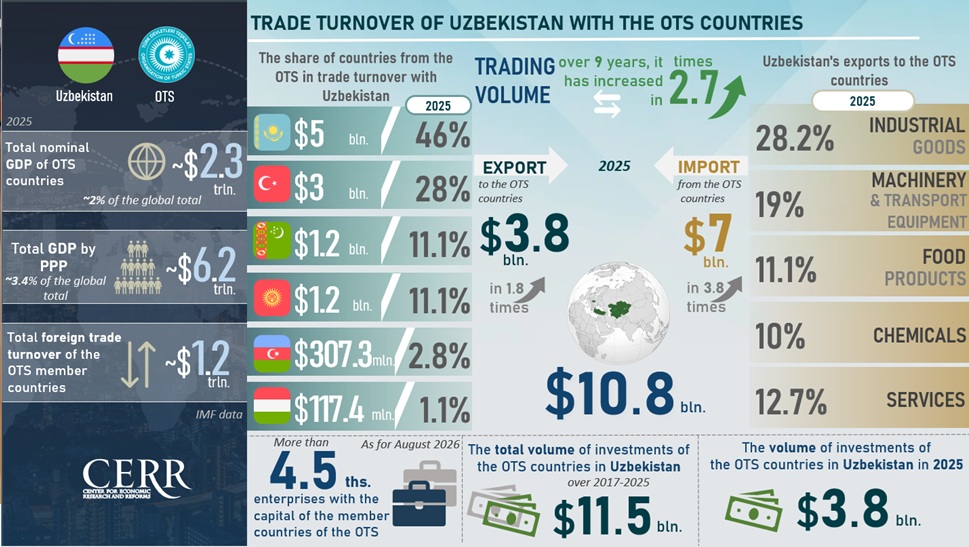
Uzbekistan has moved its economic cooperation with the Turkic states into a practical dimension
Ahead of the 13th Summit of the Organization of Turkic States, scheduled to be held in Ankara, economic cooperation within the OTS is acquiring new substance.
Water security in the turkic world: shared interests and common solutions
Water is a precious blessing that transcends national borders and has long connected peoples and civilizations.

Strengthening Transport Connectivity in Asia through the Development of the Trans-Caspian International Transport Corridor
Shifting international supply chains and expanding trade in Asia are driving demand for sustainable transport routes. For businesses, predictable delivery times, competitive rates, and reliable access to foreign markets are becoming increasingly important.