
Active diplomacy of Uzbekistan: 2025 - from dynamic dialogue to concrete results
2025 has become for Uzbekistan a stage of qualitative renewal and strengthening of its foreign policy positions. In a complex and ambiguous international situation, characterized by growing geopolitical tensions, transformation of global institutions and increased competition for resources and markets, Uzbekistan, under the leadership of President Shavkat Mirziyoyev, has consistently pursued an open, pragmatic, active and proactive foreign policy. It was this approach that made it possible not only to maintain the sustainability of external relations, but also to give them a new content that corresponds to the long-term interests of the country and the tasks of internal development.
As the President of Uzbekistan Shavkat Mirziyoyev emphasized on December 26, 2025 in his Address to the Oliy Majlis and the people, “recently the country has become an international dialogue platform where global issues are discussed.”
The diplomatic strategy of New Uzbekistan, as an integral part of the large-scale socio-economic reforms carried out in the country, was aimed at creating favorable external conditions for modernizing the economy, attracting investment, foreign tourists, expanding export potential, as well as strengthening humanitarian and cultural ties. The foreign policy course has invariably been based on the principles of openness, equal partnership, mutual respect, non-interference in the internal affairs of states and strict adherence to international law.
Political dialogue at the highest level with prominent world leaders has reached a new level and has become regular. New agreements were reached with the leaders of the United States, China, Russia, France, Italy, Turkey, South Korea, Japan, Malaysia and a number of Arab states. In 2025, the number of bilateral meetings at the level of heads of state and government exceeded 55, indicating an increase in mutual trust with foreign partners.
A similar trend was observed in the development of intensive high-level political dialogue. During the year, high-level delegations of Uzbekistan made 172 visits to 93 countries of the world, covering almost all key regions of the planet. Representatives of ministries, departments and regional administrations also played a significant role in filling the international agenda, who, with the assistance of diplomatic missions, made about 300 official trips to more than 50 countries, which made it possible to bring external relations to an applied, practice-oriented level.
Acting as an active host, Uzbekistan has become one of the centers of world diplomacy. This is clearly confirmed by the fact that forums, assemblies and conferences of the World Inter-Parliamentary Union, the UN Civil Service, the UNESCO General Conference, the International Climate Conference, the Tashkent Summit of the countries of the region and a number of other major events were organized in the country. There were over 120 high-level foreign delegations in our country, as well as about 300 delegations from regional government bodies of foreign countries. These contacts contributed to the development of interregional cooperation, the establishment of direct ties between business circles and the expansion of the legal framework for interaction.
Central Asia traditionally occupies a special place in the foreign policy strategy of Uzbekistan. In 2025, this priority received further institutional development. Uzbekistan chaired the Consultative Meeting of the Heads of State of Central Asia, and for the first time the chairmanship was carried out on the basis of a separate comprehensive program. It covered issues of economic interaction, transport connectivity, ecology, rational use of water resources and humanitarian exchanges.
The holding of more than twenty major events and the historic summit of heads of state of the region held in Tashkent under the chairmanship of President Shavkat Mirziyoyev became the culmination of regional diplomacy of the year and confirmed the desire of the Central Asian countries to deepen trust and joint development.
Today we can confidently say that our vast region is becoming united for the first time in a long time, a full-fledged subject of world politics. This is evidenced by the growing attention of the international community and the changing perception of the region on the global stage. A striking example is the development of the “Central Asia Plus” formats, which in 2025 were filled with new specific practical content. The holding of summits with the European Union, China, Russia, the United States and Japan clearly demonstrated the increased role of the region in global politics and strengthened its position as a space of stability, predictability and mutually beneficial cooperation.
An important direction of foreign policy in 2025 was the further expansion of its geography. Along with traditional partners in the CIS, Europe and Asia, contacts with the countries of Eastern Europe, the Middle East, Africa and South America have intensified. The holding of the first in history bilateral events at the highest level with Slovakia, Serbia, Jordan, Paraguay and a number of other states became evidence of the consistent expansion of Uzbekistan’s international presence. As a result, the total number of countries with which the republic maintains diplomatic relations has reached 165.
Against this background, events that had a strategic impact on the country’s foreign policy positioning acquired special significance in the international life of Uzbekistan in 2025. The signing of the Enhanced Partnership and Cooperation Agreement with the European Union and the visit of President Shavkat Mirziyoyev to Brussels marked the transition of relations with the EU to a qualitatively new level. The document created a solid legal basis for deepening political dialogue, expanding trade and economic ties, attracting investments and developing cooperation in the areas of sustainable development, green economy and digitalization, and also reflected the high assessment by European partners of the reforms carried out in Uzbekistan.
Continuing the course to expand and deepen interaction with key global centers of power, Uzbekistan continued to progressively develop relations with the United States America. A landmark event in this direction was the successful outcome of the C5+1 summit held in Washington in November, which brought together the leaders of the United States and Central Asian states. The role of Uzbekistan in this format is assessed by international experts and politicians as a key initiator of regional cooperation and a responsible partner of the United States in matters of sustainable development, security, economic interaction and expansion of humanitarian ties.
An equally significant event was the participation of the President of Uzbekistan in the meeting of the UN General Assembly. The speech of the head of state at the main international platform confirmed the country’s commitment to the principles of multilateralism, peaceful dialogue and collective search for solutions to pressing global problems.
In 2025, at the initiative of Uzbekistan, the UN General Assembly adopted four resolutions reflecting the country’s priorities in the field of sustainable development, regional security and humanitarian cooperation. In addition, Uzbekistan was elected to a number of authoritative UN bodies, which was evidence of growing confidence on the part of the international community.
The historic event of the year was the holding of the 43rd session of the UNESCO General Conference in Samarkand. For the first time in the last forty years, this forum was held outside of Paris, which became an unprecedented recognition of the cultural, historical and civilizational significance of Uzbekistan. For several days, Samarkand turned into a global platform for dialogue on issues of education, science and culture, strengthening the humanitarian dimension of the country’s foreign policy and its image as one of the centers of intercivilizational interaction.
In parallel with active political diplomacy, economic diplomacy developed dynamically in 2025, which was finally established as one of the key instruments of foreign policy. Systematic work in the format “Ministry of Foreign Affairs - diplomatic missions - sectoral departments - regions” made it possible to achieve tangible results in attracting foreign investment and expanding foreign economic relations. Over the ten months of the year, with the assistance of diplomatic missions, 34.4 billion US dollars of foreign investment were disbursed.
The effectiveness of the economic policy being pursued was highly praised by international financial institutions and rating agencies. In 2025, Fitch Ratings and S&P raised the sovereign rating of Uzbekistan from BB- to BB, and Moody’s changed the outlook from stable to positive, indicating increased confidence in the country’s economy and the sustainability of ongoing reforms.
The intensification of foreign economic activity also contributed to the growth of foreign trade indicators. Over the eleven months of 2025, the volume of foreign trade turnover reached $72.7 billion, with exports amounting to $30.8 billion, an increase of $6.6 billion compared to the same period of the previous year. A significant reduction in the negative balance in foreign trade was the result of the targeted work of diplomatic missions to diversify markets and promote domestic products abroad.
The development of tourism as an element of “soft power” played an important role in the formation of a positive international image of the country in 2025. Over eleven months, 10.7 million foreign tourists visited the country. According to statistics, every month Uzbekistan provides hospitality to over one million foreign citizens. Active participation in international exhibitions, large-scale presentation events abroad and the holding of the first Tourism Forum “Central Asia - European Union” in Tashkent contributed to strengthening the position of Uzbekistan as one of the most promising tourist destinations in the region.
Significant attention in the past year was paid to protecting the rights and interests of citizens of Uzbekistan abroad, which is an important humanitarian dimension of foreign policy. From January to September 2025, over 385 thousand consular actions were carried out, illegally seized documents were returned, wage arrears were collected, and programs for the return of compatriots to their homeland were being implemented. At the same time, digital consular services were improved, the geography of visa-free and simplified entry for citizens of Uzbekistan was expanded, and interaction with diasporas was strengthened.
Thus, summing up the results of 2025, we can confidently state that the foreign policy of Uzbekistan has demonstrated a high degree of maturity, consistency and effectiveness. The country not only strengthened its position in the international arena, but also used diplomatic tools to promote internal development, increase investment attractiveness and improve the quality of life of citizens. Uzbekistan ends the year with an expanded network of partnerships, a solid legal framework and a clear vision of future goals, remaining open to the world and looking to the future with optimism.
IA "Dunyo"
Related news
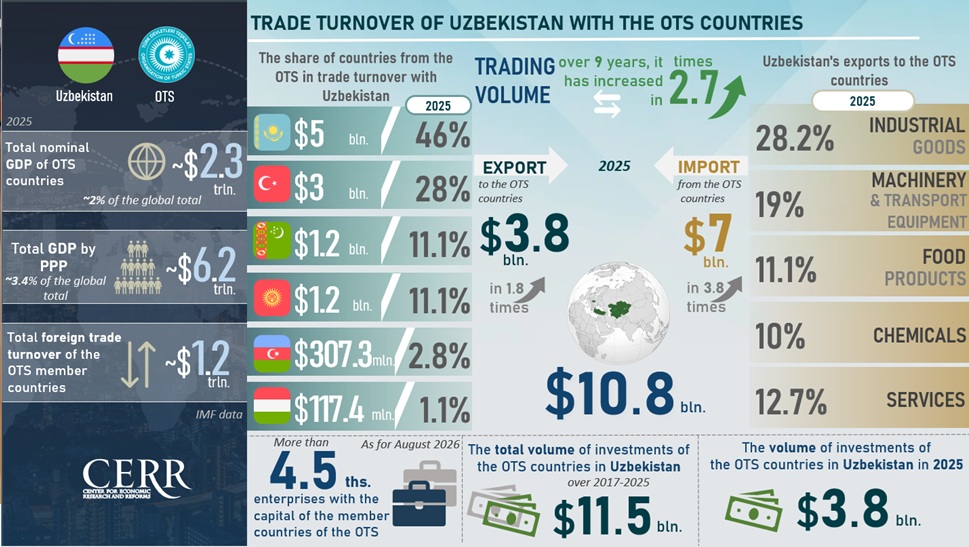
Uzbekistan has moved its economic cooperation with the Turkic states into a practical dimension
Ahead of the 13th Summit of the Organization of Turkic States, scheduled to be held in Ankara, economic cooperation within the OTS is acquiring new substance.
Water security in the turkic world: shared interests and common solutions
Water is a precious blessing that transcends national borders and has long connected peoples and civilizations.

Strengthening Transport Connectivity in Asia through the Development of the Trans-Caspian International Transport Corridor
Shifting international supply chains and expanding trade in Asia are driving demand for sustainable transport routes. For businesses, predictable delivery times, competitive rates, and reliable access to foreign markets are becoming increasingly important.