
Address by the President of the Republic of Uzbekistan Shavkat Mirziyoyev at the Eighth Consultative Meeting of the Heads of State of Central Asia and Azerbaijan
Dear Serdar Gurbangulyyevich! Distinguished colleagues!
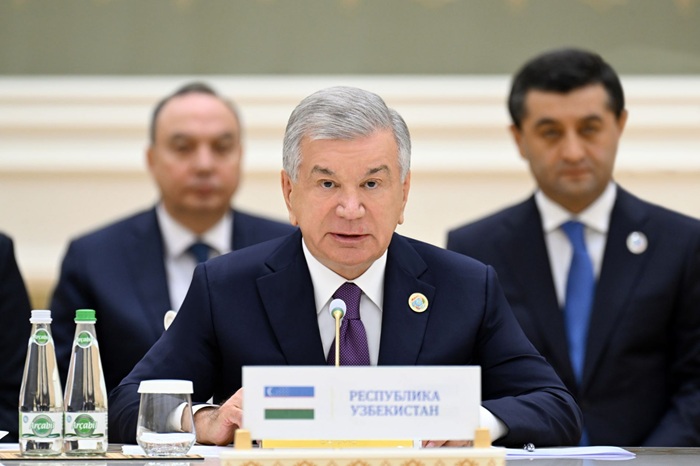
Dear Serdar Gurbangulyyevich!
Distinguished colleagues!
I join in the words of gratitude addressed to the President of Turkmenistan, distinguished Serdar Gurbangulyyevich Berdimuhamedov, for the warm welcome and the excellent organization of our meeting.
We have gathered once again on the Caspian coast, in Avaza.
Our meeting today holds special significance, as it is being held for the first time jointly with brotherly Azerbaijan.
I would like to specifically highlight Turkmenistan’s chairmanship. Over the past year, we have managed to make significant progress in regional cooperation and reach concrete agreements on a number of key issues.
I express special appreciation to the National Leader of the Turkmen people, dear Gurbanguly Myalikgulyevich Berdimuhamedov, who for many years has been making a tremendous personal contribution to strengthening friendship and good-neighborly relations between our countries.
Distinguished heads of delegations!
In recent years, Central Asia has changed significantly. The very atmosphere of relations between our countries has transformed.
We have begun to meet more frequently, discuss issues openly, find solutions and support one another.
Our Consultative Meetings have played a major role in this.
When establishing this format, we were guided by a simple understanding: the prosperity and security of Central Asia rely directly on the trust between our states.
The completion of the procedure for concluding the Treaty on Friendship, Good-Neighborliness and Cooperation for the Development of Central Asia in the 21st Century has become a historic event.
At the same time, we do not seek to create cumbersome structures. We need a flexible and transparent format in which strong, sovereign, and independent states cooperate on the basis of mutual respect, trust, and pragmatism.
This very approach has already yielded results. The region is represented much more confidently and prominently on the international arena. This is evidenced by both the growing interest in "Central Asia Plus" formats and the continuous expansion of our circle of external partners.
Distinguished colleagues!
Our close cooperation is taking place in a challenging time. The world is changing rapidly, tensions are rising, trade and transport links are being reshaped and new risks are emerging. In such a situation, it is crucial to coordinate our actions even more closely.
I would like to outline several areas that we consider particularly important for future joint efforts.
First. We need to define the next stage of cooperation between Central Asia and neighboring regions.
In fact, we can build a single space for cooperation with well-established historical, economic and transport ties.
Today, we have the opportunity to make these ties much stronger and to fill them with practical content.
We are talking about a vast region where our countries can jointly develop trade, transport, energy, industry and new technologies.
We propose discussing these issues in detail at the international conference "Interregional Dialogue for Peace and Sustainable Connectivity: A Central Asian Approach" which we will host next year in Tashkent.
Second. We need to strengthen the foundation on which our regional dialogue is built.
We propose to continue work on enhancing the legal framework that regulates the activity of the Consultative Meetings of the Heads of State of Central Asia.
At the same time, the number of documents in itself does not solve much. What matters far more is that the decisions we have already taken are implemented and deliver the results they were intended to achieve.
Third. Economic cooperation must be elevated to a new level.
We have already set ambitious goals for increasing mutual trade and investment. Now it is necessary to determine what will drive this growth.
First and foremost, this concerns joint industrial and technological value chains, shared digital services, and investment mechanisms that will enable us to launch major projects more quickly.
The Comprehensive Regional Programme for Trade and Economic Cooperation until 2035 has an important role to play in this regard. It should serve as a practical tool to help us leverage the region’s greatest advantage: our shared geography.
To achieve this, it is necessary to consistently remove trade barriers, expand industrial cooperation and launch more joint projects.
We have already reached a point where standard mutual trade is no longer sufficient; we need to create finished products together.
The formula "six economies – one product" perfectly captures the essence of what we should strive for.
When enterprises from several countries participate in a single production chain and create products together, entirely different and far stronger ties emerge between our economies. They are much more durable than a conventional exchange of goods.
To advance this work, we propose to hold a Central Asia-Azerbaijan business forum in the ancient city of Khiva in 2027.
At the same time, we consider it important to establish a special Platform for Financial and Technical Support of Joint Investment Projects.
Major initiatives require not only investment but also thorough preparation, expert assessment, clear financial instruments and ongoing support.
I propose to instruct the Council of Ministers of Trade and Investment to consider this matter in detail during its next meeting in Ashgabat.
Fourth. We need to connect our countries through a modern transport and logistics network.
We can become one of the key land routes for global trade and, at the same time, a major hub of economic activity. But to achieve this, it is not enough simply to build roads and railways.
We need a common approach to the development of transport infrastructure. Major projects need to be coordinated with one another so that the routes complement each other and function as a unified system.
Production facilities, logistics and service facilities, and industrial zones should be developed along the new transport corridors. Such a transport route creates economic activity around it and generates a much greater impact for each country through which it passes.
To ensure coordination, we propose to accelerate the establishment of the Council for Infrastructure Development. We are ready to host the first meeting of the Council in Uzbekistan.
Energy holds a special place in the overall agenda.
Our region has a diverse range of resources. It has significant hydrocarbon reserves, as well as substantial potential for hydropower, solar and wind generation. It is precisely this diversity that enables our countries to complement one another.
We need to make wise use of this potential and take a comprehensive approach to the development of the region’s energy sector.
“Green” energy will play an increasingly important role in this area.
We propose developing a Joint Concept for Low-Carbon Energy Potential. It will enable better coordination of the development of new generation capacity, the deployment of modern energy storage systems, and the creation of new energy corridors.
Another area that requires joint solutions is water and climate.
Water scarcity is becoming an increasingly serious constraint on the development of Central Asia. The climate is changing, the population is growing, and the pressure on agriculture and infrastructure is increasing.
Therefore, we need to have a more accurate understanding of how much water we have and how it is being used.
We need modern digital monitoring systems, the modernization of irrigation networks, and the widespread adoption of water-saving technologies.
Today, significant water losses are costing our region far too much.
That is why it is important to fully implement our joint initiative on the Decade of Practical Action for the Rational Use of Water Resources in Central Asia.
Starting next year, Uzbekistan will assume the chairmanship of the International Fund for Saving the Aral Sea. We regard this role as a great responsibility.
During our chairmanship, we intend to make the Fund’s work more effective, launch new environmental projects, and attract additional funding.
Particular attention should be paid to dialogue with Afghanistan on the use of water resources. This dialogue should be continuous and substantive, with due consideration given to the interests of all countries in the region.
One of the most pressing challenges facing our cities is air pollution.
Recently, Uzbekistan proposed establishing the International Consortium “Clean Air of Central Asia.”
We could launch its activities with a specific joint project: a pilot Programme for the Environmental Modernization of Industrial Zones, Agro-clusters and Transport Hubs in our countries. This would allow us to move from discussing the problem to practical action in areas where the environmental burden is particularly high.
Another area that is rapidly growing in importance is critical minerals.
Our countries possess significant reserves of raw materials essential for modern industry, energy, and new technologies.
Here, it is important for us to act together. We propose stepping up efforts to establish the Regional Alliance on Critical Minerals, an initiative put forward by Uzbekistan.
One of the first steps could be the creation of a Unified Digital Map of Critical Mineral Reserves in Central Asia. Such a resource would provide a more comprehensive picture of the region’s potential and demonstrate to international investors that our countries are ready to develop this area together.
The next major set of issues is related to technological development.
Artificial intelligence and big data are already transforming industry, transport, energy, agriculture, education, and public administration.
The productivity of our economies and their ability to compete in the future will depend to a large extent on these technologies. At the same time, digital projects often have faster results than large-scale infrastructure development.
Therefore, we propose pooling the capabilities of our countries and launching the creation of a Common Computing Infrastructure. Its foundation could be an interconnected network of national data centers. This would enable more efficient use of computing capacity, support the development of our own digital products, and create the conditions for major artificial intelligence projects.
However, infrastructure alone is not enough. We need skilled professionals, scientific research, and strong technology companies.
Therefore, we propose launching joint programmes to train specialists for key industries, supporting scientific projects, and creating more opportunities for technological entrepreneurship.
Finally, one of the most important issues for the future of our region is our people.
Our countries have significant demographic potential. The population is growing, the number of young people is increasing, and the quality of their education and professional training will largely determine what the region’s economy will look like in ten, twenty, and thirty years.
Therefore, education and youth support should have a special place in our cooperation. We need to have a clear understanding of what specialists our economies will need in the future.
To this end, we propose developing a Regional Atlas of In-Demand Professions and Skills. It could bring together our countries’ forecasts for areas where there is already a shortage of specialists and where demand is expected to grow in the coming years.
This would enable universities and vocational education institutions to take the real needs of the economy into account in advance.
In the longer term, we could train specialists for specific major projects being implemented across several countries of the region. This way, education would be directly linked to the development of industry, transport, energy, digital technologies, and other sectors.
Distinguished Heads of State!
Over the past few years, we have achieved a great deal.
Now it is important to consolidate these achievements and make cooperation among our countries sustainable for decades to come.
Our formula is simple: solidarity and trust – for the sake of development and security.
We are responsible for the kind of region we will leave to future generations. It should be peaceful, secure, economically strong, and provide people with opportunities to live, work, study, and raise their children with dignity.
We congratulate Azerbaijan on assuming the chairmanship of the Consultative Meeting. We are confident that under the leadership of the Azerbaijani side, our work within this format will gain further momentum, while our fraternal cooperation will contribute to strengthening unity, trust and solidarity.
In conclusion, I would once again like to sincerely thank His Excellency Serdar Gurbangulyyevich Berdimuhamedov for the warm hospitality and excellent organization of our meeting on the hospitable land of Turkmenistan.
Related news
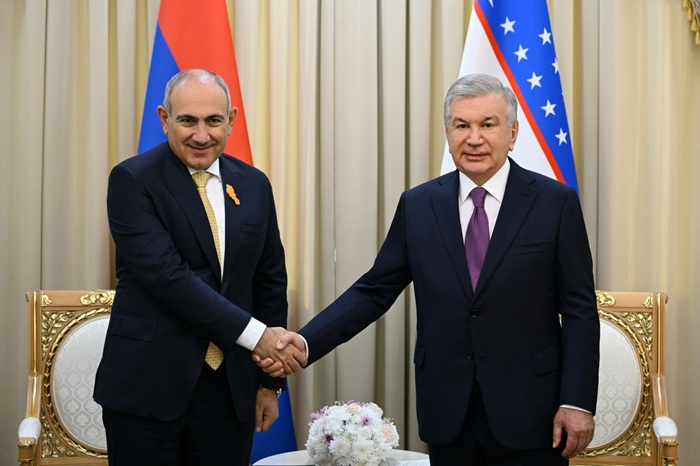
President of Uzbekistan discusses development of bilateral relations with Prime Minister of Armenia
On October 8, on the sidelines of events in Avaza, President Shavkat Mirziyoyev met with Prime Minister Nikol Pashinyan of Armenia.
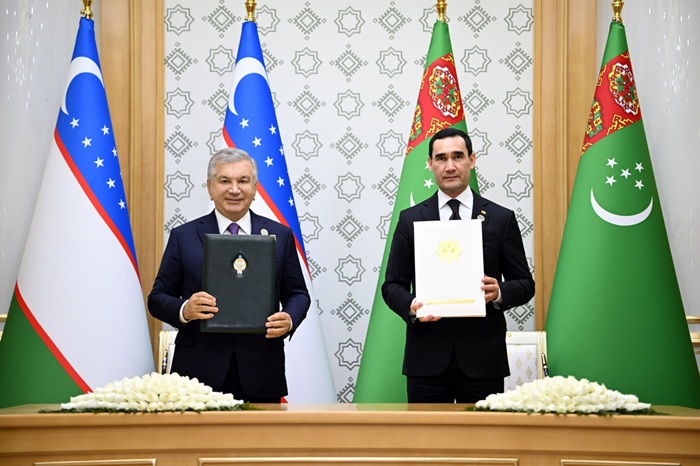
Uzbekistan and Turkmenistan sign Agreement on Establishment of High-Level Strategic Partnership Council
President of the Republic of Uzbekistan Shavkat Mirziyoyev met with President of Turkmenistan Serdar Berdymukhamedov.
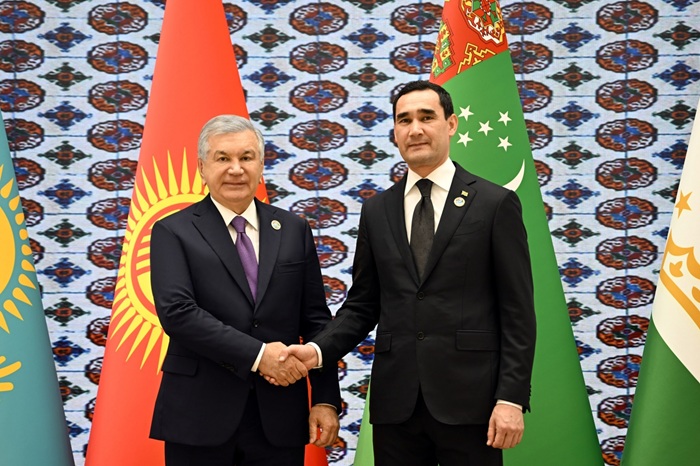
President of Uzbekistan outlines key areas of cooperation within the Consultative Meetings of the Heads of State of Central Asia and Azerbaijan
President of the Republic of Uzbekistan Shavkat Mirziyoyev participated in the eighth Consultative Meeting of the Heads of State of Central Asia and Azerbaijan, held on October 8 in the Avaza National Tourist Zone in Turkmenistan.