
If you want peace, be friends with your neighbors
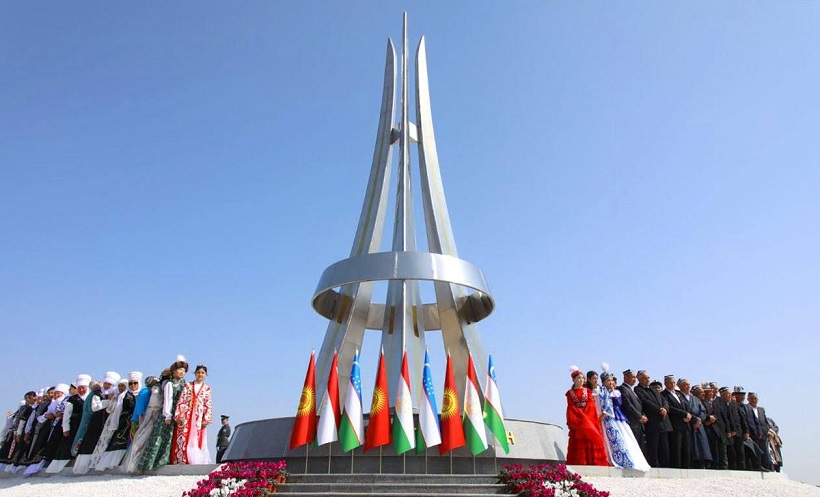
Among experts, the Latin phrase “si vis pacem, para bellum” is often used, which translates as “if you want peace, prepare for war.” It is emphasized that only force can guarantee peace.
The observed processes in Central Asia in recent years indicate the opposite. Thus, against the backdrop of geopolitical turbulence, the countries of the region regularly pursue policies based primarily on the principles of dialogue and good neighborliness.
In a short time, the appearance of the region has changed dramatically, common points of growth are being formed, and mutual trust is becoming an important condition for sustainability. Common development triggers are identified: the formation of a common economic space, the active attraction of investments, and the strengthening of cultural and humanitarian ties. A spirit of unity and solidarity has formed in the region.
As the leader of Uzbekistan Shavkat Mirziyoyev noted at the 80th session of the UN General Assembly, “Central Asia today is already different - it is united and strong, open to dialogue and full-scale partnership.”.
The political transformation of the region is reinforced progressive economic dynamics showing the growing power of the region. In particular, over the past 10 years, Central Asia's GDP has been growing by more than 6% annually - twice as fast as the world average.
Thanks to the political will and joint efforts of state leaders, significant results have been achieved in resolving border issues. An important milestone on this path was the trilateral meeting of the presidents of Uzbekistan, Tajikistan and Kyrgyzstan, held on March 31, 2025 in Khujand.
As a result, an Agreement was signed on the point at which the state borders of the three countries meet - clear evidence that the governments of our states put peace and harmony above all else.
All this confirms the idea that peace can only be achieved through mutual understanding, support and cooperation, which are the basis of friendly relations. We are guided by the principle: “If you want peace, be friends with your neighbors.”This approach reflects the essence of the integration processes taking place in the region, and, of course, deserves the attention of the world community as an “exemplary model” for resolving even the most complex conflicts of our time.
How has humanity understood the world over the centuries?
Throughout the history of mankind, peace was considered as one of the highest spiritual and social values. Even in ancient times, thinkers of Ancient Greece sought to comprehend the phenomenon of airene - a state of harmony, cessation of hostility and stable order in society.
In the philosophical thought of the East, the concept of peace also occupied a special place. It was understood, first of all, as the inner harmony of a person with himself and the world around him, as a path to spiritual balance and moral improvement.
The great thinkers of Central Asia continued to develop the idea of peace, giving it philosophical and humanistic content. Thus, Abu Nasr Farabi considered peace and harmony as an essential condition for the existence of a “virtuous city”, where justice, reason and mutual understanding between people become the basis of public well-being. Alisher Navoi in his poetic works represented the world as the highest form of spiritual and moral perfection of man, the basis of creation and mutual respect between peoples.
Thus, the idea of peace over the centuries has evolved from an understanding of it as the absence of war to an awareness of spiritual and moral harmony between people and nations.
Why was Fergana chosen as the site of the Forum?
The choice of Fergana as the site of the Forum is not accidental.
The Fergana Valley is a unique geographical space where for centuries peoples speaking different languages and professing different religions coexisted peacefully. The Great Silk Road passed through the valley; its inhabitants were engaged in crafts, trade, science and always strived for mutual understanding and dialogue. Conflict is an alien concept for the region.
Today the Fergana Valley unites the territories of three independent states, relations between which are built on the principles of good neighborliness, mutual respect, sovereignty and territorial integrity.
The Fergana Valley is the most densely populated region of Central Asia. According to data, about 11 million people live in the Andijan, Namangan and Fergana regions of Uzbekistan alone, which is almost a third of the country’s population. If we take into account the population of the territories of neighboring states geographically belonging to the region, the total figure will be about 17 million.
Taking this into account, the countries of Central Asia are persistently striving to deepen regional integration, considering it as an important condition for sustainable development. Strengthening mutual trust and partnership is becoming one of the key directions of their foreign policy. For discussion of specific steps and exchange of experience, platforms are required that promote open dialogue and coordination of positions.
One of these platforms will be the Fergana Peace Forum, which will be held on October 15-16 at Fergana State University. It will be attended by representatives of government bodies and business circles of Uzbekistan, Kyrgyzstan and Tajikistan, experts from scientific, analytical and research centers, as well as delegates from the CIS, SCO, OSCE, UNDP, EU and other international organizations.
In addition, the Fergana Valley is a multinational region where representatives of all peoples and ethnic groups live in peace and agreement.
In this regard, the attention that the government pays to strengthening interethnic friendship, creating conditions for all citizens to receive education in their native language and study national culture is important.
Today, there are more than 250 schools in the Fergana, Namangan and Andijan regions, where education is conducted in Kyrgyz, Russian and Tajik languages.
It is necessary to emphasize the important role of regional divisions of national-cultural centers involved in ensuring interethnic harmony, developing intercultural dialogue and tolerance, as well as strengthening good neighborly relations with neighboring states.
In this direction, various activities are carried out by 17 national-cultural centers (8 - in Fergana, 5 - in Andijan and 4 - in Namangan regions), including Russian, Slavic, Korean, Jewish, German, Tatar, Kyrgyz, Uyghur, Tajik and Turkish.
The activities of public associations, foundations and NGOs that implement socially significant projects - both at the expense of domestic donors and with the support of international organizations and foreign ones - deserve special mention partners such as the World Bank, UNDP, UN Population Fund, UN Women, European Union, International Organization for Migration, Saferworld, DVV International, Fair and Sustainable Development Solutions, DIA International and others.
The implementation of such projects helps to ensure access to social protection, develop entrepreneurial skills, increase the activity of women and youth in public affairs, as well as strengthen mutual understanding and friendship between residents of border areas.
In general, the first-ever Fergana Peace Forum opens a new page in the development of good neighborliness and partnership between the countries of the region.
In this case, the choice of the Fergana Valley as a venue reflects its historical role as a space of mutual understanding and harmony. Undoubtedly, this forum will provide additional incentive to further strengthen stability and expand cooperation in Central Asia.
Abror Yusupov,
PhDin political science, associate professor,
Deputy Director
Center for Analysis Democratic Processes
Related news
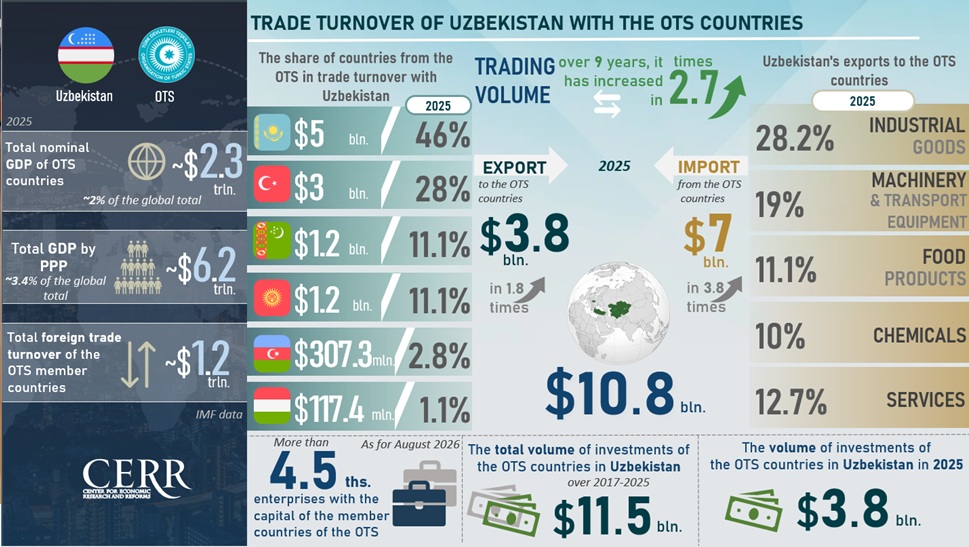
Uzbekistan has moved its economic cooperation with the Turkic states into a practical dimension
Ahead of the 13th Summit of the Organization of Turkic States, scheduled to be held in Ankara, economic cooperation within the OTS is acquiring new substance.
Water security in the turkic world: shared interests and common solutions
Water is a precious blessing that transcends national borders and has long connected peoples and civilizations.

Strengthening Transport Connectivity in Asia through the Development of the Trans-Caspian International Transport Corridor
Shifting international supply chains and expanding trade in Asia are driving demand for sustainable transport routes. For businesses, predictable delivery times, competitive rates, and reliable access to foreign markets are becoming increasingly important.