
Uzbek-Finnish cooperation: new dynamics and practical areas of interaction
The sustainability of the Finnish model and the dynamics of Uzbek reforms create a solid basis for deepening cooperation between the two countries. Finland combines technological leadership, effective management and developed social policy. A mixed development model with a high level of government regulation and an active private sector is based on the principles of long-term planning, technological leadership and equity.
Balanced economic policies keep inflation at 2-3% with a high credit rating of AA+. The research base is funded as part of the government strategy. Total R&D expenditure exceeds 3% of GDP, reaching €8.4 billion in 2023, up 6.3% year-on-year. Contributions came from the public sector, universities and businesses.
The Finnish economy remains open and export-oriented. Foreign trade in 2024 amounted to 146.5 billion euros, of which exports were 72.2 billion euros and imports were 74.3 billion euros. Technological specialization, a developed digital environment and high human capital create a predictable environment for investors.
In parallel, Uzbekistan has acted as an accelerator of reforms in Central Asia over the past eight years. The country's GDP doubled and reached $115 billion. Investments in fixed capital since 2017 amounted to $240 billion, over $130 billion came from foreign sources. International reserves exceeded $48 billion. The structure of output is changing. The share of industry increased from 20 to 26%, the share of the service sector increased from 44 to 47%, and labor productivity increased by 45%. Regulatory changes have expanded the space for private capital, and transport and energy projects have provided a new basis for industrialization and exports.
As a result of reforms, Uzbekistan’s trade with the countries of the European Union is reaching a stable trajectory. For the period 2017-2024. Trade turnover between Uzbekistan and the European Union increased 2.4 times from 2.6 to 6.4 billion dollars. In 2024, exports increased by almost 27% compared to 2023, while imports remained at a comparable level.
A new stage of bilateral political relations and trade and economic interaction
The positive dynamics in Uzbek-Finnish relations are especially noticeable.
Regular contacts at the highest level have given new impetus to the development of bilateral dialogue.
So, on November 12, 2024, in Baku, on the sidelines of the COP29 Summit, a meeting was held between the President of Uzbekistan Shavkat Mirziyoyev and the President of Finland Alexander Stubb. The parties discussed prospects for cooperation in the areas of green economy, renewable energy, innovation and education, and also exchanged views on issues of sustainable development and the climate agenda.
The political dialogue continued with a telephone conversation on September 9, 2025, during which the heads of state considered ways to expand economic and humanitarian cooperation.
In addition, at the end An official visit of the President of Finland to Uzbekistan is expected in October 2025, which is intended to consolidate the agreements reached and open new areas of partnership.
Thus, a favorable basis is being formed for deepening trade and economic cooperation, introducing Finnish technologies and attracting investments in priority sectors of the economy of Uzbekistan.
From 2019 to 2024, trade turnover more than tripled to $152 million. Uzbekistan’s exports increased almost 17 times and amounted to $4.73 million, imports from Finland increased almost three times and amounted to $147 million.
Over the past year alone, Uzbekistan’s exports to Finland increased by 56%, and imports by 3.2 times. In January-August 2025, trade volume exceeded $68 million. Trade turnover between the two countries reflects comparative advantages. Thus, Uzbekistan supplies industrial goods and services, while Finland exports machinery and transport equipment, as well as chemical products and food.
Prospects for cooperation
A new agenda for trade and economic cooperation is being formed, taking into account Finnish developments in engineering, clean technologies, digital healthcare, education and R&D management, which are aligned with Uzbekistan’s objectives of technological renewal, energy efficiency and human capital development. In turn, a favorable business environment and large infrastructure projects in the republic reduce costs for foreign companies.
Taking into account the conditions created in Uzbekistan and the country’s development priorities, there is an opportunity to further deepen Uzbek-Finnish cooperation in several areas.
According to estimates of the Center for Economic Research and Reforms, increasing exports to Finland is possible already in short term. Priority is given to positions where Uzbek manufacturers have experience and advantage, in particular, finished textiles and clothing, fruits and nuts, shoes, as well as leather, stone and cement products, copper and semi-finished copper products.
Organizationof logisticsis advisable through the ports of Helsinki and HaminaKotka with a possible reserve in Turku. It makes sense to build sales channels through large networks and distributors, including Kesko and S Group. The key conditions for success are certification according to European Union standards, stability of supply and regular contracts.
Industrial cooperationinvolves a transition to deep processing of products, with a full production cycle, for example in such areas as knitwear, wool, leather, from spinning and dyeing to the production of ready-made clothing. As technological reference points, it is possible to cooperate with such Finnish companies as Lapuan Kankurit and Pirtin Kehräämö, as well as the Aalto University Design School. In the agricultural sector, sheep breeding programs based on Finnish lines with scientific support from LUKE are of interest. Such cooperation will strengthen the raw material base of the textile cluster and increase production.
In “digital” and “green” modernizationa partnership in telecom infrastructure and critical systems management is possible with the participation of such leading players as Nokia.
In energy there are prospects for cooperation in such areas as the localization of components for solar installations and storage systems, the development of smart grids and increasing the efficiency of generation in hot climates with the participation of the Finnish companies Valoe, Fortum Solar and Wärtsilä.
For research and materials science, it is advisable to involve VTT and LUT, which will contribute to the formation of a sustainable technological and personnel reserve within the country, opening up export niches in the region.
In mechanical engineering projects with Metso and Valmet on components, service and partial localization are possible. For cargo solutions and handling technology, the competencies of Konecranes and Cargotec are indicative. In climate measurements and water chemistry solutions, Vaisala and Kemira can be reference points.
The cross-cutting priority remains with human capital. It is necessary to establish joint programs with the University of Helsinki, the University of Tampere and the University of Oulu, industrial internships and the introduction of Finnish methods for training engineers, technologists and quality specialists for high-tech industries.
As part of the creation of an institutional environment, unification of border procedures, the launch of green corridors, digital customs and mutual recognition of certificates are required. In addition, it is necessary to work on the creation of industrial and agro-processing clusters, logistics hubs, as well as training and retraining programs.
In the near future, cooperation between Uzbekistan and Finland can be put on a sustainable trajectory. For Finland, Uzbekistan is a reliable supplier of products and components, a new market for technologies and equipment, while for Uzbekistan, deepening cooperation means access to modern solutions and sales channels in Northern Europe.
In conclusionit must be emphasized that the combination of the Finnish model of effective public management, innovation and environmental responsibility with large-scale reforms carried out in Uzbekistan forms a solid basis for the implementation of joint practical projects in manufacturing, energy, telecommunications and education. Such a partnership can not only increase the technological level of the national economy, but also give a new quality to Uzbek-Finnish relations, focused on long-term, sustainable and mutually beneficial development.
Afzal Artikov,
Chief Researcher
Center for Economic Research and Reforms
under the Administration of the President of the Republic Uzbekistan
Related news
Uzbekistan and Azerbaijan Build a New Architecture of Cooperation
Deputy Director of the Institute for Strategic and Regional Studies under the President of Uzbekistan (ISRS) Bakhtiyor Mustafaev commented to a Dunyo IA correspondent on the outcomes of the Uzbekistan-Azerbaijan high-level summit held on August 23–24.
Uzbekistan’s Role in the SCO: Economy, Security and Regional Cooperation
This year, the Shanghai Cooperation Organization (SCO) is celebrating its 25th anniversary.
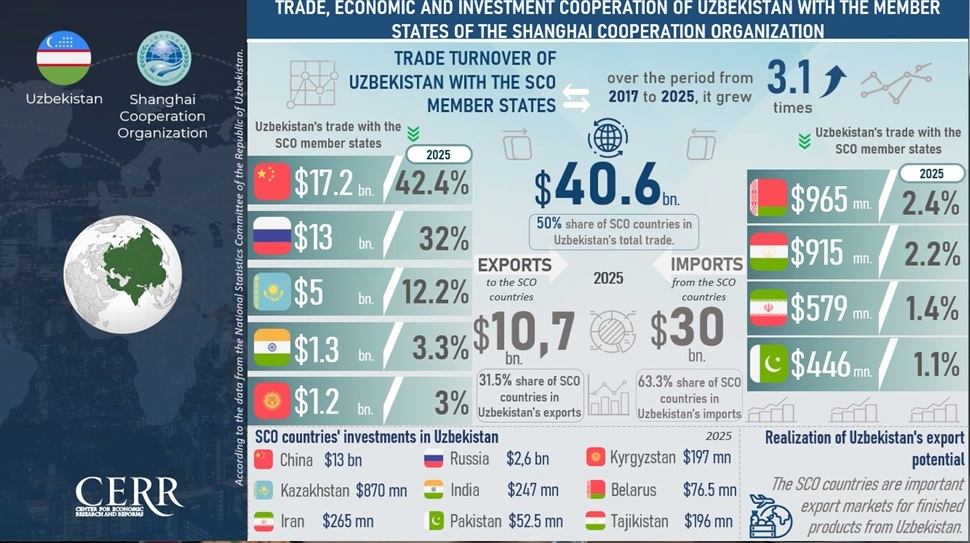
Economic Cooperation of Uzbekistan within the SCO at a New Stage of Development
The global economy is developing amid the restructuring of global supply chains.