
Uzbekistan – Türkiye: prospects for a comprehensive strategic partnership
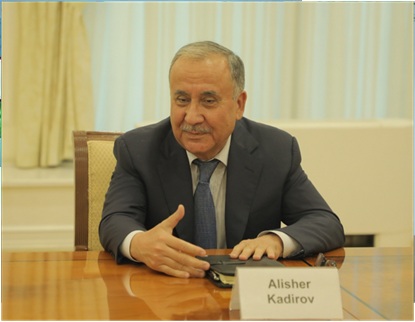
The formula “comprehensive strategic partnership” in relations between Uzbekistan and Turkey in recent years has ceased to be an exclusively diplomatic definition and has acquired real content.
Political dialogue, economic cooperation, humanitarian contacts and transport connectivity are important components of the current systemic Uzbek-Turkish relations.
Analysis of the current state of partnership between the two countries allows us to state that Tashkent and Ankara have successfully formed the institutional architecture of a comprehensive strategic partnership. Its key mechanism is the High-Level Strategic Cooperation Council, co-chaired by the presidents of the two countries, the fourth meeting of which is scheduled for 2026. The format ensures a systematic political dialogue and coordination of joint efforts in a wide range of areas.
The core factor in the effectiveness of the functioning of this institutional system is the active and trusting dialogue between Presidents Shavkat Mirziyoyev and Recep Tayyip Erdogan, supported through regular telephone conversations and frequent meetings on the sidelines of international events. This personal dimension adds dynamics to strategic interaction and creates a favorable background for deepening practical cooperation at the level of governments, business and expert communities of the two countries.
An additional dimension to Uzbek-Turkish relations is given by interaction within the Organization of Turkic States (OTS). The participation of Tashkent and Ankara in the activities of the structure makes it possible to bring state initiatives to a broader regional level and build synergy with other countries of the Turkic world. The UTG summits, including those held in 2025, demonstrated the participants’ desire for practical content in all areas of cooperation - from economics and transport to culture and digital development.
For Uzbekistan and Turkey, this is an opportunity to promote joint projects, harmonize approaches to the regional agenda, and strengthen their positions in the wider geopolitical space.
At the same time, cooperation between Uzbekistan and Turkey has a significant regional and international dimension. Thus, during a meeting in the “4+4” format in January 2026, the parties discussed the situation in Afghanistan, Gaza, Ukraine and Syria, which confirmed the desire of the two states to coordinate positions on current issues on the global agenda.
Against the background of strengthening political understanding and institutional consolidation of the Uzbek-Turkish partnership, priority attention is paid to the economic vector as a driver for the further development of relations.
This is most clearly seen in mutual trade indicators. Trade volume in 2025 was more than $3 billion, showing significant progress compared to eight years ago. The target of bringing trade turnover to $5 billion in the medium term and to $10 billion in the long term remains relevant, reflecting the potential of the two countries.
The structure of economic interaction is of particular importance. This is not only about trade, but also about creating a sustainable investment presence. As of the end of 2025, more than 2,100 enterprises with Turkish capital were operating in the country, which confirmed the sustainability of the Turkish business ecosystem in Uzbekistan. Moreover, this is one of the highest indicators among foreign partners of Uzbekistan. The dynamics of Turkish direct investment clearly reflects the progressive strengthening of this area of cooperation: in 2024, $2.2 billion was disbursed in Uzbekistan, and in January-October 2025 - $2.9 billion.
At the same time, the parties are carrying out systematic work to build up the economic component. In particular, at the 4th meeting of the joint strategic planning group, held on January 21, 2026, progress was noted in the implementation of the Action Plan of the 8th meeting of the Joint Economic Commission (JEC). The key role of SEC as an effective mechanism for the development of practical trade and economic relations is emphasized.
For Uzbekistan, cooperation with Turkey is valuable because Turkish business, along with capital, brings management experience, technology and industrial culture. In turn, the Uzbek market is interesting for Turkey as a dynamically developing economy with a population of 38 million and growing domestic demand. This configuration of interests indicates the long-term complementary nature of relations.
Meanwhile, I would like to note one of the noticeable trends of 2025 - the development of transport connectivity between the two countries, primarily in the aviation sector. The number of weekly flights has reached 97, and their route network has expanded to 8 destinations. Expanding the geography and frequency of direct flights between Tashkent, Samarkand, Namangan, Andijan, Ankara, Istanbul, and Izmir contributes to the growth of business mobility, tourist flows and humanitarian contacts. The launch of new routes by both national and private air carriers has become a real practical step towards further rapprochement.
At the same time, the increase in the number of flights not only creates convenience for passengers, but also has a broader economic effect: it facilitates contacts between entrepreneurs, simplifies participation in exhibitions and negotiations, and ensures the availability of support for joint projects. In the future, this will create conditions for the development of air cargo transportation, which will undoubtedly act as a factor in strengthening trade and economic ties.
In parallel, energy cooperation is also showing positive dynamics. Turkish companies are actively participating in the modernization of the energy infrastructure of Uzbekistan, in particular, in projects for the development of renewable energy sources, which helps to minimize the carbon footprint in the industrial sector and achieve long-term sustainable development goals.
Against this background, it is worth emphasizing the special role of cultural and humanitarian interaction. The commonality of historical, cultural and linguistic roots creates a favorable basis for expanding cooperation in the fields of education, science, culture and tourism. Branches of leading Turkish universities are successfully operating in Uzbekistan, joint educational programs are being implemented, students and teachers are being exchanged.
Indicators of tourist exchange between countries also show steady growth. At the end of 2025, Türkiye entered the top five leading countries in terms of the number of tourists visiting Uzbekistan. In turn, Türkiye is one of the most popular destinations for Uzbek citizens. The figures reflect not only the attractiveness of the Turkish tourism market, but also the overall increase in population mobility. Further promotion of ties in this area will help strengthen intercultural dialogue and public diplomacy. It is they who, in the long term, will form a strong social basis for bilateral partnership.
In general, an analysis of the dynamics of relations in 2025 allows us to identify several areas that could become key in deepening Uzbek-Turkish interaction.
Firstlythe development of industrial cooperation. An already existing network of joint ventures can become the basis for more complex projects aimed at both the domestic market and export to third countries. This approach is fully consistent with the strategic objectives of both economies.
Secondlytransport, logistics and infrastructure. Expanding air travel is certainly an important step, but the potential for cooperation in this area is much wider and includes the development of multimodal transportation, warehouse infrastructure and digital solutions in trade.
Thirdly, the service sector and human capital. Türkiye has significant experience in tourism, medicine, construction, and education. For Uzbekistan, interaction in these areas opens up opportunities not only for borrowing experience, but also for joint entry into regional markets.
To summarize, I would like to emphasize that Uzbek-Turkish relations at the present stage are developing on a trusting, constructive basis, confirming their maturity and stability. The parties demonstrate pragmatism and commitment to the principle of taking into account mutual interests, and the growing number of joint ventures, expanding transport links, growing tourist flow and stable political dialogue form a solid basis for the further development of cooperation.
Alisher Kadirov,
Head of Department, Institute of Strategic and Interregional Studies
under the President of the Republic of Uzbekistan
Related news
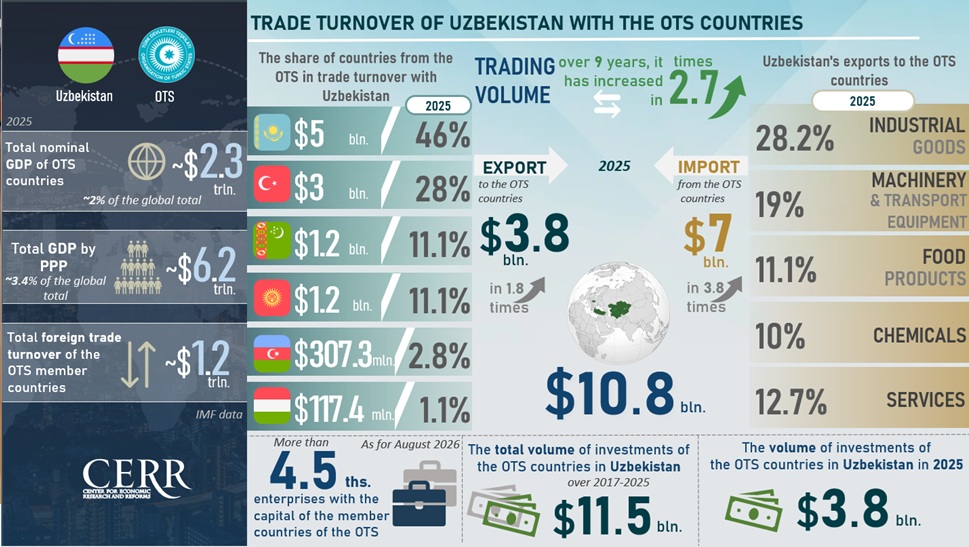
Uzbekistan has moved its economic cooperation with the Turkic states into a practical dimension
Ahead of the 13th Summit of the Organization of Turkic States, scheduled to be held in Ankara, economic cooperation within the OTS is acquiring new substance.
Water security in the turkic world: shared interests and common solutions
Water is a precious blessing that transcends national borders and has long connected peoples and civilizations.

Strengthening Transport Connectivity in Asia through the Development of the Trans-Caspian International Transport Corridor
Shifting international supply chains and expanding trade in Asia are driving demand for sustainable transport routes. For businesses, predictable delivery times, competitive rates, and reliable access to foreign markets are becoming increasingly important.