
Uzbekistan: path to the group of countries with upper middle income

According to the latest World Bank estimates, there are currently 52 countries classified as upper-middle-income countries. At the same time, the methodological parameters for measuring and establishing threshold values for well-being have changed significantly over the past 25 years.
In this regard, it is advisable to consider the level of well-being of the population in countries according to the modern version of the World Bank methodology. In addition, it seems appropriate to identify the dynamics of the main macro indicators that have contributed to dramatic changes over the past 2 decades. As a result, this will make it possible to determine the trajectory of the implementation of the long-term goal of the economic policy of the Republic of Uzbekistan towards ensuring the country’s transition to the category of states with an upper-middle income, which the government set for itself in the Strategy “Uzbekistan - 2030”.
Achievements of Uzbekistan over 5 years
Under the leadership of President Shavkat Mirziyoyev, Uzbekistan is undergoing a significant transformation that has radically changed its economic landscape.
The country demonstrates openness and sustainable development in key macroeconomic indicators. These changes open up new opportunities for growth, improving the business climate, strengthening international trade ties, expanding innovation and investment in human capital.
Over the past five years (2019–2023), the economy of Uzbekistan has doubled (from $53 billion to $110 billion in 2024), GDP per capita has almost doubled - from $1.6 thousand to $3 thousand in 2024 2024 (according to forecast estimates).
The World Bank has revised its forecast for economic growth of Uzbekistan for 2024 upward to 6%. Moreover, the country is among the three fastest growing economies among developing countries.
The results of the analysis of key macroeconomic indicators indicate significant investments in economic infrastructure and modernization of production facilities.
In 2024, the total volume of investments in fixed assets will be, according to preliminary estimates, $120.1 billion, which corresponds on average to 24% of the Republic's GDP Uzbekistan. Along with the growth in investment, the republic’s economy also demonstrates an increase in indicators in the field of employment and labor productivity.
In 2024, the employment growth rate reached 5.6%, generating a steady increase in employment. Thus, labor productivity increased by 25.1%, which characterizes an increase in the efficiency of the use of labor, technological development and an increase in the competitiveness of the national economy in the long term.
As a result, in 2024, Uzbekistan’s exports doubled, exceeding $25 billion for the first time. At the same time, during the years of liberalization of the national economy, the volume of foreign investments received increased 6 times, which made it possible to create more than 1.5 million. highly paid jobs.
An analysis of the dynamics of macro indicators and the quality of institutions in the context of 52 countries that are currently included in the group of countries with upper-middle income shows that three important factors played a key role in the transformation:
– The presence in the country of a rich potential of natural resources and the implementation ofa savings policy during the periods profitable and favorable conditions in commodity markets. Thanks to rising prices for these resources, these countries were able to raise their income to above average levels.
– The “advantageous” geographical location, in turn, gives an advantage to states as a transit and re-export destination. At the same time, these countries were able to obtain favorable conditions when concluding foreign trade contracts. In particular, these are agreements between Belarus and Russia on export prices for energy resources. Thus, Belarus receives oil and gas from Russia at reduced tariffs.
-Significant population growthin combination with the development of the institutional environment, where the experience of economic development of Malaysia is a striking example.
By comparing the dynamics of macroeconomic parameters according to the World Bank methodology for upper-middle income countries and the economy of the Republic of Uzbekistan over the past 2 decades the following trends can be seen:
2001-2010: this period reflects favorable conditions for the development of the world economy, in particular in the field of foreign trade activities. This is evidenced by high prices for raw materials, especially energy, as well as growing export potential and expanding imports. During this period, countries had the opportunity to pursue a policy of intensive savings of funds and the creation of safety cushions. These trends are typical for countries rich in raw materials. It was during this period that the majority of countries currently included in the upper-middle income category made the transition to this group of countries.
2011-2023:during this period, the global economy overcame the negative consequences of the spread of coronavirus infection COVID-19. At this stage, there was stagnation in foreign economic activity, the logistics chain for the movement of basic goods and energy resources was disrupted, which subsequently became the cause of prolonged inflationary pressure and a crisis in living standards.
Thus, drawing conclusions based on a comparison of the macroeconomic parameters of Uzbekistan with the category of countries with upper-middle income according to the metrics of the World Bank methodology, one can potentially conclude the following guidelines for long-term public policy based on trends in the category of countries with upper-middle income for 2000-2023:
- minimizing the high level of gap between inflation and GDP that does not compensate for the rate of sustainable growth. For 2010-2023 the average values of countries included and included in the category of upper-middle-income countries, taking into account their economic transformations, in terms of inflation amounted to no more than 5.07% on an average annual basis, while the annual GDP growth rate was more than 4.53%;
- Minimizing the devaluation of the national currency and potentially maintaining the current dynamics. It is worth noting that the average value of the real effective exchange rate for the group of countries with upper-middle income over the past 10 years was more than 14%, and in Uzbekistan only in 2023 this figure remained at 8.5%. At the same time, the devaluation of the national currency in Uzbekistan did not exceed 11% during the post-liberalization period.
It is also important to note that in the context of growing economic uncertainty in the world, when comparing indicators of the macroeconomic and institutional environment, the economy of Uzbekistan shows significant positive changes when compared with the development of countries with upper-middle income.
Dynamics of the Gross National Income (GNI) per capita indicator according to the Atlas method developed by the World Bank, Uzbekistan from 2021. shows a significant annual increase from 7.27% to 11.86%. This trend makes the goal of the country's transition in the long term to the category of upper-middle-income countries potentially feasible, taking into account minimizing the gap between GDP growth and inflation, taking into account the further acceleration of GDP growth and the progressive decrease in inflationary pressure, maintaining the current stability of the national currency and improving the quality of institutions.
Bobur Koraboev,
Daria Ugai,
Dilnoza Raimova,
Institute of Budgetary and Tax Scientific Research
under the Ministry of Economy and Finance of the Republic of Uzbekistan
Related news
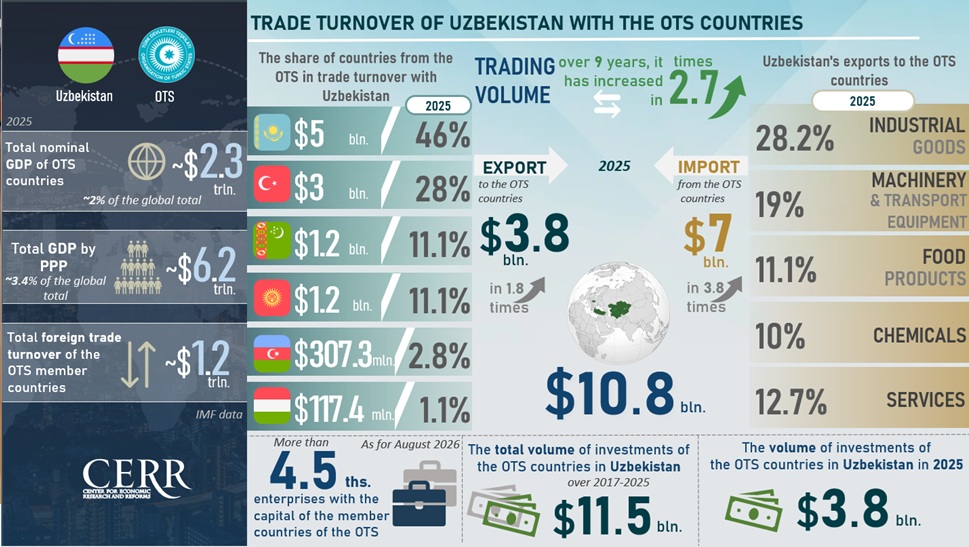
Uzbekistan has moved its economic cooperation with the Turkic states into a practical dimension
Ahead of the 13th Summit of the Organization of Turkic States, scheduled to be held in Ankara, economic cooperation within the OTS is acquiring new substance.
Water security in the turkic world: shared interests and common solutions
Water is a precious blessing that transcends national borders and has long connected peoples and civilizations.

Strengthening Transport Connectivity in Asia through the Development of the Trans-Caspian International Transport Corridor
Shifting international supply chains and expanding trade in Asia are driving demand for sustainable transport routes. For businesses, predictable delivery times, competitive rates, and reliable access to foreign markets are becoming increasingly important.