
Uzbekistan on the Road to 2030: From Strategies to Results
Uzbekistan adopted the UN 2030 Agenda together with 192 other states.
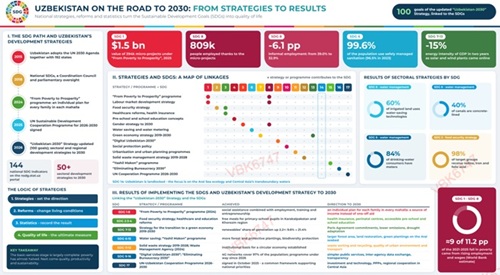
Uzbekistan adopted the UN 2030 Agenda together with 192 other states. The value of this commitment lies not in the signature itself, but in how the global goals are translated into decisions at home. In 2018, the Government approved national Sustainable Development Goals and targets, set up a Coordination Council and placed their implementation under parliamentary oversight. Today, the National Statistics Committee maintains a framework of 144 national SDG indicators, with data publicly available on the open portal nsdg.stat.uz. Civil society also plays a growing role: in recent years, public policy has provided for broader involvement of non-governmental organizations and citizens in addressing social challenges.
This was followed by two Voluntary National Reviews presented to the UN in 2020 and 2023, and the SDGs were integrated into the national “Uzbekistan 2030” Strategy and more than 50 sectoral development strategies through 2030. These sectoral strategies cover social protection, digitalization, gender equality and the green economy. In October 2025, Uzbekistan and the UN signed the Sustainable Development Cooperation Framework for 2026–2030, and a third Voluntary National Review is now being prepared.
The logic of the past few years can be summed up as a chain: national strategies set the direction, reforms change living conditions, statistics capture the results, and the ultimate yardstick is people’s quality of life. Data from recent years shows how well this chain is working.
The “Uzbekistan 2030” Strategy and the national SDGs largely overlap in their priority areas and objectives. More importantly, however, several areas now have concrete instruments that directly drive progress on sustainable development indicators and on sectoral, functional and regional national strategies.
The clearest example is the “From Poverty to Prosperity” program, developed and launched in 2024 as part of a new approach to poverty reduction. Instead of relying mainly on general support, it focuses on individual plans for families in every mahalla, combining social assistance with employment, vocational training and entrepreneurship development. In 2025, more than 394,000 micro-projects worth nearly $1.5 billion were implemented under the program, creating jobs for 809,000 people. The mechanism advances SDG 1 and SDG 8 at the same time: rather than one-off assistance, families gain a source of income. According to World Bank estimates, rising employment and wages accounted for about 9 of the 11.2 percentage points of poverty reduction in 2021–2025.
The agricultural and healthcare development strategies build on the Food Security and Healthy Nutrition Strategy through 2030, which is directly aligned with SDG 2. Free iodine, iron and folic acid supplements have reached 98% of target groups, and free meals have been introduced for primary school students in the Republic of Karakalpakstan and Khorezm Region. In healthcare (SDG 3), results are linked to better-equipped perinatal centers, home visits for mothers and children, and the phased introduction of state health insurance. In education (SDG 4), the emphasis is on accessibility: 97.2% of schools now provide an adapted environment for children with disabilities, up from 55.5% two years earlier. These changes are underpinned by long-term government concepts for the development of preschool and school education.
The energy sector (SDGs 7 and 13) illustrates how investment policy is reshaping an entire industry: the commissioning of solar and wind power plants has been accompanied by a 15% reduction in the energy intensity of GDP over two years, which also supports climate goals. This transition is grounded in the national green economy strategy and its implementation program through 2030. In water management (SDG 6), water-saving technologies now cover 60% of irrigated land, 40% of canals have concrete lining, and 84% of drinking water consumers have meters installed. Digitalization (SDG 9) is advancing under the “Digital Uzbekistan 2030” Strategy: 4G networks now cover 97% of the population. Women’s empowerment (SDGs 5 and 8) is supported by the gender strategy through 2030, legal guarantees of equal rights and measures to expand women’s participation in political and economic life.
Social protection policy and measures to reduce inequality (SDG 10) also play an important role in delivering social outcomes. The strategic approach goes beyond cash support to include access to social services, employment assistance and targeted help for people in vulnerable situations, as well as fostering the growth of the middle class.
The Labor Market Development Strategy is directly linked to SDG 1. Unemployment fell from 6.8% to 4.8%, and among women from 10.4% to 6.5%, while informal employment declined from 39.0% to 32.9%. Formal employment provides not only income, but also pension rights, social insurance and access to credit. These objectives are reflected in government measures to promote employment, support entrepreneurship and formalize labor relations.
The energy strategy has delivered one of the most visible structural shifts: the share of renewables in electricity generation rose from 9.6% to 21.4%, a 2.2-fold increase. This reduces the power system’s dependence on gas and lays the groundwork for meeting climate commitments (SDG 7).
Basic services (SDGs 3, 4, 5 and 6) have become virtually universal. Safely managed sanitation now reaches 99.6% of the population, up from 96.5% in 2023, and water supply 99.9%. Maternal mortality fell from 15.9 to 10.9 per 100,000 live births, a 31% reduction. School-readiness coverage rose from 78.6% to 98.4%, meaning that almost every child now starts first grade with experience of organized learning. The share of women in the Legislative Chamber increased from 32.0% to 39.5%. Behind these changes lie long-term reforms in healthcare, education and gender equality.
Urban development (SDG 11) is increasingly viewed as a policy area in its own right within sustainable development. The “Uzbekistan 2030” Strategy links urban development to affordable housing and utility infrastructure, transport modernization, environmental improvement and balanced territorial development. This agenda is complemented by urbanization and urban planning programs that provide for updating master plans, developing regional centers and improving the quality of the urban environment. In practical terms, this approach means not only building new residential neighborhoods, but also providing them with public transport, green spaces and basic services.
The shift toward responsible consumption and production (SDG 12) builds on the Municipal Solid Waste Management Strategy for 2019–2028 and subsequent measures to develop a circular economy. The establishment in 2024 of the Agency for Waste Management and Circular Economy Development strengthened the institutional foundation of these reforms. The agenda includes expanding waste collection coverage, reducing the number of landfills, sorting and recycling, and using waste for energy generation. As a result, the focus is gradually shifting from simple waste disposal to waste reduction, reuse and bringing secondary resources back into the economy.
Climate policy (SDG 13) brings together the energy transition, energy efficiency improvements and adaptation to growing climate risks. Its key foundations include the Strategy for the Transition to a Green Economy for 2019–2030, Uzbekistan’s commitments under the Paris Agreement and national measures to reduce greenhouse gas emissions. Practical priorities include developing renewable energy, reducing energy intensity, improving emissions monitoring and strengthening preparedness for droughts, dust storms and other natural hazards. For a country whose water and land resources are highly vulnerable, climate adaptation is no longer a stand-alone environmental task but a prerequisite for the resilience of agriculture, infrastructure and quality of life.
SDG 14, which concerns the conservation of marine ecosystems, has a particular dimension for Uzbekistan, a landlocked country. Targets relating directly to marine areas therefore do not form a separate strand of national policy. At the same time, the environmental agenda of the Aral Sea, the restoration of aquatic and riparian ecosystems, and regional cooperation on the sustainable use of transboundary waters are of great importance for sustainable development in Central Asia.
The conservation of terrestrial ecosystems (SDG 15) is supported by the “Yashil Makon” (Green Space) program and by measures to expand forest and protective plantings, restore degraded land and protect biodiversity. The updated “Uzbekistan 2030” Strategy provides for expanding green areas, increasing forest cover, rehabilitating land disturbed by the extractive industry and enlarging protected natural areas. For the Aral Sea region, creating protective green plantations on the dried-up seabed and curbing desertification are of particular importance. Here, results are measured not only by the number of trees planted, but also by their survival rate, land restoration and the preservation of natural habitats.
The institutional dimension of sustainable development (SDG 16) involves strengthening the rule of law, increasing transparency in public administration and combating corruption. These objectives are enshrined among the priorities of the “Uzbekistan 2030” Strategy and in reforms to digitalize public services and reduce administrative barriers, and are further supported by the digitalization of public administration. In particular, the “Eliminating Bureaucracy 2030” program, launched in 2026, provides for cutting excessive administrative procedures, simplifying public services, developing interagency data exchange and making government bodies more transparent. Further contributions come from the development of open data, greater accountability of government bodies and improved mechanisms for interaction between the state and citizens. Seen this way, the quality of institutions is not merely a supporting condition, but a driver in its own right for achieving all the other SDGs.
Finally, SDG 17 – partnerships for sustainable development – reflects the means of implementing the entire 2030 Agenda. For Uzbekistan, this primarily means cooperation with the UN, international financial institutions and development partners, attracting investment and technology, expanding public-private partnerships and strengthening regional cooperation in Central Asia. The UN–Uzbekistan Sustainable Development Cooperation Framework for 2026–2030, signed in October 2025, provides a common basis for supporting national priorities. At the same time, the country’s foreign policy is geared toward good-neighborly relations, the development of transport and trade links, and joint solutions to water and environmental issues. As a result, partnership is not a stand-alone project, but a mechanism for mobilizing resources, knowledge and expertise to achieve national goals.
International assessments confirm that the country is moving in the right direction. In the SDSN’s 2026 Sustainable Development Report, Uzbekistan ranked 65th out of 169 countries with an index score of 73.0. This ranking is based on a different set of indicators, so its score is not directly comparable with the national IMRI index.
Achieving the SDGs is a task not only for the capital, but for every region. In 2026, the SDSN, together with the Ministry of Economy and Finance and the French Development Agency (AFD), calculated an SDG Index for all 14 regions for the first time, based on 45 indicators. Tashkent City leads the ranking with 78.5 points, followed by Namangan Region with 65.9 points. Most regions form a tight cluster in the 61.6–65.9 range, while the greatest room for improvement lies in Kashkadarya (56.3), Surkhandarya (54.9), Tashkent (54.0) and Syrdarya (53.9) regions.
In recent years, Uzbekistan has passed an important milestone. The stage of building the institutional framework for the SDGs and expanding access to basic services is largely complete: poverty has been cut almost by half, electricity, water and school readiness have become virtually universal, and the energy sector is rapidly transforming. A more challenging stage lies ahead, in which success will be measured not by coverage, but by quality, productivity and sustainability. The main challenge on the road to 2030 is not simply to continue reforms, but to ensure that every national strategy delivers measurable results in achieving the Sustainable Development Goals and improving people’s quality of life. This will depend on the alignment of strategies with the budget, the quality of public administration, the targeting of measures in the regions and the ability to measure results honestly. The four remaining years are enough time to turn the momentum achieved into a lasting improvement in quality of life.
Tursun Akhmedov,
Rakhmatullo Ayubov,
Staff members of the Institute for Macroeconomic and Regional Studies
Related news
Policies shaping the future
A country's development is shaped by the opportunities it creates for its young people.

Uzbekistan Simplifies the Process of Launching Tech Business Projects
For technology companies looking to establish a presence abroad, opening an office rarely means relocating the entire team.
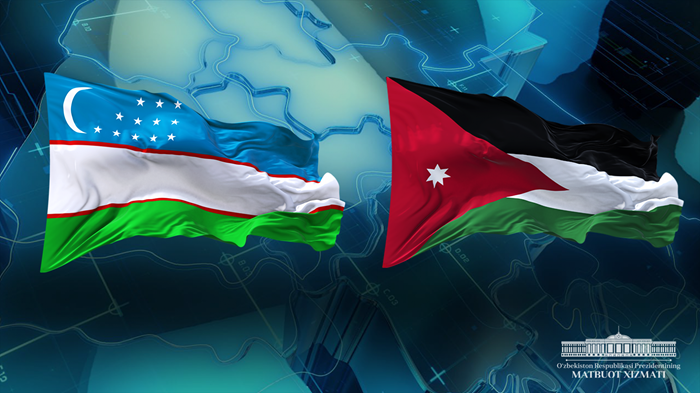
Mutually beneficial relations with the Gulf States: Developing economic cooperation with Jordan
Trade and economic relations between Uzbekistan and Jordan have expanded in recent years, with a significant increase in bilateral trade turnover.