
Uzbekistan – UAE: Partnership for a green future
Relations between the Republic of Uzbekistan and the United Arab Emirates (UAE) have been experiencing a period of rapid growth in recent years, characterized by deepening cooperation in many areas, especially in the field of sustainable development and the green economy.
Against this background, the upcoming visit of the President of Uzbekistan Shavkat Mirziyoyev to the UAE and participation in the “Sustainable Development Week 2025” (ADSW 2025) in Abu Dhabi emphasize the strategic importance of the partnership and the commitment of both countries to the principles of environmentally responsible progress.
It is worth noting that this event acquires exceptional weight in the context of current global challenges and growing cooperation between the two states.
Both Uzbekistan and the UAE are consistently implementing policies of sustainable development and environmental protection, confirming this with concrete actions.
Tashkent’s goal of achieving a 50% share of renewable energy sources in the national energy supply balance sheet by 2030 aligns well with Abu Dhabi's sustainability initiatives. In particular, it is noteworthy in this regard that our state joined the UAE initiative “Tripling Renewable Energy Capacity.”
Undoubtedly, the participation of the Uzbek leader in ADSW 2025 will make it possible to demonstrate the state’s achievements in the field of sustainable development, share a vision of the future and expand opportunities for cooperation with global actors, primarily with the Emirates.
In addition Moreover, this is acquiring a significant role in light of the announcement of 2025 in the republic as the “Year of Environmental Protection and Green Economy,” which creates a unique synergy between international experience and national priorities.
Given these circumstances, it can be stated that our country is implementing an integrated approach to solving environmental problems and sustainable development. The national program for 2025 will focus on the introduction of green technologies, water conservation, landscaping, mitigating the consequences of the Aral disaster, waste management and improving public health.
Large-scale efforts have already been made in this regard. Thus, over the past five years, Uzbekistan has significantly strengthened its environmental policy. A strategy for the transition to a green economy was adopted and the necessary institutions were created, including the Interdepartmental Council. An important step was the transformation of the relevant ministry and the creation of the Climate Council under the President. The culmination of these efforts is the enshrinement of environmental protection provisions in the updated Constitution, which emphasizes the priority of environmental issues at the state level.
In 2021, the Yashil Makon (Green Space) environmental initiative was launched. The project aims to increase the greening of the state's territory to 12.4% by 2030, covering measures such as the creation of new parks and the expansion of forests. Yashil Makon plays a key role in achieving environmental sustainability and meeting international climate obligations.
Uzbekistan has become a regional leader in promoting climate initiatives in Central Asia. At the suggestion of Tashkent, in 2022, the states of the region adopted the Green Agenda program and supported the development of a joint Strategy for adaptation to climate change.
In 2023, the Central Asian University of Environmental Studies and Climate Change (Green University) was opened, on the basis of which the Climate Scientific Forum operates with the involvement of international experts.
The Republic has proven itself to be an active subject of the global environmental agenda, putting forward the adoption of three important UN resolutions. In 2021, she proposed recognizing the Aral Sea region as a zone of environmental innovation, and in 2023, she came up with initiatives for sustainable forest management and strengthening regional environmental cooperation in Central Asia.
These measures clearly illustrate our country’s active involvement in global environmental initiatives and confirm the national course towards the development of a “green” economy.
Undoubtedly, these efforts are actively supported in the international arena, where the UAE occupies a special place.
Uzbek-UAE contacts, which began in 1992 with the establishment of diplomatic ties, over the past three decades have grown into strong strategic cooperation based on mutual respect and trust. An important moment in the development of ties was the visit of the President of Uzbekistan to the UAE in 2019, during which important agreements were signed that laid the foundation for expanding contacts in various fields, including the economy, investment and innovation.
Subsequent visits of high-ranking officials, such as the visit of the Crown Prince of Abu Dhabi Mohammed bin Zayed Al Nahyan to Uzbekistan in November The year 2023 and negotiations between President Shavkat Mirziyoyev and the Emirati delegation led by Sheikh Hamdan bin Mohammed Al Maktoum last year gave new impetus to the development of interstate dialogue.
The visit of the President of Uzbekistan to the COP 28 conference in the UAE became a significant step in strengthening the bilateral dialogue in the field of ecology and sustainable development. This event demonstrated their shared commitment to addressing global environmental challenges and strengthened cooperative ties in promoting green energy.
Thus, relations between Uzbekistan and the UAE continue to develop, covering a wide range of areas of cooperation and contributing to the sustainable progress of the two states.
One of the most dynamically developing areas of Uzbekistan-UAE cooperation is renewable energy sector. The Emirati company Masdar is a reliable and strategic partner in this area.
The flagship project was the Zarafshan wind power plant (WPP) with a capacity of 500 MW in the Navoi region, which was successfully commissioned in 2024. The wind farm is the largest in Central Asia and has the ability to provide electricity to about 500 thousand households, while preventing emissions of about 1.1 million tons of carbon dioxide into the atmosphere per year.
At COP29 in Baku last November, Masdar and the Ministry of Energy agreed to build a wind farm with a capacity of 1 GW in Mingbulak. The implementation of the project will not only increase the production of clean energy, but will also create 600 to 800 new jobs, and will also save 1 billion cubic meters of natural gas annually. Thanks to the construction of wind farms, atmospheric emissions will be reduced by 1.4 million tons per year, and energy security will increase.
Masdar projects in Uzbekistan currently generate 1.5 GW of renewable energy, with another 0.5 GW under construction. The goal is to reach a total capacity of 4 GW.
In addition to wind energy, the company is actively investing in solar energy (SPP) in Uzbekistan. In 2021, the Nur Navoi solar power plant with a capacity of 100 MW was launched. In addition, projects for the construction of solar power plants are being implemented in various regions (Gallaaral, Kattakurgan and Sherabad districts) with a total capacity of about 900 MW.
Emirati companies not only invest in the development of the energy sector, but also actively transfer experience and technologies, stimulating the sustainable development of local energy.
The Uzbek-UAE dialogue on sustainable development goes beyond the energy sector. Countries are actively exchanging experiences and implementing joint projects to combat climate change, desertification, and conserve water resources.
Agriculture and water resource management are critical areas. Uzbekistan, facing the problems of drought and water shortages, is showing great interest in the UAE's innovative technologies in the field of rational water use and the development of agriculture in arid conditions.
Cooperation in this area includes the introduction of advanced irrigation systems, the development of sustainable agriculture and the exchange of experience in adapting agriculture to climate change.
Direct interaction has been established between The Ministry of Food and Water Security of the UAE and the Ministry of Agriculture of Uzbekistan to explore the possibilities of implementing joint programs and projects in agriculture and the food industry.
Priority is also given to the issues of efficient use of water resources. Considering the UAE’s rich experience in the field of water desalination and the introduction of water-saving technologies in agriculture, the Uzbek side is actively studying and applying the best practices of Emirati firms and companies to solve the problems of water scarcity in the Aral Sea region.
In the field of sustainable urbanization and the development of smart cities, Tashkent is also adopting the experience of the UAE. In 2024, a Memorandum of Cooperation was signed in the development of data processing centers and artificial intelligence, which opens up new opportunities for the digitalization of urban infrastructure and improving the quality of life of citizens.
Thus, we can confidently say that the upcoming visit of the head of Uzbekistan to the UAE and his participation in the “Sustainable Development Week” in Abu Dhabi marks an important stage in the development of bilateral relations.
This is an opportunity for our country to attract investment and technology into the green economy, and for the UAE to strengthen its position as a regional leader in sustainable development and expand connections in Central Asia.
This interaction, based on a shared commitment to sustainable progress and a green future, has the potential to become a model for effective international cooperation in addressing global environmental challenges.
The international community is following the development of this strategic partnership with interest, considering it as a potential example to follow in the context of global efforts to achieve the UN Sustainable Development Goals and combat climate change.
Experts agree that the successful implementation of joint projects between Uzbekistan and the UAE can not only stimulate economic growth and improve the environmental situation in both countries, but also have a beneficial impact on the entire Central Asian region. Such cooperation clearly demonstrates the effective combination of sustainable progress and concern for the environment.
Alisher Kadirov,
head of department, Institute of Strategic
and interregional studies
under the President of the Republic of Uzbekistan
Related news
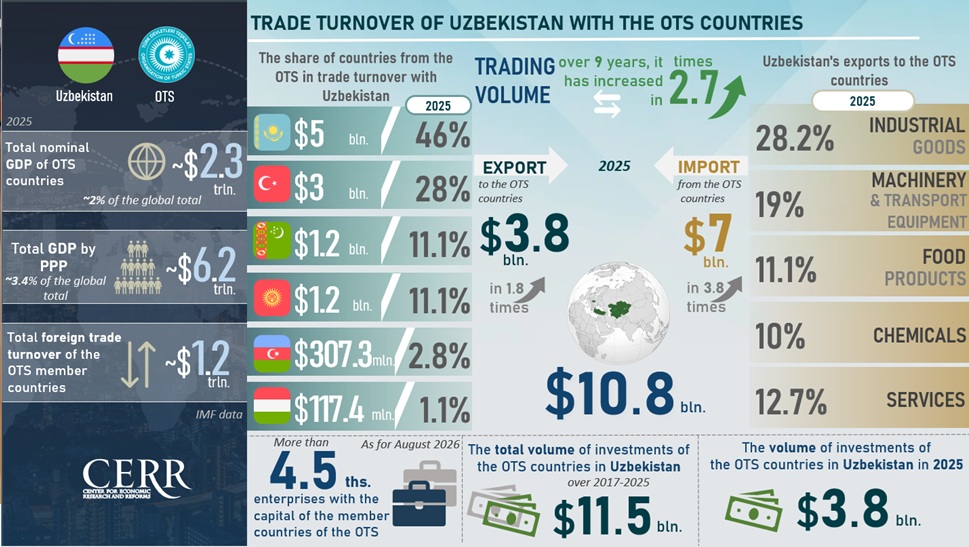
Uzbekistan has moved its economic cooperation with the Turkic states into a practical dimension
Ahead of the 13th Summit of the Organization of Turkic States, scheduled to be held in Ankara, economic cooperation within the OTS is acquiring new substance.
Water security in the turkic world: shared interests and common solutions
Water is a precious blessing that transcends national borders and has long connected peoples and civilizations.

Strengthening Transport Connectivity in Asia through the Development of the Trans-Caspian International Transport Corridor
Shifting international supply chains and expanding trade in Asia are driving demand for sustainable transport routes. For businesses, predictable delivery times, competitive rates, and reliable access to foreign markets are becoming increasingly important.