
Uzbekistan is on the verge of a decisive and rigorous fight against corruption
On December 26, 2025, President of Uzbekistan Shavkat Mirziyoyev addressed the parliament and people of the country with an annual Address, in which he summed up the results of the year and outlined priority directions for the development of the republic in the medium term.
The leader of Uzbekistan set large-scale goals for further improvement of the public administration system, outlined medium-term goals for the economic bloc of the government, promising directions for social development.
In Shavkat Mirziyoyev’s speech, in its tone and decisiveness, the topic of combating corruption, which became a kind of warning signal to the state and society. The leader of Uzbekistan announced a“state of emergency”to combat corruption in 2026, calling this evil a serious threat that impedes the development of the state, undermines justice and the rule of law, and weakens the atmosphere of trust in society.
The transition from declarations to a hard political line is evidenced by the President’s statement thattolerating corruption is a betrayal of reforms and that no one will be left without control, regardless of their position and rank.
These words are not just a declaration of intentions and voicing a position from a high rostrum. They are backed up by real actions. A few days later, on December 30, 2025, the President signed a decree aimed at further improving the system for preventing and combating corruption, which represents a fundamental step forward in the anti-corruption policy of Uzbekistan.
The Decree fundamentally changes the anti-corruption system in the country, which is manifested in the transition from reactive measures (punishment only) to systemic management of corruption risks, the formation of unified management and certification standards, strengthening the role of digital platforms and information transparency, protecting and encouraging civil participation, and interdepartmental interaction on an ongoing basis.
This means that the fight with corruption becomes an integrated part of public administration, and not a separate area of law enforcement.
The new decree introducesmodern tools for management and performance assessment,increasesthe responsibility of managers for results,formalizesdigital interaction mechanisms andstrengthens social motivation in the fight against this evil.
In addition, the document provides for the formation of unified interaction mechanisms between all participants in anti-corruption activities based on a cluster model. Its goal is to identify and eliminate corruption risks even before they transform into crimes.
The cluster model involves intersectoral interaction between the state, the expert community and civil society institutions. This is an important step towards integrating the efforts of different institutions. Thus, the state goes beyond models where the fight against corruption is carried out by only one department, and brings the system closer to collective risk management.
In fact, the new document changesthe very logic of anti-corruption policyin Uzbekistan.
And this is not without reason, since the fight against corruption is among the top priorities on the agenda of the leader of Uzbekistan. After taking office as President in December 2016, one of the first system-forming laws signed by Shavkat Mirziyoyev was the Law “On Combating Corruption” dated January 4, 2017.
The following years were marked by the formation of institutional foundations and a radically new stage in the fight against this evil. A specialized anti-corruption body was created, the digitalization of public services was actively developing, transparency mechanisms were introduced in the field of licensing and public procurement, and the practice of anti-corruption examination of legislation was formed.
In 2024–2025, special attention was paid to the development of internal mechanisms to combat corruption in government bodies. Compliance services have begun to be seen as a tool for the early identification of corruption risks and increasing the personal responsibility of managers.
This approach is in line with international practice and demonstrates the desire to build self-regulation mechanisms in the state apparatus.
The introduction of an anti-corruption cluster model in 2026 has become the institutional expression of the new approach.
This Thus, Uzbekistan is consistently moving from a punitive model of combating corruption to a systemic, preventive and institutionally oriented policy. The message of President Shavkat Mirziyoyev to the parliament and people of Uzbekistan serves as the starting point and ideological support in the rigorous fight against corruption and achieving the strategic goals of the state until 2030.
Related news
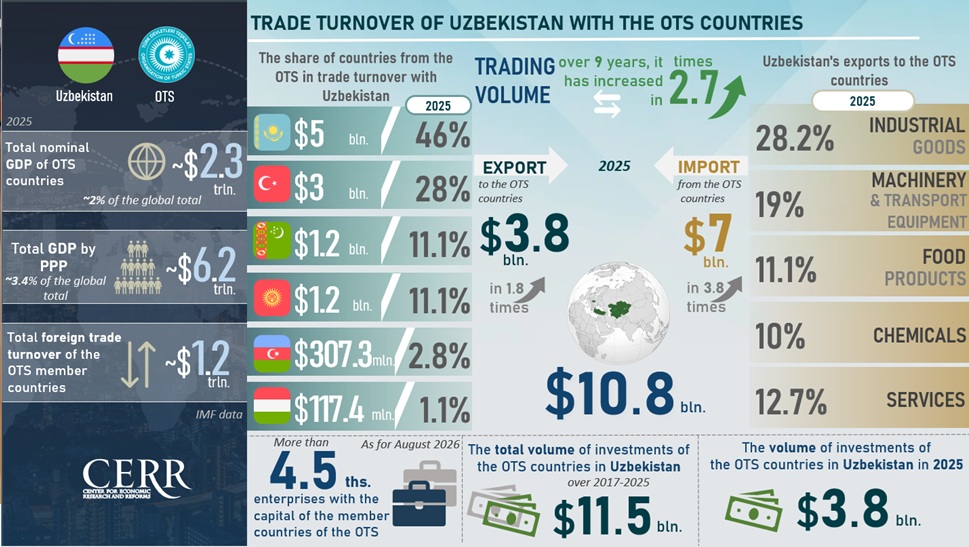
Uzbekistan has moved its economic cooperation with the Turkic states into a practical dimension
Ahead of the 13th Summit of the Organization of Turkic States, scheduled to be held in Ankara, economic cooperation within the OTS is acquiring new substance.
Water security in the turkic world: shared interests and common solutions
Water is a precious blessing that transcends national borders and has long connected peoples and civilizations.

Strengthening Transport Connectivity in Asia through the Development of the Trans-Caspian International Transport Corridor
Shifting international supply chains and expanding trade in Asia are driving demand for sustainable transport routes. For businesses, predictable delivery times, competitive rates, and reliable access to foreign markets are becoming increasingly important.