
Uzbekistan as a new investment hub of Eurasia: from regional transformation to global recognition
In June 2025, the fourth International Investment Forum was held in Tashkent - an event that has already become the hallmark of the new Uzbekistan.
The Forum brought together more than 8,000 participants, including about 3,000 representatives from almost 100 countries. Among them are Russia, China, the United States of America, Arab states, countries of Europe, Asia, and Africa. At the same time, the presence of the heads of such key international players as the European Bank for Reconstruction and Development and the BRICS New Development Bank serves as a clear indicator that Uzbekistan is gradually becoming one of the attractive destinations for the influx of investments.
The total amount of agreements signed during the forum amounted to $30.5 billion - 15% more than the results of 2024 ($26.6 billion), and almost four times higher results of the first forum in 2022 ($7.8 billion).
In turn, the planned opening of an office of the European Investment Bank in Tashkent, as well as the improvement of the country's credit rating by the international agencies Moody's and S&P to a “positive” level demonstrated high confidence in the reforms being carried out in Uzbekistan and real economic interest on the part of the international community.
Over the past seven years, Uzbekistan has gone from a closed economy to a dynamically developing investment hub, which is increasingly attracting the attention of international business and capital.
GDP indicators reflect fundamental changes in the country's economic model. According to the International Monetary Fund, the economy of Uzbekistan continues to demonstrate stability and dynamism - the country's gross domestic product increased from $69.7 billion in 2017 to $115 billion in 2024. Real GDP growth in 2024 was 6.5%, confirming the sustainability of the reform course.
The growth of the industrial sector, in particular, the manufacturing industry, is noteworthy.
Today, production volumes have increased 1.6 times compared to 2017, while its share exceeded 85% of total industrial output - one of the best indicators among the countries of Central Asia.
In addition In addition, the gross added value of industry increased 10 times - from $2.7 billion to $28.8 billion. By 2030, it is planned to increase the added value of industry to $45 billion.
One of the key factors in Uzbekistan’s economic success has been a radical improvement in the investment climate through large-scale structural reforms. The Law on Investments and Investment Activities (2019) established legal guarantees, including protection against expropriation, repatriation of profits, international arbitration, as well as tax incentives and a one-stop-shop system. Liberalization of the currency regime, deregulation of administrative procedures and support for free economic zones had a positive impact on creating a favorable environment for investors.
The result of this successful work was that from 2017 to 2024, $188 billion of investments in fixed assets were attracted into the economy of Uzbekistan, of which $87 billion were foreign investments. The number of enterprises with the participation of foreign capital exceeded 16 thousand, which is 3.2 more than in 2017.
An important step in the investment attraction strategy was the creation of the National Investment Fund (UzNIF), the management of which was entrusted to the European company Franklin Templeton. The initial value of the fund’s assets is $1.68 billion. According to M. Dan, CEO for Central Asia at Templeton Global Investments, “many international institutional investors, recognizing the effectiveness of the reforms being carried out in the country and understanding the direction in which the republic is moving, want to invest in Uzbekistan.”
In this regard, UzNIF represents an excellent opportunity for investors to gain access to a diversified portfolio of companies and to investments in the country's economy as a whole.
Strengthening interest in Uzbekistan on the part of international partners was a logical consequence of not only consistent reforms within the country, but also a change in its role in the regional and international architecture. In this regard, it is necessary to identify several main factors that contributed to this.
First, the proactive foreign policy line of the government of Uzbekistan. Tashkent has significantly intensified its participation in international and regional integration associations. For information, since 2017, within the framework of only four Eurasian associations - the CIS, SCO, UTG and EAEU - Uzbekistan has put forward more than 300 specific initiatives, including 105 within the SCO, 102 - CIS, 76 - UTG, 20 - EAEU.
At the same time, Uzbekistan is striving to build productive dialogue with external players, taking into account the interests of all its partners - Russia, China, the USA and the European Union. Such a foreign policy strategy indicates the country's openness to cooperation, while simultaneously creating a favorable environment for foreign investors. A balanced and pragmatic approach to building external relations will transform Uzbekistan into a promising space of mutually beneficial multilateral cooperation.
Secondly, the stability of Central Asia. In the context of international conflicts and contradictions, the region maintains an atmosphere of good neighborliness and mutually beneficial cooperation.
Central Asia, until recently perceived as a fragmented space, today demonstrates an unprecedented level of trust and consolidation. This was largely facilitated by the political will of the President of Uzbekistan, who initiated the mechanism of Consultative Meetings of the Heads of State of Central Asia (CHGCA). In addition, the countries cemented their commitment to regional cooperation by signing a number of documents of strategic importance. The main one is the Regional Development Concept “Central Asia – 2040”. It reflects the deep awareness of the countries of the region of common interests and consolidates a stable trend towards building long-term mutually beneficial partnerships.
An indicator of positive changes in Central Asia was the signing in April 2024, for the first time in the history of independence of the countries, of the Khujand Declaration of Eternal Friendship between Uzbekistan, Tajikistan and Kyrgyzstan and the agreement on the point of intersection of the state borders of the three countries.
As a result, one of the sensitive aspects of relations between states - the issue of borders - has become closed.
An illustrative example is the interaction between Uzbekistan and Kyrgyzstan. Border crossing procedures have been simplified, entry is allowed without presenting foreign passports (using ID cards). As a result, in 2024, 3 million vehicles crossed the border of Uzbekistan. The Dostuk checkpoint in Osh (Kyrgyzstan) alone serves up to 20 thousand people daily. For comparison: in 2016, about 300 people crossed the border. up to 500 people.
Over the past eight years, the number of existing checkpoints has tripled to 25, significantly increasing the level of human mobility.
Uzbekistan continues to implement a broad agenda aimed at strengthening regional cooperation, the formation of a single market, a common transport and energy infrastructure, a common security community.
In this regard, interaction with South Asia has become a promising direction of government policy, where within two hours of flight time there are markets with 25% of the world's population and a GDP reaching, according to the IMF, - 5.22 trillion. USD
Recognizing that the Central Asian region has the potential to become a key logistics and production corridor between the continents of Europe and South Asia, Tashkent is making efforts to stabilize Afghanistan and involve it in regional economic ties. According to experts, the comprehensive integration of the country - energy, transport, food - will contribute to the transition of the Islamic Emirate to a “peaceful path”, and then its transformation into a responsible subject of international relations.
Confirmation of practical work in this direction was the 1st meeting of the Termez Dialogue on interconnectedness between Central and South Asia, held in May 2025. The event was organized by the Institute of Strategic and Interregional Studies together with the Ministry of Foreign Affairs of Uzbekistan.
The agenda of the Forum focused on ensuring regional security and stability against the backdrop of the continuing threats of terrorism, extremism and drug trafficking. At the same time, the main goal of the Termez Dialogue was the formation of a new paradigm of relations, free from conflicts and confrontation, which is based on the principle of cooperation for the benefit of the prosperity of the two regions.
Thus, the implementation of the concept of transregional interconnectedness will contribute to the transformation of Central Asia into an economic corridor between South Asia and the European continent.
Thirdly, qualitative changes in the economy of Central Asia. Thus, over the last decade, the region’s economy has grown by an average of 6.2% per year, with the global average growth of 2.6%. According to IMF forecasts, until 2028 this pace will continue, remaining higher than in developing countries as a whole.
At the same time, the Central Asian region has significant potential and competitive advantages: a young and growing population, a rich raw material base, a geostrategic location between key world markets.
Central Asia is one of the youngest regions of the world in which the pool of labor resources is concentrated. For reference, from 55 million in 2000 its population has grown to 83 million, and according to UN estimates it will exceed 100 million by 2050. At the same time, the average age of the region's population is 28.7 years - significantly lower than in China and Europe.
In addition, the region has an extensive resource base, containing about 20% of the world's uranium reserves, 17.2% of oil and 7% of gas. In addition, Central Asia is in the top 20 in coal and electricity production, as well as in reserves of strategic minerals, including 39% of the world's reserves of manganese, 30% of chromium, 20% of lead, 5% of the volumes of titanium, copper, aluminum, cobalt, molybdenum.
Central Asia is located at the crossroads of many transport routes, on the junction of the poles of new centers of power - China, Iran, Pakistan, Turkey, India.
The investment attractiveness of Uzbekistan is the result not only of internal reforms and economic growth, but also of building a competent regional development model based on institutional maturity, coordinated policies and international openness.
Today we are witnessing a historical transformation: Uzbekistan is transforming from a peripheral player into one of the key economic hubs of Eurasia.
This transformation is systemic in nature - the country's success creates a multiplier effect for the entire Central Asia, gradually turning the region into a vital bridge between the world's largest economies - from Europe to South Asia.
The results of the 4th International Investment Forum 2025 are not just economic achievements, they are evidence of the formation of a new pole of attraction in the global economic architecture. Central Asia is proclaiming itself as a region of the future - young, dynamic, resource-rich and geostrategically significant. In conditions when investors are looking for new reference points to consolidate, Tashkent is able to offer not only macroeconomic stability and reliability, but also participation in the formation of a new Eurasian economic reality. In this context, the statement by the President of Uzbekistan Sh. Mirziyoyev on the importance of promoting the concept of “Common space for investment and trade”in Central Asia is not just a declaration, but in fact a practical “road map” for the near future.
Akramjon Nematov
First Deputy Director of the Institute of Strategic and
Interregional Studies under the President of the Republic of Uzbekistan
Kamila Sobirova,
Leading researcher at the Institute of Strategic and
interregional studies under the President of the Republic of Uzbekistan
Related news
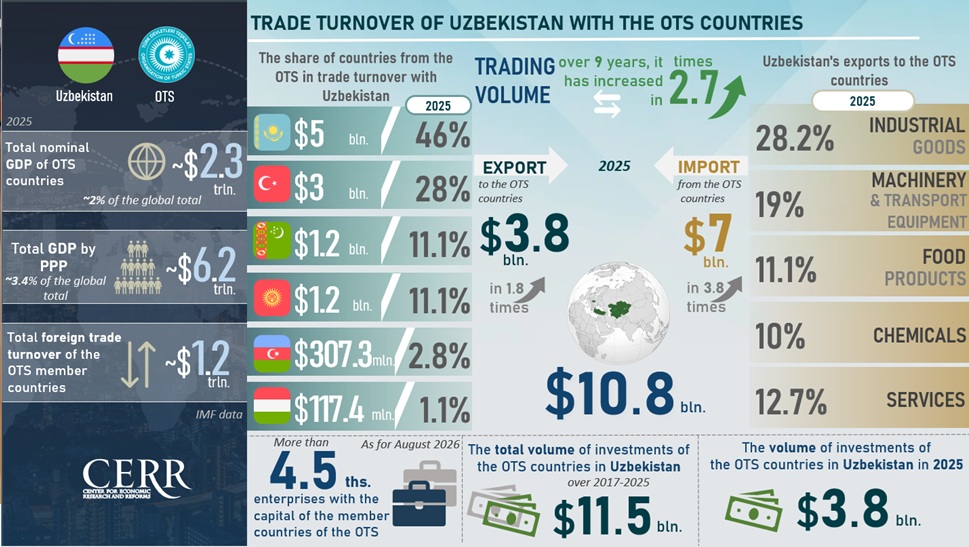
Uzbekistan has moved its economic cooperation with the Turkic states into a practical dimension
Ahead of the 13th Summit of the Organization of Turkic States, scheduled to be held in Ankara, economic cooperation within the OTS is acquiring new substance.
Water security in the turkic world: shared interests and common solutions
Water is a precious blessing that transcends national borders and has long connected peoples and civilizations.

Strengthening Transport Connectivity in Asia through the Development of the Trans-Caspian International Transport Corridor
Shifting international supply chains and expanding trade in Asia are driving demand for sustainable transport routes. For businesses, predictable delivery times, competitive rates, and reliable access to foreign markets are becoming increasingly important.