
Uzbekistan and Kazakhstan: a new stage of strategic partnership
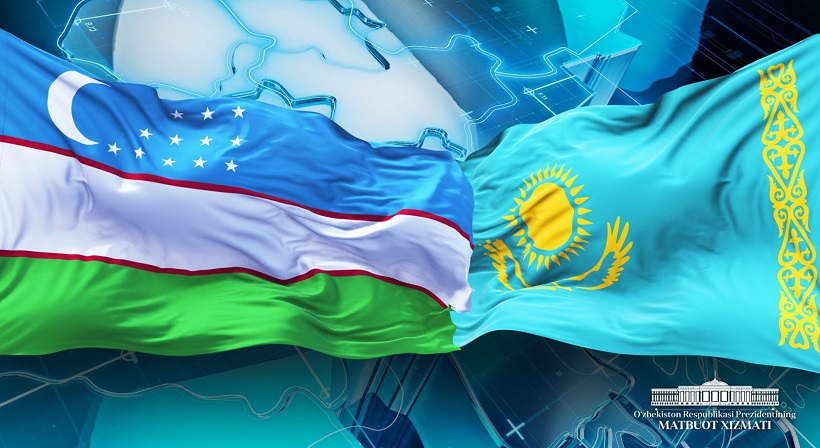
Uzbekistan and Kazakhstan demonstrate steady dynamics in the development of comprehensive cooperation, covering the areas of trade, investment, industrial cooperation, transport and energy, as well as the humanitarian and educational spheres. The Strategic Partnership and Alliance Program for 2024–2034, adopted during the recent visit of President Shavkat Mirziyoyev to Kazakhstan, has become a solid basis for further strengthening the allied relations of the two fraternal states.
In 2024, foreign trade turnover between Uzbekistan and Kazakhstan exceeded 4.27 billion US dollars, which is almost double the level of 2017 (exports $1.5 billion, imports $2.8 billion). Active work is underway to implement the agreement of the leaders to bring this figure to $10 billion by 2030.
Uzbekistan exports textiles, engineering products, construction materials and food to Kazakhstan, and imports metallurgical products, wheat, petroleum products and electricity. The expansion of the range of supplies and the growth in trade volumes indicate the complementarity of economies and the growing integration of markets.
Kazakhstan is one of the five largest investors in the economy of Uzbekistan. Today, more than 1,144 enterprises with the participation of Kazakh capital are registered in the republic. An important decision was the creation of the Uzbek-Kazakh Investment Fund in 2024, which will finance joint projects in industry, agriculture, transport and renewable energy.
Industrial cooperation demonstrates significant results. Industrial zones “Center for Industrial Cooperation” are actively developing in border areas, the construction of which will enter the final stage in 2025. Cooperation between mechanical engineering, agricultural machinery, chemical and light industry enterprises is underway. There are joint projects for the production of automotive components, electrical equipment, fertilizers, and building materials.
The countries agreed to develop joint technology parks and industrial clusters, including the initiative for “smart” industrial cooperation (smart industry).
In the agricultural sector, the parties are developing cooperation in production and processing agricultural products: agreements on joint agro-industrial clusters, exchange of seed material and agricultural technologies have been signed, pilot projects are being implemented for the joint cultivation and supply of agricultural products (grains, vegetables, fruits) in the territories of the two countries, which will contribute to the formation of sustainable agri-food chains and increasing the export potential of the region.
Kazakhstan remains key transit partner of Uzbekistan, playing an important role in ensuring the country’s access to world markets. The parties are actively developing transport and logistics corridors and multimodal routes. The promising direction is Turkmenistan - Uzbekistan - Kazakhstan - Russia. In 2025, a new railway route Xi'an - Khorgos - Almaty - Saryagash - Tashkent was launched, which significantly reduces the time it takes to transport goods from China.
The parties agreed to develop transport and logistics hubs and increase transit volumes within the Trans-Caspian International Transport Route (TITR). Agreements were reached to accelerate the construction and modernization of roads and railways, as well as to create a single logistics space.
Kazakhstan actively supports Uzbekistan in ensuring energy stability by supplying electricity during peak periods. Work is underway to integrate energy systems and develop projects in the field of green energy. Cooperation in the field of renewable energy sources is being discussed, including the joint construction of solar and wind power plants.
Cooperation in the field of water use and environmental protection is being developed, including issues of joint and rational use of transboundary water resources. The leaders of the two countries emphasized the importance of the speedy practical implementation of strategic projects of regional importance, in particular the construction of the Kambarata HPP-1. This project is seen as a multifaceted initiative aimed at the joint development of energy and water resources in Central Asia in the interests of sustainable development of all countries in the region.
Kazakhstan is among the top 5 countries in terms of the number of tourists to Uzbekistan. The visa regime has been simplified, joint tour packages are being developed within the framework of the “Silk Road without Borders” initiative, plans have been agreed upon to create common tourist routes and joint projects to develop infrastructure in border areas.
Uzbekistan and Kazakhstan are actively developing cultural and humanitarian ties. Particular attention is paid to strengthening ties in the field of culture, youth policy, science, education, tourism and sports.
Branches of leading Kazakhstani universities operate in Uzbekistan, academic exchange and scientific internship programs, sports and cultural events are being implemented. Among the significant decisions are the opening of a branch of the Tashkent Institute of Irrigation and Agricultural Mechanization Engineers in Almaty and the start of the activities of the South Kazakhstan University named after Mukhtar Auezov in Chirchik. These initiatives are aimed at expanding academic mobility, sharing experience and training highly qualified personnel in the fields of engineering, water management and agricultural technology.
Cooperation between research institutes of the two countries is developing. A Memorandum was signed on the establishment of the Uzbek-Kazakh Expert Council under the auspices of the strategic institutions of the two countries. The Council will become a new platform for expert dialogue, analysis of key trends and development of joint proposals to strengthen regional stability and economic integration.
The symbol of the spiritual unity of peoples was the opening of the monument to the great poet and thinker Alisher Navoi in Astana in 2025.
Cooperation between Uzbekistan and Kazakhstan covers all key sectors of interaction and forms of regional integration in Central Asia. The parties support initiatives within the framework of the UTG, SCO, CIS, CICA, and the C5+1 format.
The implementation of agreements reached at the highest level opens up new horizons for deepening integration and forming a sustainable space of cooperation in Central Asia. The creation of the Council of Ministers of Foreign Affairs and the Council of Regional Heads, the launch of the Joint Strategic Partnership Program for 2024–2034 and the Consultative Meetings of the Heads of State of Central Asia indicate the progressive strengthening of allied ties and focus on a common future.
There is potential and opportunities for mutual cooperation in a number of priority areas. This is the expansion of industrial cooperation, the development of cooperation in the field of energy and food security, the fight against climate change, tourist exchanges, digital technologies and artificial intelligence, personnel training, etc.
Related news
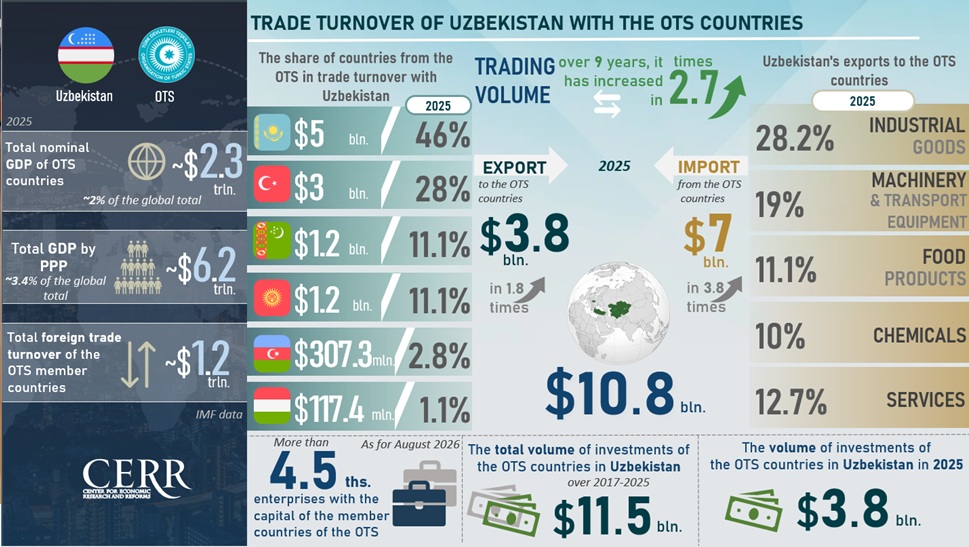
Uzbekistan has moved its economic cooperation with the Turkic states into a practical dimension
Ahead of the 13th Summit of the Organization of Turkic States, scheduled to be held in Ankara, economic cooperation within the OTS is acquiring new substance.
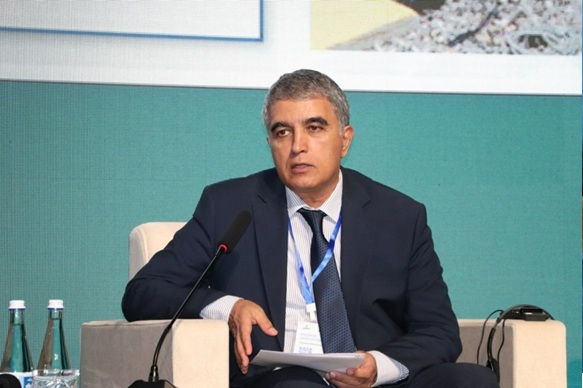
Water security in the turkic world: shared interests and common solutions
Water is a precious blessing that transcends national borders and has long connected peoples and civilizations.

Strengthening Transport Connectivity in Asia through the Development of the Trans-Caspian International Transport Corridor
Shifting international supply chains and expanding trade in Asia are driving demand for sustainable transport routes. For businesses, predictable delivery times, competitive rates, and reliable access to foreign markets are becoming increasingly important.