
Strengthening international legal aspects of cooperation between Central and South Asia
In recent years, cooperation has been established at the interregional level between the states of Central Asia and South Asia. The Central Asia region includes: Kazakhstan, Kyrgyzstan, Tajikistan, Turkmenistan and Uzbekistan. The South Asia region includes Afghanistan, Bangladesh, Bhutan, India, Maldives, Nepal, Pakistan and Sri Lanka with a population representing 40% of the population of Asia and 22% of the world's population.
In terms of strengthening cooperation between the two regions, an important aspect worth noting is the historical one, which is associated with the ancient trade routes of the Great Silk Road, which took place since the 3rd century BC
Uzbekistan, pursuing its active foreign policy within the framework of international organizations, especially in the last decade, has been actively promoting international treaty initiatives from the UN rostrum. For example, on July 11, 2022, the General Assembly unanimously approved resolution 76/295 “On strengthening connectivity between Central and South Asia,” initiated by Uzbekistan in collaboration with 40 countries, including Azerbaijan, Armenia, Angola, Vietnam, Vanuatu, Ghana, Cuba, Kazakhstan, Kyrgyzstan, China, Cote d'Ivoire, Qatar, Egypt, Iran, Nepal, Malaysia, Mongolia, Morocco, Pakistan, Russia, Senegal, Tajikistan, Turkey, Turkmenistan, Sri Lanka, the Philippines and others.
The structure of the resolution “On strengthening interconnectedness between Central and South Asia” consists of an introductory part and 17 points. The introductory part states that the General Assembly is guided by the provisions of the UN Charter, which enshrines the promotion and adoption of measures to establish regional cooperation,
Reaffirming its resolution 70/1 “Transforming our world: the 2030 Agenda for Sustainable Development” of 25 September 2015, aimed at the full implementation of the 2030 Agenda
Also reaffirming its commitment to accelerating the implementation of collective economic, social and environmental solutions and Achieving the Sustainable Development Goals within the Decade of Action,
noting the holding of an international conference on “Central and South Asia: Regional Connectivity. Challenges and Opportunities”, held in Tashkent
highlighting the importance of strengthening cooperation for the implementation of the Vienna Declaration and Vienna Program of Action for Landlocked Developing Countries for the Decade 2014–2024, which are based on the establishment of new, stronger partnerships between these countries and transit countries and their development partners at all levels,
Recalling the first United Nations Global Conference on Sustainable Transport, held in Ashgabat, in November 2016, and the second United Nations Global Conference on Sustainable Transport, held in Beijing, in October 2021,
considering that quality, reliable, sustainable and viable connections based on stability...,
Noting the importance of transport and transit corridors for accelerating economic growth, increasing the efficiency of trade and economic relations between the countries of Central and South Asia and realizing their unique transport, transit and investment potential,
emphasizing the importance of the comprehensive and progressive development of relations between Central and South Asia in areas of mutual interest, based on mutual trust and maximum benefit for all, in the spirit of global solidarity and for the sake of the common future of current and future generations...,
recognizing the important role of regional organizations in strengthening interregional and intraregional ties...,
Given the importance of cooperation between Central and South Asia...
The resolution reaffirms that regional cooperation is one of the effective forms of multilateralism and international cooperation, in creating safe, affordable, accessible and sustainable transport networks, also resilient to unexpected emergencies, the importance of effective border controls for developing connections between countries, expanding transport infrastructure and information and communication technologies and forming new international transport networks corridors, the importance of Afghanistan's potential role in establishing connections between Central and South Asia, as well as intermodal transport for connections between Central and South Asia, the need to develop cooperation between civil aviation authorities to enhance regional connectivity and economic cooperation, takes note of the report of the Secretary General entitled “Roadmap for Digital Cooperation”, the contribution of mutual exchange and learning through experiences of interaction between Central and South Asia in the study, preservation and enhancement of their tangible and intangible cultural heritage, the formation of potential tourism routes, the efforts of Central and South Asia South Asia to further strengthen relations between the regions and their peoples, including in the areas of education, science and technology, innovation, tourism, culture, arts and sports, the importance of energy links between Central and South Asia, sharing experiences on voluntary and mutually agreed terms between Central and South Asia to promote sustainable development, including through providing access to clean energy technologies, commitment to enhancing the role of sustainable transport in job creation, increasing the potential for regional economic integration and connectivity, invites member states to join their efforts in the fight against common challenges and threats to stability and security in Central and South Asia.
In order to fulfill the above tasks, Uzbekistan primarily pursues an active foreign policy not only in the Central Asian region, but also actively cooperates within the CIS, SCO, as well as with the European Union, the UN and its structural divisions.
Work is actively carried out at the bilateral level, and primarily with neighboring bordering countries in order to ensure regional stability and security.
The legal basis for the implementation of the priority tasks of the foreign policy activities of Uzbekistan is the implementation of accepted international obligations, the Constitution of the Republic of Uzbekistan and other legal documents that are aimed at:
formation of the most favorable foreign policy conditions for the effective implementation of the democratic reforms carried out in the country and the dynamic processes of modernization of society and economy;
preservation and strengthening of peace and stability in Central Asia, transforming the region into a zone of security and sustainable development;
formation of a balanced, multifaceted system of strategic partnership with the leading countries of the world and international organizations;
promotion of international initiatives of Uzbekistan in the most important areas of regional and international policy;
assistance in increasing the volume of exports of domestic products and expanding its geography;
active assistance in attracting foreign direct investment and advanced technologies in priority sectors of the national economy;
assistance in attracting foreign tourists and developing the tourism infrastructure of the republic;
providing assistance in expanding and deepening cooperation in the field of transport and transit, development of international transport communications and logistics infrastructure;
ensuring comprehensive protection of the rights and interests of citizens and legal entities of the Republic of Uzbekistan outside the republic;
strengthening ties with compatriots living abroad.
Speeches of the President of the Republic of Uzbekistan at sessions of the UN General Assembly are important legal sources and international treaty initiatives. Thus, speaking at the 72nd session of the UN General Assembly on September 19, 2017. The head of state noted that a peaceful and economically prosperous Central Asia is the most important goal and key task for Uzbekistan.
For this purpose, on the initiative of the President of the Republic of Uzbekistan and under the auspices of the UN, a high-level international conference “Central Asia: one past and a common future, cooperation for sustainable development and mutual prosperity” was held, which was held in Samarkand on November 10-11 2017. The successful holding of this conference served as the basis for the subsequent unanimous adoption of a special resolution by the UN General Assembly on June 22, 2018 aimed at “Strengthening regional and international cooperation to ensure peace, stability and sustainable development in the Central Asian region.”
In a speech at the 75th session of the UN General Assembly on September 23, 2020, the head of state drew special attention to the fact that in the Central Asian region Asia is undergoing fundamental changes, and it has been possible to create an atmosphere of good neighborliness, mutual trust, friendship and respect between the countries of the region.
At the 78th session of the UN General Assembly on September 19, 2023, the President of the Republic of Uzbekistan expressed confidence that with the support of the international community, Central Asia will continue to follow the path of consolidation. Transforming it into a peaceful and prosperous region will remain a priority goal of Uzbekistan’s foreign policy.
It should be noted that in the first year of his tenure as President of the Republic of UzbekistanSh.M. Mirziyoyevhas made dramatic changes, visiting more than a dozen countries and leading important new policy initiatives. This has become a strong incentive for the development and solution of regional problems in the countries of Central Asia.
In recent years, the countries of Central Asia have paid special attention to interregional cooperation, including cooperation with the countries of South Asia, which is also one of the key factors in ensuring security.
In terms of the above, an important component of the foreign policy activities of the Republic of Uzbekistan are issues of regional cooperation and, above all, efforts to unite forces aimed at supporting stability, security and reconstruction in Afghanistan.
In this regard, Uzbekistan has intensified its activities in solving the Afghan problem. Thus, in 2018, on the initiative of the head of state, an international conference “Peace Process, Security Cooperation and Regional Cooperation” was held, as a result of which the Tashkent Declaration was adopted, in which for the first time a general consensus was reached on the need for a political settlement of the situation in Afghanistan.
Regarding cooperation with the countries of South Asia, a notable event was the high-level international conference “Central and South Asia: Regional Connectivity. Challenges and Opportunities”, held on July 15-16, 2021, which made a significant contribution to international efforts to promote peace in Afghanistan. The organization of the high-level conference was a step towards strengthening regional connectivity and discussing the challenges and opportunities associated with the situation in Afghanistan.
The conference was attended by the President of Afghanistan Ashraf Ghani, the Prime Minister of Pakistan Imran Khan, foreign ministers and high representatives of the countries of Central and South Asia, other foreign countries, heads of authoritative international and regional organizations, global financial institutions and companies, leading research and analytical centers.
The event was attended by a total of more than 250 delegates from more than 40 countries and international organizations. About 90 media representatives arrived in Tashkent to cover the event.
The main goal of the forum is to strengthen historically close and friendly ties, trust and good neighborliness between the states of Central and South Asia in the interests of all peoples and countries of both regions.
In his video message during the conference, UN Secretary-General Antonio Guterres said, that regional cooperation between the countries of Central and South Asia is extremely important for maintaining peace and stability in Afghanistan.
The UN Secretary-General expressed gratitude to the President of the Republic of UzbekistanSh.M. Mirziyoyevfor the initiative to hold the forum. “Ties play a central role in issues of trade, economic growth and sustainable development,” the UN chief emphasized. “But this is not just about the economy,” he added. “The connections strengthen regional cooperation and promote friendly relations between neighbors, near and far.”
Today, according to the UN Secretary-General, regional connectivity between the countries of Central and South Asia is more important than ever - this is the only way the states of the region can maintain peace and stability in Afghanistan.
The situation in Afghanistan has worsened. Since January 2021 alone, approximately 270 thousand Afghans have fled their homes. To date, the total number of internal refugees in the country has exceeded 3.5 million.
The UN Secretary-General called on the entire international community to join forces to achieve peace in the region. “Let's work together so that everyone can appreciate how beneficial peace is, and the very prospect of strengthening ties in the region could counterbalance the threat of further deterioration of the situation in Afghanistan. Today’s conference is an important step in this direction.”
International High-Level Conference “Central and South Asia: Regional Connectivity. Challenges and Opportunities" is intended to form a political and expert platform for a multilateral discussion of the model of mutually beneficial strategic link "Central Asia - South Asia" in the transport and logistics, energy, trade, production, investment, technological and cultural-humanitarian spheres.
During the plenary and sectional sessions, forum participants discussed the possibilities of promoting initiatives aimed at development trade-economic, transport-communications and cultural-humanitarian cooperation in the context of further deepening regional interconnectedness.
The conference participants agreed to develop a draft special resolution of the UN General Assembly on strengthening interconnectedness between Central and South Asia.
The Conference was opened by the President of the Republic of Uzbekistan Sh.M. Mirziyoyev
According to him, located at the crossroads of the Great Silk Road, Central and South Asia have closely interacted with each other in various aspects for many centuries. “The peoples of these regions have repeatedly been within the framework of common state entities, as well as a common political, economic and humanitarian space. Central and South Asia have always been connected by reliable trade arteries and have been a bridge for the countries of the Middle East, Europe and China.” For many centuries, thanks to close ties between peoples and the spread of various religions and unique folk traditions, a diverse and rich culture of the East has been formed.
The President also mentioned that, unfortunately, in the 19th century, due to historical circumstances, the interconnectedness of the two adjacent regions was disrupted. “We still feel the negative consequences of this - there are no effective cross-border routes, poorly developed trade and economic ties, and the potential of cultural and humanitarian relations is not fully exploited,” the president said.
The modern world is ready for global geopolitical transformations that offer new opportunities. The revival of mutual ties in Central and South Asia, where about two billion people live today, is becoming a more relevant and objective process.
"We recognize that interconnectedness, cooperation, dialogue and, most importantly, trust are the driving force for ensuring stability and sustainable development, improving the living standards and well-being of the people of our regions."
The head of state emphasized that for the states of both regions it is important to both strengthen peace, trust and good neighborliness, and build an open and constructive policy.
The formation of sustainable trade, economic, transport and communication ties should become the main driver for the further development of the entire vast region in the long term.
"We have an objective need to strengthen our cooperation through the digitalization of economies, the development of e-commerce and the introduction of innovations."
One of the key links in the practical interconnectedness of Central and South Asia is the Islamic Republic of Afghanistan. Interregional partnership should become an important factor in establishing peace and stability and reviving the economy in this country. This will open up new prospects for the integration of Afghanistan into regional processes.
According to the president, one of the main conditions for sustainable development of regions and strengthening partnerships is security and stability, and this can only be ensured through constructive dialogue and joint efforts.
One of the priority tasks is also to create favorable conditions for the development of trade and economic ties and the growth of mutual investments, developing measures for free movement of goods and services, the formation of a developed system of transport communications and energy infrastructure.
A proposal has been put forward to create a modern, efficient and safe transport and logistics infrastructure in Central and South Asia. The key element, according to the president, will be the Termez-Mazar-i-Sharif-Kabul-Peshawar railway, the construction project of which has already received widespread support, including from leading international financial institutions. This project, following the example of the established international transport corridor “North-South”, which already connects India with the countries of Central Asia, will make it possible to fully realize the transit potential of the two regions, create the shortest route, and significantly reduce the time and costs of transporting goods between South Asia and Europe through Central Asia and the countries of the Commonwealth of Independent States. The project to build a trans-Afghan railway corridor is also promising.
The driving force of economic cooperation will be the introduction of new digital platforms.
According to the President, we need to jointly look for ways to ensure food security in the vast region, associated with rising prices for basic food products and their shortages.
The President believes that together we can more effectively counter terrorism, extremism, transnational crime, including in cyberspace. He put forward a proposal to develop a Joint Anti-Drug Action Plan with the participation of the UN Office on Drugs and Crime.
Environmental issues and promoting green development require special attention. The problem of the drying up of the Aral Sea is increasingly becoming planetary in nature. It is necessary to take all possible measures to mitigate the consequences and prevent similar natural disasters in the future.
The unique tourism potential of Central and South Asia has not been fully exploited. A proposal was put forward to develop a Program for Central and South Asia within the framework of the World Tourism Organization, which will be aimed at popularizing the historical and cultural heritage of the peoples of the regions.
In addition to economic aspects, the expansion of scientific, cultural and humanitarian exchanges is one of the important conditions for strengthening friendship and trust.
The President believes that it is necessary to encourage joint research and innovative work, the organization of scientific and educational internships, experience exchange programs.
Central Asia is located at the “junction” of Europe and Asia. In the south it borders with Afghanistan. The Great Silk Road once passed through the territory of Central Asia. Located next door to Europe, this region today plays an increasingly important geopolitical role.
In July 2022, the International Conference “Afghanistan: Security and Economic Development” was held in Tashkent. The event was attended by special representatives from more than 20 countries of Central and South Asia, Europe, America, the Near and Middle East, the Asia-Pacific region, as well as representatives of international and regional organizations, including the UN, the European Union, FAO, the Economic Cooperation Organization, the Organization of Islamic Cooperation and the Shanghai Cooperation Organization.
The conference was aimed at discussing and coordinating international approaches to ensuring the security, reconstruction and economic development of Afghanistan. Uzbekistan provides humanitarian assistance to the people of Afghanistan.
In recent years, Uzbekistan has launched large infrastructure projects in Afghanistan, such as the construction of the Surkhan-Puli-Khumri power transmission line, the construction of the Termez - Mazar-i-Sharif - Kabul - Peshawar railway, etc.
In recent years relations between the states of Central and South Asia have intensified, aimed at expanding trade and transport-transit relations, which are economically beneficial for the regions with access to China, India and Pakistan, and other regions.
The states of Central Asia are developing traditional trade and economic cooperation with India, participating in the implementation of its programs “New Silk Road of Indian Foreign Policy” and “Uniting Central Asia” with access to Indian Ocean. Such cooperation makes it possible to expand regional interconnectedness and open new transport corridors for interaction with Japan (dialogue “Central Asia plus Japan”), South Korea (“Eurasian Initiative”), Muslim states - Iran, Pakistan, Saudi Arabia, UAE.
The expansion of the EAEU to include Uzbekistan and Tajikistan will allow the countries of the region to expand opportunities to other important continental transport hubs with access to the sea routes of Russia, China, the Near and Middle East and the European Union.
Central Asian states are also interested in projects of interstate railway corridors Russia - Kazakhstan - Uzbekistan – Turkmenistan – Iran – Oman – India; Uzbekistan - Kyrgyzstan - Tajikistan - Afghanistan - Pakistan - China, which opens up opportunities in the southern direction.
In the future, the Central Asian states will develop and implement the construction of the Andijan - Osh - Irkeshtam railway, which will provide the closest land access to the markets of China.
Uzbekistan's access through Turkmen ports to the Caspian Sea is promising, then through the Turkmenabad-Farab railway and road bridges across the Amu Darya along the transport and transit route Uzbekistan - Turkmenistan - Iran - Oman.
An important transit potential for the states of Central and South Asia is the construction of a railway through Russia - Central Asia - Afghanistan - China - Iran with the subsequent establishment of transport and economic ties with India, Iraq and other countries.
The states of Central Asia will continue to need to ensure rapid development of transport infrastructure in order to attract funds from the international capital market to create a common logistics system TRASEKA (restoration of the Great Silk Road), providing new access to the Middle East and world markets.
In strategic terms, the main directions of regional interaction and coordination of Central and South Asia are:
deepening geo-economic interaction in order to ensure security and stability in the region;
development of trade and economic ties and creating favorable conditions for the growth of trade turnover and strengthening cooperation;
expanding communication links, transit opportunities and transport infrastructure, effective use of the logistics and tourism potential of the region;
developing a unified transport strategy and sustainable long-term mechanisms for mutually beneficial cooperation, taking into account the interests and needs of all states in the region;
coordinating efforts to implement digital platforms in the field of international trade, customs regulation and transport, banking and financial activities, healthcare, education, science and culture;
improving the regular mechanism of mutual regional consultations to develop common positions in an increasingly globalized world.
Therefore, it is important to develop economic interaction, strengthening the internal solidarity of Central and South Asia, without compromising the existing relations of the Central Asian countries with Russia, China and other regional and global powers.
Khakimov Ravshan,
Doctor of Law,
Chief Researcher
Institute of State and Law
Academy of Sciences of the Republic of Uzbekistan
Related news
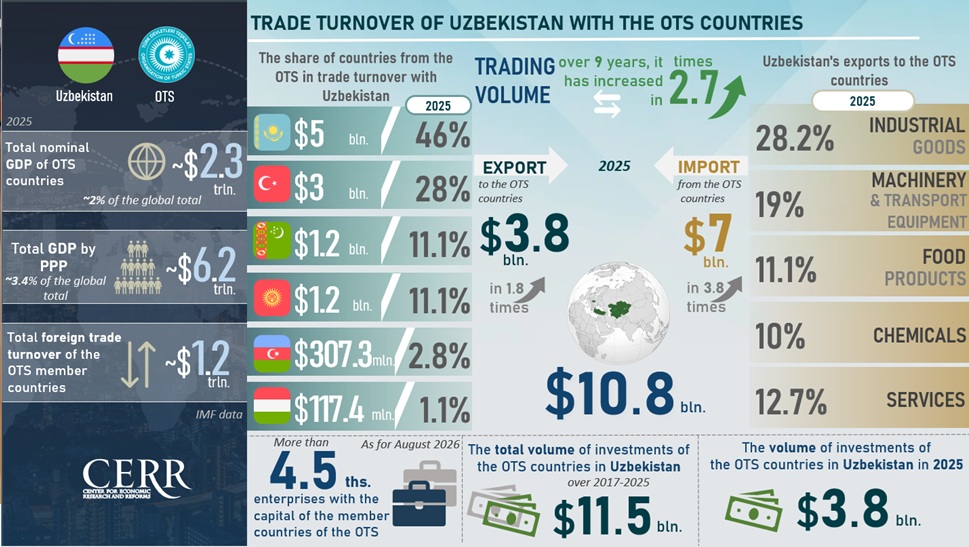
Uzbekistan has moved its economic cooperation with the Turkic states into a practical dimension
Ahead of the 13th Summit of the Organization of Turkic States, scheduled to be held in Ankara, economic cooperation within the OTS is acquiring new substance.
Water security in the turkic world: shared interests and common solutions
Water is a precious blessing that transcends national borders and has long connected peoples and civilizations.

Strengthening Transport Connectivity in Asia through the Development of the Trans-Caspian International Transport Corridor
Shifting international supply chains and expanding trade in Asia are driving demand for sustainable transport routes. For businesses, predictable delivery times, competitive rates, and reliable access to foreign markets are becoming increasingly important.