
Strategy “Uzbekistan – 2030”: updating the strategy and clarifying target indicators
The priority areas of the Strategy “Uzbekistan - 2030”, adopted on September 11, 2023, identified sustainable economic growth, the creation of a new education system, healthcare and social protection, creating favorable environmental conditions, building a fair and modern state, guaranteeing the sovereignty and security of the country. And the cross-cutting priority of all these reforms is the growth of the well-being of the people, their trust in the state and confidence in the future. In general, updating the strategy is a transition from goals to management based on measurable results, linked to performers and financing.
What changes have been achieved during the period of strategy implementation? The effectiveness of the implementation of the strategy is reflected both in statistical indicators and in changes in the quality of life and consumer activity of the population. In 2023–2025, the nominal volume of GDP increased from 107.5 billion to 140 billion US dollars, the volume of exports and foreign investment is growing, and innovative activity is developing. The resulting indicators of the reforms were a decrease in the unemployment rate from 6.8% to 4.9% and a reduction in the poverty level from 11% to 6.8%.
What are the reasons for updating the Uzbekistan 2030 Strategy?
The tasks of accelerating the further development of the country led to the update of the strategy and its targets indicators. The Uzbekistan-2030 strategy has been revised based on external and internal factors. It should be noted that external influencing factors include the geopolitical situation in the world, global economic trends, technological innovation, natural and environmental changes and growing demand for energy and water resources. Internal factors of influence today can be considered demographic growth, urbanization and migration, which implies strengthening the quality of institutions and increasing management efficiency. Based on this, the country has developed a draft Strategy “Uzbekistan – 2030” for 2026–2030 (hereinafter referred to as the Strategy). The draft revised Strategy has been published for public discussion.
In the updated Strategy, within the same five priorities and 100 goals, individual objectives and performance indicators have changed. Of the existing target indicators, most have already been achieved, new tasks have appeared, and therefore the list of performance indicators has been expanded and updated. In addition, the document identifies the responsible ministries and departments, as well as the specific sources of funding necessary to achieve each goal.
In which areas do reforms provide “mechanisms of change”?
Economy. The largest number of tasks and performance indicators in the direction “II. Ensuring the well-being of the population through sustainable economic growth.” It is planned to bring the GDP volume to $240 billion by 2030 by maintaining the annual inflation rate within 5–6 percent, ensuring fiscal stability, increasing the investment attractiveness of the country, effectively using the local raw material base and developing industry and services based on advanced technologies, deepening the integration of the Republic of Uzbekistan into global transport and logistics networks, strengthening the export potential of the national economy.
Transition towards a green economy, transforming the country into a regional “IT-НUB” through the development of digital technologies, increasing competition in the banking sector, creating the most favorable conditions for the free activity of entrepreneurs, and comprehensive development of the regions will create new jobs, ensure employment and increase incomes of the population. This is what will serve to reduce poverty and increase the well-being of the population, which will entail the development of economic sectors, especially construction, tourism, the services sector.
Education. Such goals of the Strategy also provide for the creation of decent conditions for the realization of the potential of young people, the development of education and healthcare. In part “I. Creating decent conditions for realizing the potential of every person”, performance indicators have been developed that will make it possible by 2030 to achieve such goals as ensuring 50 percent coverage of graduates of secondary schools and academic lyceums with higher education and their employment in industries and areas with decent wages. Achieving the inclusion of 10 higher educational institutions in the TOP-1000 ranking of the most prestigious higher educational organizations in the world (QS, THE, ARWU) will increase the competitiveness of our youth not only in local, but also in external labor markets.
The introduction of the cluster system "enterprise - university - scientific organization" will contribute to the expansion of types of innovative products in the "driver" areas of the economic sectors. It is envisaged to create spin-off production clusters at higher educational institutions in order to accelerate the process of introducing scientific ideas of scientists into economic circulation in the fields of transport and logistics, agricultural production, energy, biotechnology, geology and metalworking, mechanical engineering and electronics. The development of science, especially among young people, will improve Uzbekistan’s position in the Global Innovation Index and allow it to become one of the 60 leading innovative countries in the world.
Health. As they say, human education reduces the risks of diseases and increases life expectancy, and health (physical, mental, social) is the foundation for a full life and self-realization. The Strategy provides for an increase in the average life expectancy of the population over the next 5 years, a reduction in early mortality from cardiovascular diseases (30-69 years), from cancer and respiratory diseases, as well as a reduction in the rate of births of children with life-threatening congenital defects. In the field of maternal and child health, there are 9 performance indicators. Issues of promoting proper nutrition and a healthy lifestyle among the population, and reducing the prevalence of obesity among adults are also on the Strategy’s agenda.
Social protection. For vulnerable segments of the population, the state policy will continue to radically improve the system of providing professional social services, create a new system to support persons with disabilities, as well as create a comfortable and favorable environment for them. For children left without parental care, there will be a 100% introduction of alternative non-institutional forms of care, and for children with special educational needs, the coverage of inclusive education will be increased.
The state pays special attention to the empowerment of women. Different cultures have different ideas about the roles of men and women, which are shaped by history, religion and tradition. At the same time, globalization and possible prospects for the country's development require a policy to ensure gender equality and increase the social and political activity of women. The draft Strategy includes the tasks of increasing the number of women trained in professional and entrepreneurial skills, increasing the number of women involved in the active use of information and communication technologies, increasing the share of women in leadership positions over 30 percent, as well as resolving relationships in families in a state of conflict or on the verge of family divorce.
Ecology, law, security. Priorities “Saving water resources and protecting the environment”, “Ensuring the rule of law, organizing public administration focused on serving the people”, “Consistent continuation of policies based on the principle of “a safe and peaceful state”” are also on the agenda of the Strategy, indicating specific objectives and performance indicators.
Mechanisms for achieving goals for each priority
Mechanisms for achieving goals for each priority are reflected in strategic documents. For example, to implement the objectives of the Priority “Water Conservation and Environmental Protection”, the National Climate Strategy for mitigating the effects of climate change and adaptation to them, the Strategy for the implementation of measures for the management of industrial waste were developed.
For the development of driver sectors of the economy and achieving GDP growth of up to $240 billion by 2030, industry strategies were developed: Industry Development Strategy of the Republic Uzbekistan, Strategy for the development of the automotive industry, Strategy for the development of light industry, Strategy for the development of the building materials industry, Strategy for the development of the jewelry industry, Strategy for the development of the tourism sector of the Republic of Uzbekistan, Strategy for modernization, accelerated and innovative development of the construction industry, etc.
The development and implementation of strategic documents at the territorial level will allow achieving goals and objectives in a comprehensive and targeted manner. Thus, the Strategy for the comprehensive development of all spheres until 2030 in each region of the republic considers the socio-economic development of the territory through the prism of the economy and well-being of the local population. The development of such a document involves not only local authorities, but also leading ministries and departments - the Ministry of Economy and Finance, the Ministry of Investment, Industry and Trade, the Ministry of Agriculture, the Ministry of Digital Technologies, the Ministry of Employment and Poverty Reduction, the Ministry of Energy, the National Committee on Ecology and Climate Change, etc.
The republic's think tanks - the Institute of Macroeconomic and Regional Studies, the Center for Economic Research and Reforms, etc. - participated in the development of sections of the Strategy. This indicates that Uzbekistan is pursuing an evidence-based policy, when decision-making in various areas (economics, social sphere, ecology, law, security) is based on scientific data, forecasts and expert assessments to achieve medium and long-term goals.
Main expected results until 2030(macro outcomes)
The main results of the updated Strategy "Uzbekistan - 2030" are expressed through economic, social, environmental and other indicators. In the economy sphere, it is expected to achieve macroeconomic stability and sustainable GDP growth of up to $240 billion, transform the country into a regional “IT-НUB” and enter the top 60 innovative countries in the world, deepen the integration of the republic into global transport and logistics networks and strengthen the export potential of the national economy. Creating a favorable business climate and creating sustainable jobs, ensuring employment of the population will reduce income inequality and poverty. It is envisaged to eliminate absolute poverty (based on the cost of minimum consumer expenditures) in the country and reduce its level to 0 percent.
In the social sphere it is envisaged to create decent conditions for realizing the potential of young people, improving education and medicine, expressed in the target indicators of increasing life expectancy to 78 years, 80% enrollment in kindergartens and 50% enrollment in higher education. It is expected that the quality of education in universities will improve, that 10 higher educational institutions will be included in the TOP-1000 rating of the most prestigious higher educational organizations in the world (QS, THE, ARWU), and that the cluster system “enterprise – university – scientific organization” will be introduced.
In ecology it is expected that the process of transition to a green economy will continue, the introduction of green energy technologies, the construction of houses that meet the green standard, increasing the culture of rational water use and the development of water-saving technologies, preventing air pollution and the negative impact of climate change.
Doctor of Economics, Professor D.M. Karimova
Institute of Macroeconomic and Regional Research
Republic of Uzbekistan
Related news
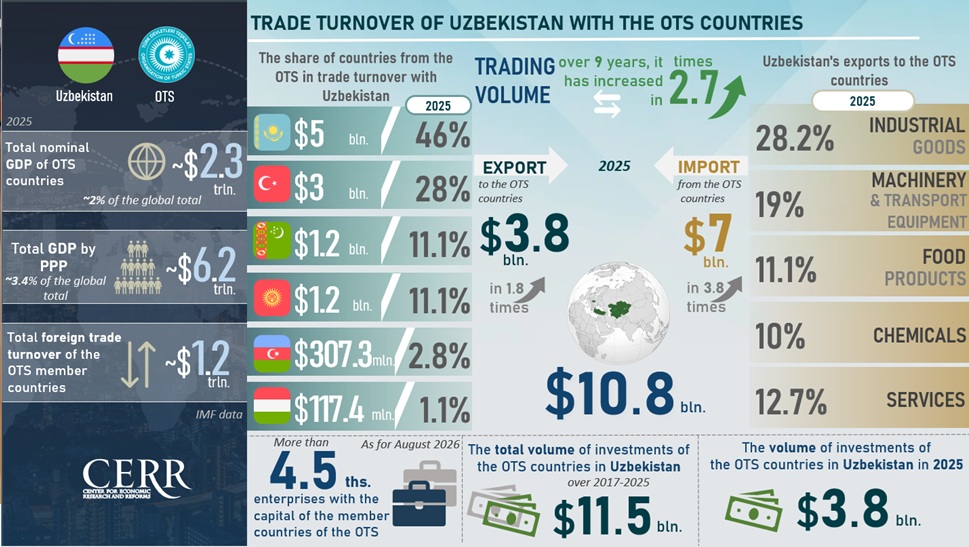
Uzbekistan has moved its economic cooperation with the Turkic states into a practical dimension
Ahead of the 13th Summit of the Organization of Turkic States, scheduled to be held in Ankara, economic cooperation within the OTS is acquiring new substance.
Water security in the turkic world: shared interests and common solutions
Water is a precious blessing that transcends national borders and has long connected peoples and civilizations.

Strengthening Transport Connectivity in Asia through the Development of the Trans-Caspian International Transport Corridor
Shifting international supply chains and expanding trade in Asia are driving demand for sustainable transport routes. For businesses, predictable delivery times, competitive rates, and reliable access to foreign markets are becoming increasingly important.