
The strategic partnership between Uzbekistan and Pakistan is a key factor in strengthening the interconnectedness of Central and South Asia
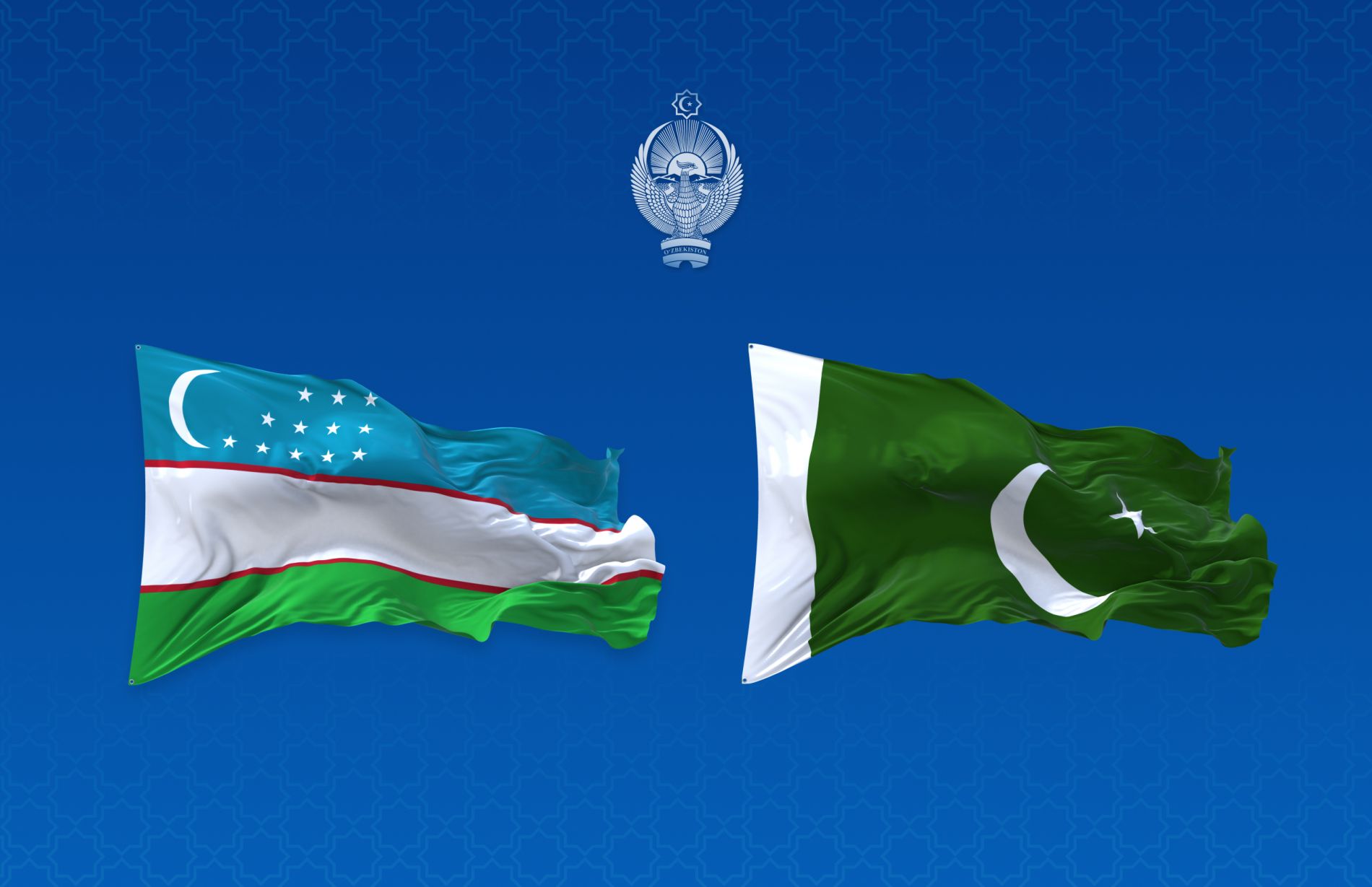
The state visit of the President of Uzbekistan Shavkat Mirziyoyev to Pakistan will take place on February 5-6.
This visit is considered as a logical continued intensification of the Uzbek-Pakistani dialogue in recent years and at the same time as an important stage in the implementation of Uzbekistan’s foreign policy strategy, focused on expanding cooperation with the countries of South Asia.
The visit takes place against the backdrop of the formation of a new architecture of regional interconnectedness, where Central and South Asia are increasingly perceived as complementary regions united by common economic, historical and civilizational interests roots.
Pakistan became one of the first countries to recognize the independence of Uzbekistan. This happened on December 20, 1991. The establishment of diplomatic relations on May 10, 1992 laid the institutional basis for bilateral interaction. However, a qualitatively new stage in the development of relations began in recent years, when the political dialogue acquired a systemic and strategic character.
The key milestone was the signing in July 2021 of the Joint Declaration on the Establishment of a Strategic Partnership, which cemented the mutual interest of the parties in deepening cooperation in a wide range of areas.
In March 2022 President of Uzbekistan Shavkat Mirziyoyev visited Pakistan, which confirmed the coincidence of strategic approaches of Tashkent and Islamabad on issues of regional development, stabilization of the situation in Afghanistan and expansion of economic ties between Central and South Asia.
Regular contacts between the leaders of the two states on the sidelines of multilateral forums played a special role. The SCO Samarkand summit in September 2022, meetings within the framework of the Conference on Interaction and Confidence Building Measures in Asia (CICA), the Economic Cooperation Organization (ECO), as well as global climate and economic summits contributed to the formation of a trusting and pragmatic dialogue.
The official visit of the Prime Minister of Pakistan Shahbaz Sharif to Uzbekistan in February was of particular importance 2025. As a result, a Joint Declaration and a Protocol on the creation of a Strategic Partnership Council at the highest level were signed. The creation of this mechanism has given Uzbek-Pakistani relations a stable institutional basis and opened up opportunities for systematic coordination of bilateral initiatives and monitoring the implementation of agreements reached.
High-level political dialogue, primarily through the Ministries of Foreign Affairs, occupies a special place in the architecture of Uzbek-Pakistani relations. Regular inter-Ministry of Foreign Affairs political consultations make it possible to synchronize the parties' approaches to key issues of the regional and international agenda, including security, sustainable development and reform of multilateral institutions.
The Foreign Ministers of Uzbekistan and Pakistan maintain an active dialogue both in a bilateral format and on the sidelines of international organizations - the UN, the Shanghai Cooperation Organization, the Economic Cooperation Organization and the Organization of Islamic Cooperation. Mutual visits and meetings contribute to the practical implementation of agreements reached at the highest level, as well as the formation of a common position on issues of regional stability.
In June 2025, a bilateral Action Plan was signed, providing for specific measures to develop political, trade, economic and humanitarian cooperation. This document has become an instrument for the transition from political declarations to the practical implementation of joint projects.
In general, interdepartmental cooperation covers a wide range of areas - from financial and economic interaction to coordinating the efforts of special representatives for Afghanistan. This allows us to consider bilateral relations as truly comprehensive and multifaceted.
Uzbekistan and Pakistan actively interact within the framework of international and regional organizations, promoting the principles of multipolarity, respect for sovereignty and non-interference in the internal affairs of states. Cooperation within the SCO and ECO is seen as an important element in strengthening regional stability and economic integration. The parties demonstrate similar approaches on issues of sustainable development, climate change, food security and peace. Particular attention is paid to the Afghan issue, where Tashkent and Islamabad consistently advocate for a political and diplomatic settlement and the integration of Afghanistan into regional economic processes.
The development of inter-parliamentary relations deserves special attention. Regular contacts between parliamentary delegations, the functioning of friendship groups and the exchange of experience in the field of lawmaking contribute to the convergence of legal systems and the creation of a favorable regulatory framework for expanding economic and investment interaction.
In April 2025, a Pakistani delegation led by the Chairman of the Senate of the Parliament, Yusuf Reza Gilani, visited Uzbekistan and took part in the 150th anniversary Assembly of the Inter-Parliamentary Union. The Pakistani delegation was also received by the head of our state.
In September of the same year, the parliamentary delegation of Uzbekistan led by the Speaker of the Legislative Chamber Nuriddinjon Ismailov visited Pakistan, where fruitful negotiations were held in the Parliament and ministries and departments of Pakistan.
Economic dimension Uzbek-Pakistani relations are showing steady positive dynamics. The parties set clear goals to increase bilateral trade turnover to $2 billion. At the end of 2025, the volume of mutual trade turnover reached 445.8 million US dollars, which indicates a steady increase in trust between the business circles of the two countries.
The structure of trade reflects the complementarity of the economies. Uzbekistan exports agricultural products, cotton yarn, chemicals and transport services, while Pakistan supplies pharmaceuticals, textiles, food products and light industrial products. At the same time, the parties consider trade only as a starting point for deeper industrial and investment cooperation.
The priority areas in this context are the pharmaceuticals, textile and leather industries. The creation of joint ventures and localization of production are considered as an effective mechanism for increasing added value and entering the markets of third countries.
The development of transport and logistics cooperation is of strategic importance. Uzbekistan attaches particular importance to access to the Pakistani ports of Karachi and Gwadar, which opens up new opportunities for diversification of foreign trade routes.
The key cooperation project is the Trans-Afghan Railway, implemented in the trilateral format of Uzbekistan-Afghanistan-Pakistan. The signing of the framework agreement in July 2025 was an important step towards the practical implementation of the project, which can significantly reduce the time and cost of transportation, as well as strengthen the economic interconnectedness of Central and South Asia.
Along with this, tourism is becoming one of the most dynamically developing areas of Uzbek-Pakistan interaction. In 2024-2025, there was a steady increase in mutual tourist flows, which was facilitated by the liberalization of the visa regime, the restoration of direct flights and the active promotion of tourism potential.
So, if in February 2025 there was 1 flight per week between the two countries, today Tashkent, Islamabad and Lahore are connected by 4 weekly flights. Thanks to this, as well as the huge potential of our country in the field of ziyorat tourism, the number of Pakistani tourists visiting Uzbekistan, which amounted to 5.4 thousand at the end of 2024, increased 3.3 times in 2025 and exceeded 18 thousand. In this context, tourism is also becoming one of the promising areas of economic cooperation, which has a multiplier effect on the economy.
Cultural, educational and tourism tourism, as well as the development of joint tourist routes focused on the markets of South Asia, remain promising areas.
Cultural and humanitarian ties between Uzbekistan and Pakistan are based on deep historical roots associated with traditional ties of the Baburid era. A common historical and cultural heritage serves as an important factor in bringing peoples closer together and strengthening mutual trust.
It is important to note that the modern development of Uzbekistan and the transformation processes taking place in it are of sustained interest from the expert community and public circles of Pakistan. The policy of large-scale reforms, implemented under the leadership of President Shavkat Mirziyoyev, is considered by Pakistani analysts as a significant and in many ways unique modernization experience, combining institutional transformations, economic liberalization and an active foreign policy. A clear confirmation of this interest was the book of the Pakistani journalist and writer Muhammad Abbas Khan “Uzbekistan: The Third Renaissance - The Concept of the Future.” In October 2025, the Embassy of Uzbekistan in Islamabad, in collaboration with the Daily Ittehad media holding, held a presentation of this literary and journalistic book written in Urdu. And this is no coincidence. In recent years, cooperation between think tanks of the two countries has been actively developing. This interaction contributes to the development of joint approaches to regional processes and the formation of a long-term vision of bilateral cooperation.
Representatives of the cultural and arts sector of Pakistan traditionally take an active part in major international cultural events held in Uzbekistan. In turn, festivals, presentations, and exhibitions dedicated to the historical and cultural heritage, tourism potential and modern development of our country are increasingly being held in Pakistan.
The implementation of such large-scale cultural, tourism and information projects, the establishment of direct regular flights and business forums have led to a multiple increase in cultural and humanitarian exchanges.
Thus, the upcoming visit of President Shavkat Mirziyoyev to Pakistan is intended to give new impetus to the development of strategic partnerships, the expansion of economic and transport and logistics cooperation, as well as deepening humanitarian ties. Of course, it will confirm the mutual interest of the parties in the formation of sustainable interconnectedness of Central and South Asia and strengthening the role of the two countries as responsible participants in regional and global processes.
IA "Dunyo"
Related news
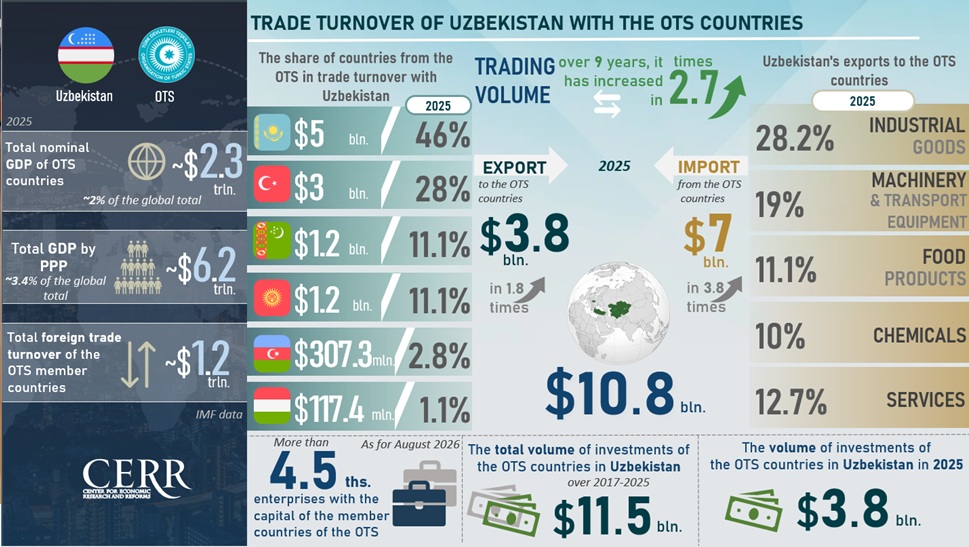
Uzbekistan has moved its economic cooperation with the Turkic states into a practical dimension
Ahead of the 13th Summit of the Organization of Turkic States, scheduled to be held in Ankara, economic cooperation within the OTS is acquiring new substance.
Water security in the turkic world: shared interests and common solutions
Water is a precious blessing that transcends national borders and has long connected peoples and civilizations.

Strengthening Transport Connectivity in Asia through the Development of the Trans-Caspian International Transport Corridor
Shifting international supply chains and expanding trade in Asia are driving demand for sustainable transport routes. For businesses, predictable delivery times, competitive rates, and reliable access to foreign markets are becoming increasingly important.