
GCC – Central Asia: a new model of regional diplomacy

The international expert community is paying special attention to the transformation of the role of regional diplomacy in the modern world. Diplomatic dialogue between different regions is becoming a key tool not only for strengthening international ties, but also for effectively solving global problems in the context of growing interdependence of states.
In this context, the format of cooperation between the Gulf Cooperation Council (GCC) and the countries of Central Asia (CA) represents a unique model of interregional interaction. The uniqueness of this format lies in the fact that it unites two geostrategically important regions, each of which has its own specific development, but at the same time has deep historical, cultural and religious ties.
Historical perspective of diplomatic relations
The interaction of Central Asia and the Arabian Peninsula, dating back more than two millennia, has undergone several significant transformations.
The Great Silk Road, formed in the 2nd century BC, created the first system of sustainable economic contacts between regions. The Central Asian states served as key transit points through which goods were exchanged, from Chinese silk and Samarkand paper to Arabian incense and jewelry.
The spread of Islam in the 8th century gave this interaction a spiritual and intellectual dimension. Samarkand, Bukhara and other cities turned into scientific centers of the Islamic world. Outstanding scientists of Central Asia - al-Bukhari, al-Khorezmi, Ibn Sina - created works that became fundamental for the entire Islamic civilization.
Since the 16th century, traditional ties have weakened due to geopolitical changes and the opening of maritime trade routes. In the 20th century, Soviet isolation further alienated the regions from each other.
The acquisition of independence by the Central Asian states in 1991 opened a new page of relations.
Key stages in the formation of diplomatic dialogue
Formation of a systematic diplomatic dialogue between The GCC and Central Asia went through several important stages, each of which made a significant contribution to the development of cooperation between the two regions.
The first stage(1991-2000) was the time of formation of bilateral relations, during which the parties became acquainted with each other’s political systems and economic capabilities. During this period, the first diplomatic missions were opened and basic interstate agreements, mainly of a framework nature, were concluded. Cooperation developed gradually, as both sides needed time to better understand the specifics and prospects for interaction between Central Asia and the GCC countries.
The second stage(2001-2010) was marked by the development of bilateral relations and the formation of a legal framework for interaction. During this period, numerous cooperation agreements were signed in various fields, including economics, culture, and education. It is especially necessary to note the intensification of trade, economic and financial-investment interaction.
At this time, the first large investment projects with the participation of Arab capital in Central Asia were implemented. The main directions included: development of irrigation systems and modernization of agricultural infrastructure in Uzbekistan and Kazakhstan, implementation of oil and gas projects in Turkmenistan, support for humanitarian and educational initiatives in Tajikistan and Kyrgyzstan.
The third stage(2011-2020) was characterized by diversification of areas of cooperation and the first attempts to institutionalize dialogue; there was an expansion of areas of interaction, inclusion of security, counter-terrorism, and environmental issues on the agenda. It is noteworthy that the first contacts began on a multilateral basis, in particular, in the format of meetings of foreign ministers.
A significant diplomatic event of this time was the meeting of the foreign ministers of Central Asia and the League of Arab States, held in 2014 in Riyadh, which laid the conceptual basis for the subsequent intensification of interregional dialogue. This meeting served as an institutional precedent for the formation of a more focused format of interaction between Central Asia and the GCC.
Analysts note that the results of the meeting in the capital of KSA demonstrated significant potential for cooperation between the states of the two regions, which stimulated the political elites to search for more effective formats of cooperation.
It should be emphasized that one of the key factors that contributed Intensifying interaction between the two regions included internal reforms in the countries of Central Asia, especially in Uzbekistan, as well as strengthening regional cooperation within Central Asia. These processes have created more favorable conditions for the development of external relations and attracting foreign investment.
In this context, the formation of the “Samarkand Consensus” in 2017 can be noted. During the High-Level International Conference in Samarkand, the states of Central Asia consolidated their positions on issues of regional cooperation, laying the foundation for more systematic cooperation. International recognition of this initiative was secured in June 2018 by the adoption by the UN General Assembly of a special resolution supporting regional integration processes. These events created favorable conditions for the subsequent formation of more comprehensive formats of international cooperation, including the CA-GCC dialogue.
The fourth stage(2021 to date) marks the transition of bilateral cooperation to a multilateral format. This process culminated in the historic first GCC-CA summit, which opened a new chapter in relations between the regions.
This event was preceded by careful preparation, consisting of a series of consultations at the expert level; multi-stage negotiations between foreign ministers; development of a comprehensive cooperation agenda.
First GCC-CA summit in Jeddah
On July 19, 2023, the first historic summit of heads of state of the Cooperation Council for the Arab States of the Gulf and Central Asia was held in Jeddah, Saudi Arabia. This event marked a new stage in relations between the two regions and laid the foundation for systematic multilateral cooperation.
The summit, which was chaired by the Chairman of the Cabinet of Saudi Arabia, Crown Prince Sheikh Mohammed bin Salman bin Abdulaziz Al Saud, was attended by the presidents of all five Central Asian republics and the leaders of the GCC member countries.
Opening the summit, the Crown Prince of Saudi Arabia highlighted the historical ties between the regions and noted the economic potential of cooperation: “Our summit today is just a continuation of these ties to make a promising start, based on our historical heritage, capabilities, human resources and economic growth that has contributed to our countries' gross product reaching almost 2.3 trillion US dollars.”
The most important result of the summit was the adoption of the Joint Action Plan between the GCC and the countries of Central Asia for 2023-2027. This document identified the main areas of cooperation, including political dialogue and security issues, economic cooperation and investment opportunities, strengthening ties between peoples and establishing effective partnerships between business sectors.
“We welcome the adoption of a joint action plan between the Cooperation Council and the countries of Central Asia for the period from 2023 to 2027. It involves working on issues of political stability, strengthening dialogue, interaction in the field of economics and investment, as well as establishing effective partnerships,” said Crown Prince of Saudi Arabia Mohammed bin Salman Al Saud. He called on the summit participants to intensify efforts aimed at ensuring energy security and sustainability of global food supply chains.
The heads of state of Central Asia made concrete proposals for developing cooperation.
In particular, the President of Uzbekistan Shavkat Mirziyoyev initiated the creation of a joint council of investors with the participation of business representatives and its first meeting to be held in Samarkand, emphasized the relevance of creating a free trade zone with the Gulf countries, called on partners to take an active part in the project for the construction of the Trans-Afghan Railway, which will connect the Gulf states with Central Asia along the shortest route. He also put forward an initiative to organize a single visa-free tourist space “Gulf - Central Asia”.
President of Kyrgyzstan Sadyr Japarov invited the Gulf countries to participate in the construction of the China-Kyrgyzstan-Uzbekistan railway and the Kambar-Ata-1 hydroelectric power station. The leader of Kazakhstan, Kassym-Jomart Tokayev, spoke in favor of creating a mechanism for meetings of ministers of agriculture and developing cooperation in the energy sector. The head of Tajikistan Emomali Rahmon in his speech focused on the creation of a specialized Investment and Development Support Fund, and the President of Turkmenistan Serdar Berdimuhamedov voiced the initiative to establish a joint Transport Committee of the countries of the Central Asia - GCC format.
The leaders emphasized the importance of strengthening political and strategic relations at the collective and bilateral levels, as well as continuing political coordination for achieving regional and international security and stability. For these purposes, a permanent mechanism was created - a meeting of the foreign ministers of the Central Asian and GCC countries, which should ensure regular political dialogue between the regions.
One of the key decisions of the summit was the identification of Uzbekistan as the host country of the next summit.
Second summit in Samarkand
After the successful holding of the First GCC-Central Asia Summit, active preparations began for the Second Summit, which is to be held in Uzbekistan in May 2025. The choice of Samarkand, one of the oldest cities in Central Asia, with a rich history and cultural heritage, as the venue for the summit is symbolic. This city has functioned for centuries as a key center of commercial relations, intellectual progress and international diplomacy.
From the point of view of historical perspective, from Samarkand the universe has always been perceived as a holistic and indivisible entity, devoid of artificial barriers and fragmentation. It is this concept that forms the core of the unique phenomenon known as the “Samarkand Consensus”. In modern conditions, a fundamentally new paradigm of international interaction is being formed on the foundation of this philosophy.
Preparation for the second summit includes a number of important events aimed at implementing the agreements reached at the first summit and forming the agenda for the upcoming summit. In December 2024, during a telephone conversation between the President of Uzbekistan Shavkat Mirziyoyev and the Emir of the State of Qatar Sheikh Tamim bin Hamad Al Thani, issues of preparation for the second summit were discussed.
An important stage in the preparation for the summit was the Second Ministerial Meeting of the Strategic Dialogue between the GCC and Central Asia, which took place in Tashkent on 15 April 2024. As part of this meeting, a review of the implementation of the results of the first summit was carried out and further steps were outlined to develop cooperation.
Following the meeting, the ministers emphasized the need to develop trade and economic ties between the regions, including cooperation in ensuring sustainable supply chains, transport and transit connections, food, energy and water resources, as well as the implementation of joint investment projects and the development of clean energy. Particular attention was paid to preparations for the first Gulf and Central Asian Investment Forum, which took place in Riyadh on May 29 last year.
Among the expected results of the summit in Samarkand is the adoption of new strategic documents defining the further development of cooperation between the two regions, the launch of a number of joint projects and initiatives, as well as strengthening the institutional basis for interaction. Particular attention is expected to be paid to the issues of digitalization, innovation, artificial intelligence, sustainable economy and smart agriculture.
Uzbekistan, acting as the organizing country, is actively preparing for the summit, using the experience of organizing other international events.
In particular, by analogy with the preparations for the recent “Central Asia - European” summit Union", which was held in Samarkand on April 3-4, 2025, large-scale work is expected to ensure security, logistics and infrastructure for the high-level event.
One of the key tasks in preparing for the summit is to ensure continuity and further development of the results achieved at the first summit, as well as the formation of a long-term cooperation strategy that takes into account the interests of all participating countries and responds to the current challenges of our time.
Key areas of cooperation between Central Asian and GCC countries
Economic cooperation and investment represent a fundamental area of interaction between the GCC and Central Asia. Analysts note that the economic activity of the Gulf countries in Central Asia has expanded significantly in recent years, which is associated both with the diversification of the economies of the GCC countries and with the improvement of the investment climate in the Central Asian states.
One of the key factors determining the interest of the GCC countries in Central Asia is the desire to diversify their economies and reduce dependence on the oil and gas sector. In this context, the long-term development strategies adopted by all Gulf countries, aimed at creating oil-independent economies and investing in green technologies, resonate with Central Asian countries, which see the innovative progress of the GCC as an attractive development model.
Central Asia is a promising, capacious market with more than 80 million consumers. The region contains 7% of the world's oil and gas reserves and large deposits of rare earth critical materials. Stocks of 10 critical materials available in the region range from 5.2% to 38.6%.
The UN estimates that by 2050 the region's population will exceed 100 million people. At the same time, the region will remain one of the youngest - the average age of the population will be about 30 years.
Over the past 7 years, the region's economy has grown from $273.3 billion to $450 billion, which indicates significant potential for investment and trade.
An important feature of economic cooperation is its multi-vector nature. Investments from the GCC countries are directed to various sectors of the economy of the Central Asian states, including energy, agriculture, infrastructure, real estate, tourism and the financial sector.
Cooperation in the field of renewable energy is particularly active. Leading companies from the GCC countries, including ACWA Power, Masdar, Mubadala, TACA and Nebras Power, are actively involved in solar and wind power projects in Central Asia. In particular, in Uzbekistan it is planned to build facilities with a total capacity of more than 15 gigawatts, including energy storage facilities, which will contribute to the development of sustainable energy and the introduction of advanced technologies in the region.
Development of a comprehensive roadmap for cooperation in the field of renewable energy sources and the creation of a research program at the Climate University in Uzbekistan would synergistically combine the technological potential of the Gulf countries with the natural resources of Central Asia.
Special attention is paid to the formation of effective mechanisms for stimulating investment. At the Second Ministerial Meeting of the Strategic Dialogue, proposals on mechanisms for promoting investment from participating countries were considered. In this regard, the Central Asia-GCC Investor Council could be promising for coordinating large projects in infrastructure and energy.
The development of digital infrastructure is of particular importance. The formation of a unified platform for e-commerce between Central Asia and the GCC has the potential to multiply the volume of online trade, which becomes especially relevant in the context of global challenges associated with the disruption of traditional supply chains.
Transport and logistics infrastructure is becoming a critical element in deepening economic integration. The initiative put forward at the summit in Jeddah by the President of Uzbekistan involves the implementation of the Trans-Afghan Railway project. According to experts, the implementation of this strategic initiative will reduce the time of transporting goods between regions by 30-40% and reduce logistics costs by 15-20%.
In addition, the GCC states are demonstrating interest in participating in the construction of transcontinental transport arteries, including the China-Kyrgyzstan-Uzbekistan railway and Uzbekistan–Afghanistan–Pakistan, capable of radically improving the connectivity of Central Asia with global markets.
The development of tourism has become an important component of economic cooperation. Regular air traffic has already been expanded between the capitals of the countries of the two regions, and joint tourist routes have been developed. In addition, the introduction of a visa-free zone between the countries of Central Asia and the Gulf helps to actively increase tourist flows and strengthen business contacts.
Security and counter-terrorism issues are high on the cooperation agenda. Both regions face serious security challenges, including terrorism, extremism, drug trafficking and cross-border crime. In this regard, coordination of security efforts is becoming one of the priority areas of interaction.
At the summit in Jeddah, the leaders of the GCC and Central Asian countries emphasized the need to continue political coordination to achieve regional and international security and stability. The joint statement following the summit noted the need to strengthen cooperation in the fight against terrorism, extremism and other forms of cross-border crime.
Particular attention of the international expert community is directed to Afghan issues, given that without establishing lasting peace in this country it is impossible to ensure not only regional, but also global security. Afghanistan, which shares borders with three Central Asian states, represents a critical factor in the stability of the entire region, which necessitates the coordination of efforts of all stakeholders, including the GCC and Central Asian countries.
Security cooperation also includes combating the financing of terrorism, countering radicalization and extremist propaganda, especially in the Internet space. The countries of the two regions have significant experience in these areas, and joining forces can increase the effectiveness of countering these threats.
As part of the institutionalization of cooperation on security issues, the possibility of creating a regular consultation mechanism between the relevant authorities of the GCC and Central Asian countries is being discussed, as well as holding joint seminars, conferences and other events aimed at exchanging experience and developing common approaches to solving security problems.
It is necessary to emphasize that security cooperation between the GCC and Central Asia is based on the principles of respect for sovereignty, territorial integrity and non-interference in the internal affairs of states, which creates a solid basis for interaction.
It is these fundamental principles, extending to all areas of interregional dialogue, that allow us to build long-term partnerships based on equality and mutual respect for interests parties.
In addition, this kind of communication represents a fundamentally new model of regional diplomacy, characterized by the complex nature of interaction and the versatility of the initiatives being implemented.
The potential of this model goes beyond the framework of bilateral interaction, acquiring strategic importance in the context of the formation of new transport and logistics corridors, energy alliances and investment mechanisms over a vast area from the Arabian Peninsula to the borders of China. At the same time, the commonality of cultural and civilizational values and historical heritage creates a solid basis for long-term cooperation.
Alisher Kadirov,
Head of the ISMI Department
under the President of the Republic of Uzbekistan
Related news
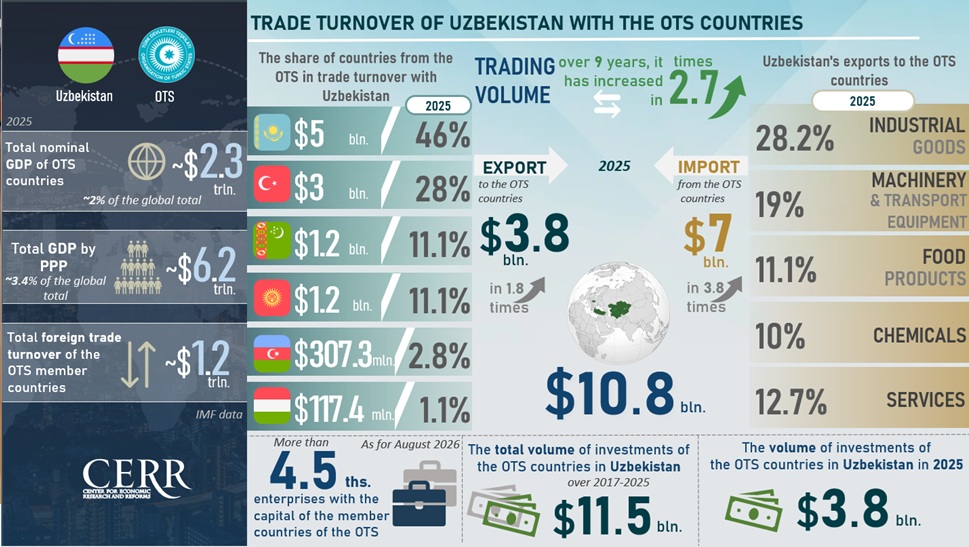
Uzbekistan has moved its economic cooperation with the Turkic states into a practical dimension
Ahead of the 13th Summit of the Organization of Turkic States, scheduled to be held in Ankara, economic cooperation within the OTS is acquiring new substance.
Water security in the turkic world: shared interests and common solutions
Water is a precious blessing that transcends national borders and has long connected peoples and civilizations.

Strengthening Transport Connectivity in Asia through the Development of the Trans-Caspian International Transport Corridor
Shifting international supply chains and expanding trade in Asia are driving demand for sustainable transport routes. For businesses, predictable delivery times, competitive rates, and reliable access to foreign markets are becoming increasingly important.