
The Samarkand Initiative is a platform for promoting the goals of the UN Future Summit

The “Summit” held in September future" of the UN and the "Pact for the Future" adopted as a result, reflect the current demand for increasing the effectiveness of multilateral mechanisms for constructive dialogue on pressing issues of global and regional security and development.
Recent alarming trends associated with a weak global response to solving the problems of the pandemic, the Ukrainian crisis and the increase in armed conflicts have revealed gaps in the functioning of international institutions responsible for maintaining world order and stability.
Multiple sanctions measures, supply chain disruptions, worsening technology gaps, climate change, food security and humanitarian crises in certain countries and regions of the world are undermining efforts to achieve the 17 Sustainable Development Goals formulated back in 2015.
In response to these challenges and risks, the UN Secretary-General In 2021, Antonio Guterres published the “Our New Agenda” program, initiated the UN “Future Summit” and the development of a joint “Pact for the Future”. All this represents an unambiguous call for the formation of a new global consensus on what a common future should look like and “concrete ideas” on how to advance the common agenda.
One of the platforms for the practical implementation of the goals of the Future Summit could be the Samarkand Solidarity Initiative for the sake of common security and prosperity, voiced by the President of Uzbekistan Shavkat Mirziyoyev.
As the head of Uzbekistan noted, putting forward his proposal, “now such dialogue, free from geopolitical rivalry, ideological contradictions and disputes, is extremely in demand.”
The Samarkand initiative is fully consistent with the “Pact for the Future”, the UN Sustainable Development Goals, designed to strengthen international cooperation to ensure equitable socio-economic growth of states, improve the quality of life of the present and future generations of the planet.
Due to its historical role as a political, economic, trade and cultural center of the entire East, as well as the active and proactive diplomacy of Uzbekistan in the international arena, Samarkand is capable of becoming a platform for cooperation based on dialogue, mutual understanding and trust. Playing the role of a communication hub on the Great Silk Road, this ancient city made an important contribution to the development of intercultural and intercivilizational cooperation.
The Leader of Uzbekistan accurately noted that on the basis of the “Samarkand Spirit” a fundamentally new format of international interaction can be built.
In confirmation of this, one can recall how the idea of consultative meetings was born in Samarkand heads of state of Central Asia. In November 2017, this ancient city hosted the international conference “Central Asia: a common history and a common future, cooperation for sustainable development and progress.” This event marked the emergence of the “Samarkand Consensus” phenomenon, reflecting the common focus of all countries in the region on joint discussion and search for solutions to sensitive and complex problems of interstate interaction in Central Asia.
The results of the conference received wide support from the international community and were enshrined in the UN General Assembly resolution “Strengthening regional and international cooperation to ensure peace, stability and sustainable development in the Central Asian region” (June 2018).
Today Samarkand has become a significant platform for discussing and finding solutions to global and regional problems.
The summits of the Shanghai Cooperation Organization, the Organization of Turkic States, the meeting of the foreign ministers of Central Asian countries with the EU High Representative for Foreign Affairs and Security Policy Josep Borrell, the UN Convention to Combat Desertification (CRIC-21), the 14th meeting of the Conference of the Parties to the CMS COP 14 Convention and other major international events took place here.
On the sidelines of the SCO Samarkand summit in 2022, an agreement was reached to launch the China-Kyrgyzstan-Uzbekistan railway project. Negotiations on the construction of such a highway, which will connect participants with Iran, Turkey and further Europe, have been ongoing for more than 20 years.
In May of this year, the Asian Women's Forum was held in Samarkand, which confirmed the relevance of this dialogue platform for discussing issues of gender policy, the active participation of women in government, public administration and economic development.
In recent years, Uzbekistan has achieved tangible results in ensuring gender equality, protecting the rights and interests of women. According to the World Bank, the country is among the top five leaders that have achieved the greatest success in implementing reforms in this area.
In the coming year, it is planned to hold in Samarkand the official EU-Central Asia summit, the second summit of the strategic dialogue between the countries of the region and the Gulf Cooperation Council, an international climate forum.
Uzbekistan attaches great importance to cooperation with the UN in the implementation of projects for the socio-economic development of the country, the search for solutions to pressing global and regional problems security.
The speeches of the Head of State always emphasize the leading and consolidating role of the UN as a universal global organization in addressing issues that cannot be resolved by any country alone.
Advancing the stabilization process in Afghanistan remains an important area of cooperation with the UN. Over the past few years, a whole series of international events have been held in Uzbekistan on Afghan issues alone, resulting in practical results that could contribute to stabilizing the situation in this country. Adopted following the results of the high-level international conference on Afghanistan “Peace Process, Security Cooperation and Regional Cooperation” (April 18 in Tashkent), the Tashkent Declaration was distributed as an official document of the 72nd session of the UN General Assembly and Security Council.
Holding in July 2022 in Tashkent, with the active support of the UN, the international conference “Afghanistan: Security and economic development" made it possible to once again draw international attention to the issues of promoting the country's post-conflict reconstruction and its integration into the world community.
The conference participants especially noted the consistent efforts of the UN and its agencies to provide humanitarian assistance to the Afghan people and called for the continuation of assistance programs.
Currently, Uzbekistan is actively participating in the implementation of UN programs to provide humanitarian assistance and peaceful reconstruction of Afghanistan. Through the International Multifunctional Transport and Logistics Hub established in Uzbekistan in the border city of Termez, humanitarian aid is regularly sent to the neighboring country by the World Food Program and other UN structures.
An important area of cooperation between Uzbekistan and the UN in the field of security remains issues of combating terrorism and extremism.
On the initiative of Shavkat Mirziyoyev, on March 3-4, 2022, the international conference “Regional cooperation of the countries of Central Asia within the framework of the Joint Plan of Action for the Implementation of the UN Global Counter-Terrorism Strategy” was held.
The conference made a significant contribution to the consolidation of the efforts of the countries of the region and the world community to implement the UN counter-terrorism strategy in Central Asia. The Tashkent Declaration and the updated Joint Plan of Action for the implementation of the UN Global Counter-Terrorism Strategy in the region were adopted, and it was also decided to open an office of the UN Counter-Terrorism Office in Central Asia.
An important area of interaction between Uzbekistan and the UN is the development of cooperation inenvironmental security issueswithin institutions such as the United Nations Environment Program (UNEP), the United Nations Development Program (UNDP), the Special Program UN for the Economies of Central Asia (SPECA), UN Regional Climate Change Conference (UNFCCC).
A significant contribution of Uzbekistan to solving the problem of restoring the Aral Sea, combating climate change, protecting the environment, and ensuring the safety of hydropower facilities was the adoption in May 2021 of a Special Resolution of the UN General Assembly on declaring the Aral Sea region a zone of environmental innovation and technology. The document reflects the role of the UN in the creation of the International Innovation Center of the Aral Sea region and the establishment, under the auspices of the UN, of the Multi-Partner Trust Fund for Human Security for the Aral Sea region.
All these steps show the scale of intensified cooperation between Uzbekistan and the UN and its institutions in recent years. The country's growing activity in jointly holding international events, the implementation of specific technical assistance programs and practical interaction on security issues make a solid contribution to the sustainable development of Central Asia.
In this vein, the Samarkand Initiative as a dialogue platform can become an effective platform for promoting the goals formulated at the Future Summit, in particular the launch of an inclusive dialogue to strengthen international solidarity and cooperation, restore trust and create a sustainable world.
Zilola Yunusova,
Expert at the Center for Foreign Policy Research
and International Initiatives (Uzbekistan)
Related news
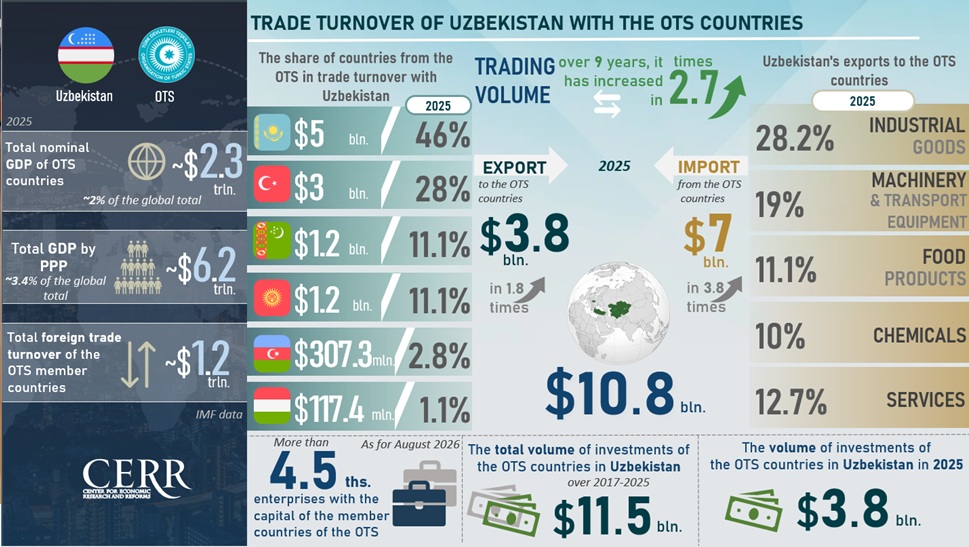
Uzbekistan has moved its economic cooperation with the Turkic states into a practical dimension
Ahead of the 13th Summit of the Organization of Turkic States, scheduled to be held in Ankara, economic cooperation within the OTS is acquiring new substance.
Water security in the turkic world: shared interests and common solutions
Water is a precious blessing that transcends national borders and has long connected peoples and civilizations.

Strengthening Transport Connectivity in Asia through the Development of the Trans-Caspian International Transport Corridor
Shifting international supply chains and expanding trade in Asia are driving demand for sustainable transport routes. For businesses, predictable delivery times, competitive rates, and reliable access to foreign markets are becoming increasingly important.