
Renovation and investment projects in Tashkent were considered

President Shavkat Mirziyoyev on May 14 got acquainted with the presentation of renovation and investment projects in the city of Tashkent.
According to the resolution of the Cabinet of Ministers of December 24, 2024, the master plan of the capital of Uzbekistan until 2045 was approved. In accordance with this document, the city's territory is divided into three zones - conservation, reconstruction and renovation.
The renovation zone includes old low-rise buildings and buildings that do not meet modern urban planning and seismic resistance requirements. It is planned to gradually replace such structures with modern residential and infrastructure complexes.
The presentation provided information on upcoming steps in this direction. It was noted that the master plan provides for over 300 sites for renovation. As part of the first stage, scheduled for 2025–2026, it is planned to implement 65 projects. This will improve the functionality of the relevant areas, create favorable conditions for residents and improve the environment. As a result, the differences between outdated and modern neighborhoods will gradually be reduced, ensuring their harmonious neighborhood. Development will be carried out with the preservation of existing trees and the creation of new green areas.
The head of state pointed out the need for a comprehensive study of the compliance of these projects with the architectural appearance and infrastructure of the city, as well as to ensure their safety based on geological and seismic studies. He emphasized that residential buildings must be linked to social infrastructure facilities - such as schools, kindergartens and recreation areas.
As the President noted, green spaces are the “lungs” of the city, and ditches and canals are its “circulatory system.” In this regard, the new master plan pays special attention to the issues of landscaping and drainage. In particular, it is planned to triple the area of green zones in Tashkent and its suburbs - up to 25 thousand hectares. This, in turn, requires improved irrigation networks.
The presentation also discussed the irrigation and drainage system consistent with the new master plan. By 2030, it is planned to reconstruct 100 kilometers of canals and develop walking areas along them.
Together with the Turkish company Su-Yapi Engineering and Consulting, studies of problems in the drainage system were carried out. Based on aerial photography, geodetic data and precipitation analysis, a master plan for its modernization was developed. Last year, 45 areas of possible flooding were eliminated, and this year such measures will cover another 34 areas.
The President emphasized the need to continue this work, expand coverage and train specialists in this area.
Information on the status of the implementation of investment projects in the city was also presented. 717 investment projects totaling $25 billion have been formed in Tashkent. This year it is planned to disburse 7.5 billion dollars and launch 265 projects. As part of their implementation, residential complexes, shopping and entertainment centers will be built, as well as new industrial enterprises and thousands of jobs will be organized.
Official website of the President of the Republic of Uzbekistan
Related news
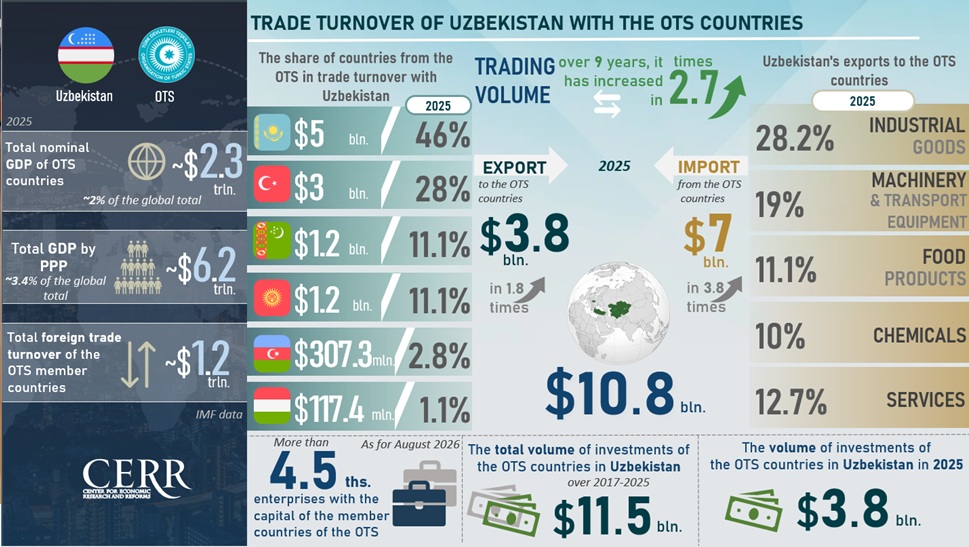
Uzbekistan has moved its economic cooperation with the Turkic states into a practical dimension
Ahead of the 13th Summit of the Organization of Turkic States, scheduled to be held in Ankara, economic cooperation within the OTS is acquiring new substance.
Water security in the turkic world: shared interests and common solutions
Water is a precious blessing that transcends national borders and has long connected peoples and civilizations.

Strengthening Transport Connectivity in Asia through the Development of the Trans-Caspian International Transport Corridor
Shifting international supply chains and expanding trade in Asia are driving demand for sustainable transport routes. For businesses, predictable delivery times, competitive rates, and reliable access to foreign markets are becoming increasingly important.