
Industrial cooperation in the SCO space: from dialogue to project integration
Against the backdrop of sanctions wars and instability in the global economy, industrial cooperation between the SCO countries is of particular importance. By combining enormous human potential and natural resources, the SCO member states are able to form sustainable production chains and develop mutually complementary industries.
The development of industrial cooperation will strengthen technological independence, expand export and investment opportunities, and reduce dependence on foreign markets - which is especially important in the context of disruptions in global supplies and growing competition for resources and technologies.
By According to data for 2025, the SCO countries unite about 47% of the world's population (3.6 billion people), of which more than 60% of the working population is an important resource for industrial growth.
In 2024, the total GDP of the organization's members reached 30% of the world, and foreign trade turnover increased by more than 100 times compared to 2001. The volume of exports amounted to about 20% of world exports, led by China ($3.5 trillion), India ($442 billion) and Russia ($386 billion). The volume of investments in joint ventures and industrial cooperation of the SCO member countries exceeded $120 billion, which contributed to the introduction of innovative technologies, localization of production and the development of value chains within the region.
Current macroeconomic indicators reflect not only the scale of the economy, but also the wide range of industrial potential of the SCO countries. Thus, at the present stageChinais a world leader in the production of electronics, mechanical engineering and chemical products, and the country’s industrial production accounts for more than28%of the world’s volume.
Russia, with a large and diverse resource base, plays a significant role in the global metallurgy, oil and gas sector and defense industry, providing about 12% of global exports of natural resources.
India is demonstrating significant growth in pharmaceuticals, information technology and the textile industry.In these areas, the country is increasing exports by 15–20% annually.
Iran, possessing one of the world's largest oil and gas reserves, exports over 2 million barrels of oil annually and develops a petrochemical industry, which provides a significant share of the country's GDP (about 15%).
In turn, Belarus is known for its large machine-building complex and the production of tractors, trucks and agricultural machinery - the export of these goods amounts to approximately $3.5 billion. per year.
The countries of Central Asia are actively developing their mining and manufacturing industries. Kazakhstanis one of the largest exporters of uranium and copper, with industrial production in the country growing by 7%. Kyrgyzstan and Tajikistan are increasing their electricity production and mining industries, showing stable growth of 5-6% annually. Turkmenistan remains a key exporter of gas, expanding the capacity of the gas industry and exporting 60 billion m3 per year.
At the same time, it is important to note that starting from 2022, the member countries of the association began to substantively discuss and promote initiatives related to industrial cooperation, recording this in the final documents.
At the summit in Samarkand (2022)members of the Organization adopted a Program for stimulating industrial cooperation between business circlesof the SCO countries.
At the summit in Bishkek (2023) the initiative to creation of joint platforms for the exchange of technological innovations and best practices in industry, designed to increase the competitiveness of enterprises of the SCO countries in international markets.
In addition, the final documents emphasized the importance of the development of cluster and cross-border industrial complexes, capable of integrating production chains and optimizing logistics between countries. In this context, particular importance is attached to the formation of “green” industrial corridors aimed at introducing environmentally friendly technologies and reducing the carbon footprint.
In addition, in 2024, at a meeting of heads of state in Astana, the idea of creating ajoint investment fund to finance promising industrial projectswas supported, especially in the sectors of mechanical engineering, electronics and chemicals industry. This fund is designed to stimulate innovative developments and modernization of production, as well as strengthen industrial cooperation on the basis of mutual benefit.
Thus, the initiatives taken, the high interest in industrial cooperation and the availability of industrial infrastructure contributed to the deepening of industrial cooperation between the SCO member countries.
Thus, Russia and China is actively developing cooperation in such strategic sectors as energy, chemistry, metallurgy and technology. The largest joint project - the Amur gas chemical complex, being built by SIBUR and Sinopec, will produce up to 2.7 million tons of polymers per year by 2027 and will become one of the largest in the world.
As part of Russian-Chinese cooperation, joint technology parks are being created aimed at developing high-tech industries. Among them are the "Changchun Sino-Russian Science and Technology Park","China-Russia Innovation Park",as well as the "High-Tech Center at Skolkovo", which houses research structures in the field of ICT, AI and robotics.
In the pharmaceutical sector in May of this year. The first International Institute of Biomedicine and Pharmaceuticals was created in Guangzhou - an educational and scientific center with laboratories in Russia and China.
The joint production of the vaccine "Sputnik V"was organized in India with the participation of the Gamaleya Center (Russia) with pharmaceutical companies "Dr. Reddy's Laboratoriesand Hetero Biopharmawith a total production capacity of more than100 million dosesper year. The project has become one of the largest examples of Russian-Indian cooperation in the field of biotechnology.
In addition, Iran actively cooperates with China and Russia in the oil and gas sector. China has invested more than€2 billion. to modernize the Abadan Oil Refinery, which made it possible to increase oil refining by 70%. Russia plans to invest another$8 billion. into Iranian gas projects, of which about$5 billion. already provided for in the agreements.
The China-Belarus Industrial Park "Great Stone" is one of the largest and most successful examples of industrial cooperation between Belarus and China. Beijing has invested almost $1.3 billion in it. By the end of 2025, it is planned to create about5 thousands. jobs, including for IT specialists. It serves as an important platform for the development of high-tech and innovative industries, as well as for attracting foreign investment.
In this vein, it is important to note that Russia, China and India, being key economies in the SCO, play an important role in supporting the industrialization and development of Central Asia. These states are actively promoting joint projects in such sectors as energy, mechanical engineering, transport and the chemical industry, contributing to the development of the industrial potential of the region.
Chinais investing in the creation of industrial zones and logistics hubs in Kazakhstan (Khorgos Eastern Gate industrial park), Kyrgyzstan (industrial Birlik zone),Tajikistan (Sughd industrial park)and the Jizzakh industrial park in Uzbekistan are also attracting investments.
Currently, the Jizzakh industrial zone is the only one in Central Asia where the BYD Uzbekistan plant is located, which plays an important role in increasing the industrial potential of the region.
These projects are being implemented within the framework of the “One Belt, One Road” initiative and contribute to the development of industry and improvement of transport infrastructure in the region.
The PRC is also actively involved in the development of the renewable energy sector in Uzbekistan. Agreements have been signed with China on projects to build 4.8 GW of solar and wind power plants by 2023.
China Gezhouba Group has completed construction of the first phase of solar power plants worth $350 million. The total capacity is 1000 MW.
A Chinese company has begun construction of a solar power plant with a capacity of 100 MW in the Chui region of Kyrgyzstan. The project will create about500jobs. InTajikistan, the state-owned company China Datang Corporation intends to build a solar power plant with a capacity of up to500 MWin the Sughd region.
Russia, in turn, is diversifying cooperation from the oil and gas sector towards the agricultural, chemical, and automotive industries. Among the significant projects in Kazakhstan are the cultivation of greenhouse tomatoes on an area of 500 hectares with an investment of $1.7 billion, the production of fertilizers by the Eurochem company in the amount of$1 billion. and the production of automobile tires by Tatneft worth $274 million.
Russia is also actively cooperating with other countries. For example, in early August of this year. Within the framework of the 7th Kyrgyz-Russian Economic Forum, almost 30 agreements were signed for a total amount of about $270 million. in the fields of aviation, industry, transport, agriculture, digital economy, education, media and product supply.
Indiais actively developing pharmaceutical cooperation with Central Asia, investing in local production of drugs and their export. There are already several generic and vaccine joint ventures operating in the region with leading Indian companies such asSun Pharma,Dr. Reddy’s Laboratories, Cipla, etc.
At the same time, India provided about 6.5 thousand places for training in the IT field and 1.5 thousand scholarships for students and specialists from the countries of the region. IT centers were also opened in all these countries. Among India's largest projects: the Center for Biomedical Research in the Mountains in Kyrgyzstan, the reconstruction of the Varzob-1 hydroelectric power station in Tajikistan and the Industrial Training Center in Turkmenistan.
Despite the active agenda of industrial cooperation within the SCO, there are challenges and restrictions that hinder further development. In particular:
Firstly, limited transport and logistics connectivity. Insufficiently developed logistics between individual countries (for example, between India and Central Asia via Afghanistan)restricts trade turnover. The Chabahar port project, important for transporting goods from India to Iran and further to the Central Asian region, is progressing slowly. Despite an agreement to transition control in 2018, the full rollout of the infrastructure is behind schedule.
Second, inconsistency of technical standards and regulatory regimes. The lack of a unified regulatory and technical framework in industry makes it difficult to integrate production chains. For example, in mechanical engineering, differences in safety standards and certification between China, Russia and India hinder the joint development and supply of high-precision equipment.
Third,differences in levels of development and technological barriers. Within the SCO, significant differences remain in the levels of socio-economic development, technological lag (especially the countries of Central Asia), lack of qualified personnel and infrastructure. This creates technological and logistical barriers, increasing the dependence of less developed members on leading powers, and also makes it difficult to implement joint projects and form regional production chains due to differences in investment, infrastructure and human capital.
Fourth, financial constraints and weak investment integration. The absence of a fully functioning SCO Development Bank and the low level of interbank financing make it difficult to launch large infrastructure and industrial projects. In 2024, the initiative to create the Bank was discussed again, but no concrete decisions on its launch were made.
In general, for the effective development of industrial cooperation within the SCO, a systematic approach to overcoming current challenges is required. This includes the harmonization of technical standards, the development of financial instruments, the protection of intellectual property and deepening logistics integration - key measures to maintain the pace of industrial cooperation in a global competitive environment.
In this context, the Central Asian countries, which act as the core of the SCO, can play a special role. Possessing significant natural resources and developing infrastructure, they are capable of becoming not only a solid resource basis for industrial cooperation, but also in the future - turning into a key industrial hub of the organization.
Given the above, it is important to note that the upcoming regularmeeting of the SCO heads of state in early September of this year. in Tianjinwill allow us to determine further priorities and specific mechanisms for the implementation of joint projects aimed at strengthening industrial cooperation and developing an innovative economy in the Eurasian space.
Shavkat Alimbekov,
leading researcher
International Institute of Central Asia
Related news
Uzbekistan has moved its economic cooperation with the Turkic states into a practical dimension
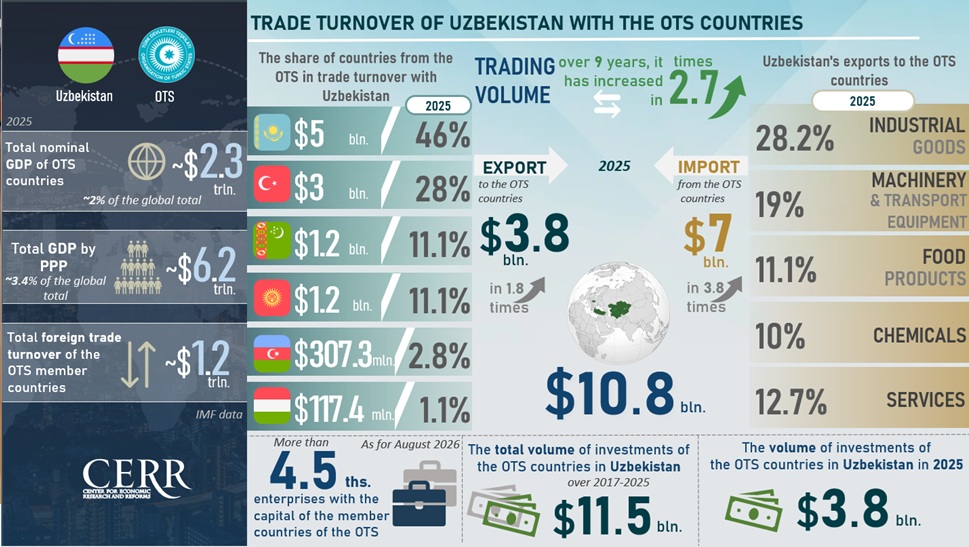
Ahead of the 13th Summit of the Organization of Turkic States, scheduled to be held in Ankara, economic cooperation within the OTS is acquiring new substance.
Water security in the turkic world: shared interests and common solutions
Water is a precious blessing that transcends national borders and has long connected peoples and civilizations.

Strengthening Transport Connectivity in Asia through the Development of the Trans-Caspian International Transport Corridor
Shifting international supply chains and expanding trade in Asia are driving demand for sustainable transport routes. For businesses, predictable delivery times, competitive rates, and reliable access to foreign markets are becoming increasingly important.