
The work being carried out was analyzed and current tasks in the medical field were identified.

On May 7, a video conference meeting was held under the chairmanship of President Shavkat Mirziyoyev, dedicated to improving the quality of primary and specialized medical care, streamlining the consumption of medicines and improving medical education.
Over the past 7 years, the volume of funding for the healthcare sector has increased 6 times. Medical facilities in the regions have been modernized. More than 400 high-tech operations, which were previously carried out exclusively in the capital, are now carried out in regions and districts. A system has been established that connects primary care with specialized medical care.
In Uzbekistan, there are 29 doctors for every 10 thousand people, which is comparable to the figures in the USA, Great Britain and Finland, and exceeds similar data for Turkey and Canada. However, the efficiency of work and the quality of treatment remain insufficient.
Thus, due to the weak performance of primary care in the regions, the level of morbidity and complications does not decrease. Non-communicable diseases cost the country's economy approximately $1 billion annually.
One in four ambulance calls are for patients with chronic diseases. In some places, the ambulance actually functions as a clinic. There are imbalances in the distribution of personnel, beds and finances between district and regional institutions.
The introduction of the health insurance system is postponed annually. Appointment scheduling and medical services are still not fully digitalized.
Due to omissions, two deputy ministers of health were relieved of their positions, and another received a warning.
Issues of improving the work of primary care, disease prevention, improving the qualifications of health workers and improving the quality of treatment were discussed at the meeting. Taking into account the coverage of the population, analysis of diseases and the nature of requests, a new operating procedure has been determined.
Primary care will be reformed, each medical team will enter into a bilateral agreement with the population under its care. People will be able to freely choose a family doctor, including private specialists.
A guaranteed package of medical care will be approved, within which services and medications will be fully covered from the budget.
Primary care doctors and nurses will work only full time. The number of obstetricians and gynecologists in clinics will be doubled, and for every 3 thousand children there will be a pediatrician.
Medical centers and family clinics in the regions will be optimized in terms of coverage. The central clinic will be transformed into a consultative and diagnostic department of the district hospital, where all narrow specialists will concentrate.
The basic salary of a family doctor will be the equivalent of $500, a nurse - $300. If you have a certificate of qualification, the same bonus will be paid. For active work in the mahalla, training of patients with chronic diseases, early detection of oncology, diabetes, stroke, heart attack and prevention of complications, further salary increases are provided. Thus, family doctors will be able to receive up to 1.5 thousand dollars, nurses - 600-800 dollars in equivalent.
This system will be tested this year in 15 districts and cities, and starting next year throughout the Samarkand region.
At the same time, the responsibility of family doctors and nurses will be strengthened. Cases of heart attacks, strokes, early deaths of mothers and children, and disability due to chronic diseases will be considered extraordinary.
The corrupt practice of medical advisory commissions when determining disability will be abolished. Now the decision will be made on the basis of a document drawn up by the family doctor and the medical and social expert commission.
Responsible officials in the sphere and regional khokims have been instructed to implement the “90 days of changes in medicine” program, according to which order will be brought to the waiting areas and corridors of medical institutions, and sanitary culture will be improved. The “Clean Hands” program will be introduced in schools and social institutions to improve sanitary and hygienic conditions.
Issues of specialized medical care were also discussed.
In the republican medical centers, only high-tech complex operations will be carried out at the expense of the budget.
The system for issuing and distributing electronic referrals will be completely revised with approval list of diseases and a single basic tariff.
A referral issued for treatment at the republican level will be posted on a single electronic platform where all public and private clinics can see it. The patient himself will choose a suitable medical institution based on the proposals.
Particular attention is paid to oncohematology in children - 75 percent of such diseases in the country are detected in late stages. In this regard, a five-year program to combat childhood oncology is being developed with funding of at least $110 million.
The regulation of drug consumption was discussed separately. Developed countries use drugs with proven effectiveness. In Uzbekistan, 42 percent of imported drugs do not have proven effectiveness, but are still prescribed by doctors and used by the population.
The Minister of Health has been instructed to exclude from clinical protocols drugs found to be ineffective or with insufficiently proven effectiveness.
Inspections on rational use will be carried out in all medical institutions, especially in children's hospitals antibiotics.
Particular attention is paid to the quality of medical education.
Over the past 7 years, enrollment in medical universities has increased to 25 thousand people per year, 40 percent study in private universities. However, there is no transparent system for assessing knowledge and skills.
In this regard, from now on, the knowledge of graduates of medical universities and technical schools in the use of modern diagnostic and treatment methods will be assessed on the basis of a transparent system. For this purpose, a National Center for Assessment of the Medical Sphere is being created, which will evaluate both students and existing doctors.
All public and private clinics will be accredited. Advanced training of specialists will be transferred to universities, specialized centers and regional institutions.
It was also instructed to introduce dual education, transfer universities under the control of clinics and ensure their financial autonomy.
In general, responsible persons were instructed to effectively use budget funds, accelerate digitalization, introduce insurance, impose discipline and achieve citizen satisfaction with the quality of medical services.
Official website of the President of the Republic of Uzbekistan
Related news
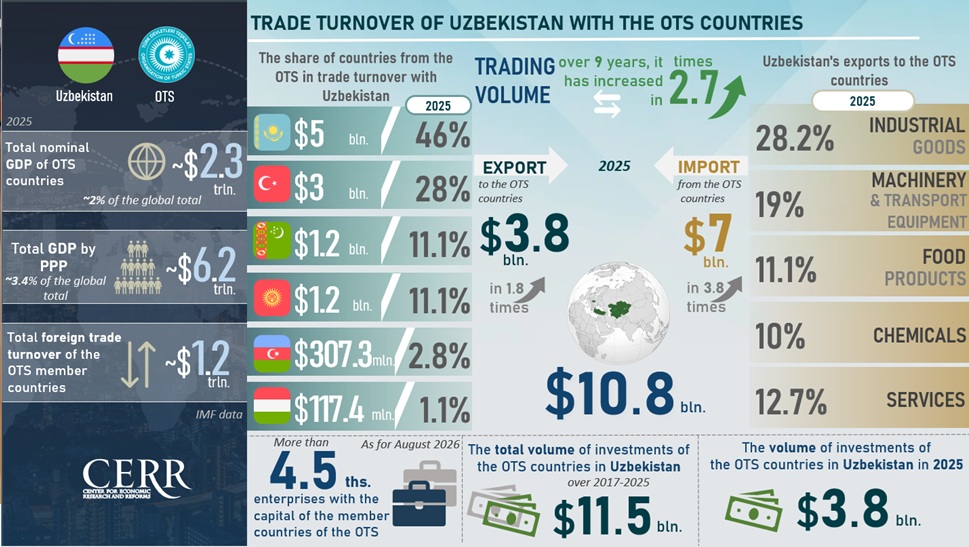
Uzbekistan has moved its economic cooperation with the Turkic states into a practical dimension
Ahead of the 13th Summit of the Organization of Turkic States, scheduled to be held in Ankara, economic cooperation within the OTS is acquiring new substance.
Water security in the turkic world: shared interests and common solutions
Water is a precious blessing that transcends national borders and has long connected peoples and civilizations.

Strengthening Transport Connectivity in Asia through the Development of the Trans-Caspian International Transport Corridor
Shifting international supply chains and expanding trade in Asia are driving demand for sustainable transport routes. For businesses, predictable delivery times, competitive rates, and reliable access to foreign markets are becoming increasingly important.